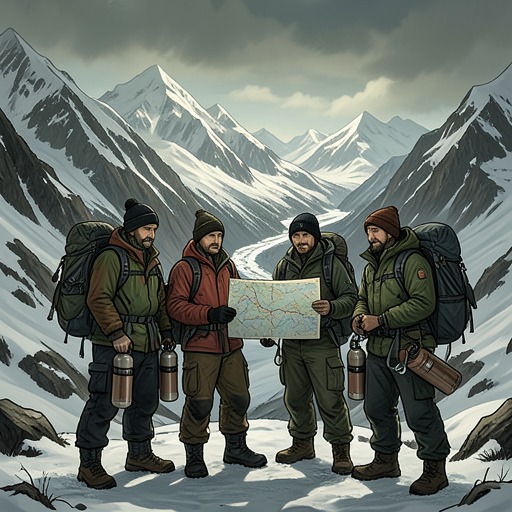
Supplementary oxygen cylinders
The ClimbSupplementary oxygen cylinders were both essential equipment and a measure of how little margin for error the Mountain Madness expedition had. Their changing suppliers, delayed shipment, allocation among climbers, and dwindling stock tied commercial decisions to practical choices on the mountain: how much oxygen climbers could carry, how long they could remain high, and whether the team could make another attempt if the first went wrong.
Procurement and competing suppliers
When Scott Fischer hired Anatoli Boukreev, one immediate planning concern was oxygen. Fischer wanted to reduce the weight carried by clients and was interested in lightweight titanium canisters from Poisk, a supplier in St. Petersburg. Its three-liter canister weighed at least half a kilogram less than the usual three-liter bottle. Boukreev had contacts at the factory and undertook to negotiate after returning from Manaslu.
Those negotiations ran into a supplier dispute. Poisk representatives told Boukreev that Henry Todd of Himalayan Guides had made an advance purchase agreement that effectively made him the exclusive distributor of Poisk oxygen for Everest. Boukreev had introduced Todd to the factory the previous year, and he was disconcerted to find Todd controlling the supply. With Mountain Madness clients due to leave for Kathmandu in late March and a summit attempt possible in early May, the team needed oxygen but had not secured any.
Boukreev proposed buying from Zvesda in Moscow, where he believed he could obtain a better price. He continued negotiating with Poisk, hoping that a deal there could save Mountain Madness nearly a third of Todd’s price and possibly earn him a small commission. Todd, in turn, warned that Poisk would deal through him alone and pressed Mountain Madness to accept his package, including masks and regulators. Karen Dickinson, handling the team’s business while Fischer was away, argued that Boukreev could get a better offer; Todd insisted on a take-it-or-leave-it contract. Mountain Madness accepted Todd’s terms. Dickinson later judged that the team had started too late and that Todd had outmaneuvered them.
The resulting order combined two kinds of cylinder. A confirmation memo listed 55 Poisk three-liter bottles and 54 Zvesda four-liter cylinders, along with 14 regulators and 14 masks. The compromise preserved access to the lighter Poisk bottles for the summit push while using the heavier, larger-capacity Zvesda cylinders for lower elevations and the Sherpas’ climbing work. The list initially looked like routine procurement; the book notes that its figures would later attract close scrutiny and painful questions.
Delays and a narrowing supply
The supplier agreement did not ensure timely delivery. Several weeks before Boukreev reached Kathmandu, the oxygen had been loaded onto a truck in St. Petersburg for transport to Amsterdam and onward by air. The truck was stopped at a Russian border crossing because another item in the shipment lacked proper customs paperwork. Rather than remove that item, officials held the whole load. Todd could offer no definite date for its release, only assurances that it might move soon.
Todd promised Boukreev that he would deliver the order, and said that, if the shipment failed to arrive, he would give Mountain Madness oxygen from his own expedition’s supply, already in Kathmandu. The shortage nevertheless remained a pressing problem: oxygen was not a commodity that could simply be replaced locally. When Fischer arrived in Kathmandu on March 22, the delivery was still uncertain. The shipment’s significance also went beyond the original order. Later in the expedition, the oxygen supply was dwindling as clients, including Pete Schoening, used bottles at a reported cost of $325 each; Fischer faced the added prospect of paying to evacuate Ngawang Topche Sherpa by helicopter.
Allocation before the summit bid
The available stock at Camp IV made the team’s plan concrete. On summit night the Mountain Madness climbers had 62 canisters there: nine Zvesda bottles and 53 of the lighter Poisk bottles. Just over half, by volume, of the oxygen purchased from Todd was on hand for the summit bid. Most of the rest had already been consumed, particularly by Schoening and Ngawang Topche Sherpa; a small amount remained at Base Camp for medical emergencies.
The nine heavier Zvesda cylinders were reserved for sleeping at Camp IV before the climb. The 53 Poisk canisters were set aside for May 10. The distinction mattered operationally: the bulkier bottles served the night’s needs, while the lighter supply was reserved for movement toward the summit. The available quantity was already minimal for the planned ascent and return.
The carrying plan distributed the bottles across guides, clients, and Sherpas. Six Sherpas were climbing with the expedition; five planned to use oxygen, while climbing sirdar Lopsang Jangbu Sherpa climbed without it but carried one bottle for emergencies. Each of the other five Sherpas carried two bottles for personal use and two more for clients and guides, making 21 bottles carried by the Sherpas. The six client climbers, Fischer, and Neal Beidleman carried two bottles each; Boukreev carried one. Together, the guides and clients carried 17 bottles. In all, climbers took 38 Poisk canisters uphill, leaving 15 full Poisk bottles at Camp IV, as well as whatever Zvesda oxygen remained from the night before.
The one-attempt margin
That remainder could not support a second attempt after a delayed or complicated summit push. The team had too little oxygen to stay high overnight and try again on May 11, so the plan amounted to May 10 or no second chance. Charlotte Fox and Tim Madsen had already been told the expedition’s limit in stark terms: “one shot, no more.” The allocation thus converted a supply constraint into a decisive feature of the climbing plan.
The cylinders also belonged to a wider system of coordination that proved imperfect. The clients expected the fixed ropes above Camp IV to be ready before they departed, but the Sherpas had not gone ahead to install them. At the Balcony, climbers from the Fischer and Hall expeditions bunched together, switching from their first oxygen canister to their second while they waited and recovered at extreme altitude. The missing ropes and the oxygen exchange were separate problems, but together they show how the summit route depended on equipment being in the right place at the right time.
The allocation also sharpened the stakes of Boukreev’s role. He and Fischer had agreed before the expedition that Boukreev, if conditioned and acclimatized, would guide without oxygen. Fischer planned three canisters—eighteen hours of oxygen—for each client, with a return to Camp IV by 6:00 P.M. before nightfall and before the clients’ supply ran out. Boukreev’s oxygen-free ascent was therefore linked to an intended reserve function: if clients were late, he could bring them help, including oxygen, hot drinks, or physical assistance. The book presents his early descent not as a consequence of his own bottle count, but as a decision made against the risk that the clients could exhaust theirs before returning.
Equipment within a fragile system
Oxygen was only one part of the expedition’s equipment infrastructure. Martin Adams criticized the expedition’s old two-way radios, arguing that every climber should have had a lightweight, easy-to-use radio. On summit day, neither Beidleman nor Boukreev had been issued one. Communications between Base Camp and Fischer and Lopsang Jangbu Sherpa were relayed through several people, and Dr. Ingrid Hunt believed she was receiving incomplete or distorted information as the emergency worsened. The oxygen bottles could be counted and assigned, but their use depended on a broader organization whose communication links were unreliable.
The book’s attention to exact counts turns the bottles into more than inventory. The figures distinguish what had been ordered, what reached Camp IV, what was consumed, and what remained available for emergencies or a second attempt. Across those stages, the cylinders register a shrinking reserve: a procurement compromise, a delayed shipment, a finite allocation, and finally a climb with no meaningful oxygen margin for a repeat. They are physical equipment, but also a record of the expedition’s dependence on supply and coordination under conditions where a missing bottle could matter as much as a missing rope or a message that failed to arrive.