Taiwanese National Expedition
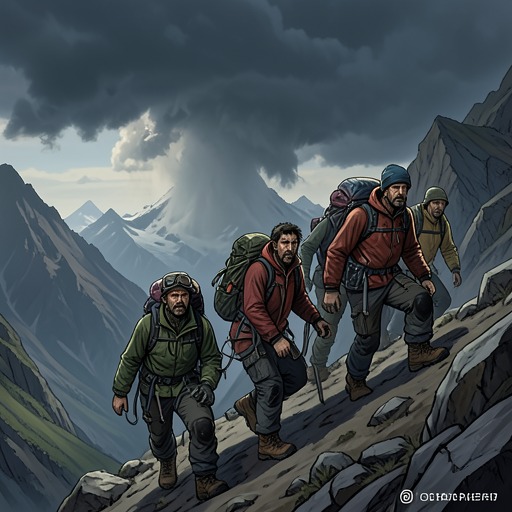
The ClimbThe Taiwanese National Expedition was a team led by Makalu Gau during the 1996 Everest season, where its participation became part of the crowded, increasingly commercial expedition scene. Other climbers questioned the team’s qualifications, but its members nevertheless joined the summit traffic on May 10. Before that attempt, Chen Yu-Nan fell into a crevasse and died; during the following storm, Gau was found unconscious but breathing and returned to Camp IV alive.
Identity and Reputation
In 1996, more than four hundred people would eventually trek to Everest Base Camp and pitch their tents, a dramatic contrast with the much smaller gatherings of the early 1980s. In that crowded camp, the Taiwanese National Expedition became a subject of jokes that masked serious anxiety about its members’ qualifications and whether they could descend safely. The book records one climber comparing the prospect of climbing with the team to being on a mountain with the Jamaican bobsled team. These comments establish the expedition’s reputation among its fellow climbers, not an independent assessment of every member’s ability.
The expedition was headed by Makalu Gau, also identified as Gau Ming-Ho. Its leader’s presence gave the team a role beyond the ridicule: Gau would be among the Taiwanese climbers who joined the summit ascent, and later one of the people whose survival was uncertain during the emergency. The narrative’s contrast between the team’s camp reputation and Gau’s eventual rescue makes the jokes part of the social climate around the expedition, rather than a final judgment on its members.
Cooperation and the Rope Plan
The Taiwanese National Expedition was among the teams involved in an agreement to cooperate on fixing ropes between Camp III and Camp IV on April 26. The agreement also involved Mountain Madness, Adventure Consultants, Alpine Ascents, and the Johannesburg Sunday Times Expedition. Mountain Madness planned to send Sherpas rather than guides; when commitments to establish Camp III and then rest its Sherpas threatened that contribution, Anatoli Boukreev went in their place. The episode places the Taiwanese team within the expeditions’ shared logistical arrangements, where rope work and labor schedules affected access to the summit route.
A separate expectation concerned the higher route on summit day. Members of the Mountain Madness and Adventure Consultants teams understood that their climbing sirdars, Lopsang Jangbu Sherpa and Ang Dorje Sherpa, would leave Camp IV ahead of the clients to fix ropes. But neither sirdar nor other Sherpas had departed early to do so. Lopsang later said that a member of a Montenegrin expedition had told him the rope was already fixed; Jon Krakauer questioned that account, while the book also describes reasons the expedition leaders might have believed the route work was complete. The Taiwanese team is not identified as the source of that disputed report. This distinction matters: it was one of several expeditions sharing the route and rope-fixing agreement, but the evidence does not establish that it caused the failure to prepare the higher ropes.
Chen Yu-Nan’s Fall
On the morning of May 9, as Mountain Madness climbers prepared breakfast at Camp III, Sherpas told them that a member of the Taiwanese expedition had stepped out of his tent to use the bathroom and fallen into a crevasse. He had not been wearing crampons. The Sherpas said they would assist the Sherpas climbing with the Taiwanese team in trying to extricate him; the climber was identified as Chen Yu-Nan.
The fall unfolded alongside the preparations for the next day’s summit bid. While Sherpas went to help, Fischer and his guides hurried their clients through breakfast so they could continue to Camp IV, where they would rest before climbing. The moment therefore shows how an emergency involving one expedition took place amid the shared demands of several teams moving through the high camps. Chen could not be saved. The account later identifies his death as a loss already suffered by the Taiwanese expedition before Gau’s own ordeal.
Joining the Summit Traffic
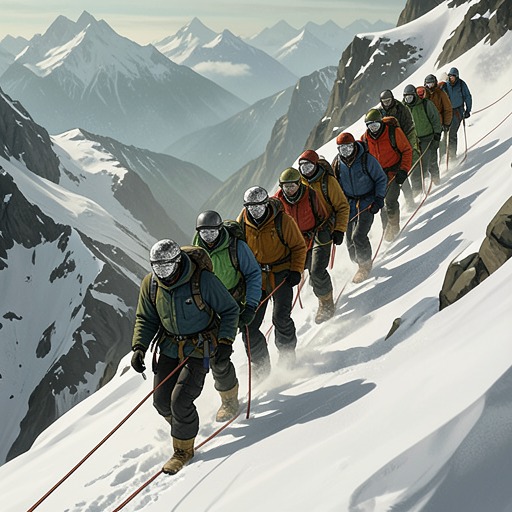
The Taiwanese party’s role in the summit attempt was not limited to its earlier agreement about rope work. On May 10, after the climbers left the South Col, members of the Taiwanese expedition joined the advancing groups behind the teams led by Rob Hall and Scott Fischer. By about 4:00 A.M., the teams had become thoroughly intermingled with three members of the Taiwanese expedition: Gau and two Sherpas. Hall and Fischer were surprised that the Taiwanese climbers had joined them, apparently seeking to climb in the wake of stronger parties that would break trail and use fixed ropes.
The crowded route mattered because climbers’ progress depended on a shared line through difficult terrain. The three expeditions converged on the same ascent, and the Taiwanese climbers were moving among them rather than on an isolated route of their own. The book’s visual account of Doug Hansen approaching the summit places Gau among the climbers on the same high-altitude route, but it does not establish that Gau himself reached the summit.
Rescue and Aftermath
During the emergency, the Mountain Madness Sherpas and a Taiwanese Sherpa went up the mountain in search of Fischer and Gau. The searchers returned to Camp IV with Gau, whom they had been able to revive with hot tea and oxygen. They had found Fischer unconscious but still breathing; at about 1:00 P.M., they put an oxygen mask on him and connected it to a full bottle. The rescue thus brought one expedition leader back from the mountain while leaving the other in critical condition.
The effort took place amid serious communication difficulties. Dr. Ingrid Hunt at Base Camp said messages between her and the climbers passed through several Sherpas at different camps, with information relayed down the chain and then back up. She felt she was not receiving complete or accurate reports, and communication with Pemba at Camp IV was sporadic. In a later account of the search, the report from the Taiwanese Sherpas that Gau was back initially came with the claim that Fischer was dead. When they were questioned further, they clarified that Fischer was breathing. The correction captures the uncertainty surrounding the rescue: Gau’s return was confirmed while the status of the person they had gone looking for remained unclear.
The book’s retrospective note identifies the Taiwanese National Expedition as an ill-fated effort that had already lost Chen Yu-Nan before the May 10 disaster. Gau’s recovery did not undo that death, and the evidence does not provide a full account of the expedition’s later movements or outcome. Its place in the narrative is instead defined by a sequence of entanglements with other teams: a controversial reputation at Base Camp, cooperation over ropes, a fatal fall, a shared summit route, and a rescue that returned its leader alive.