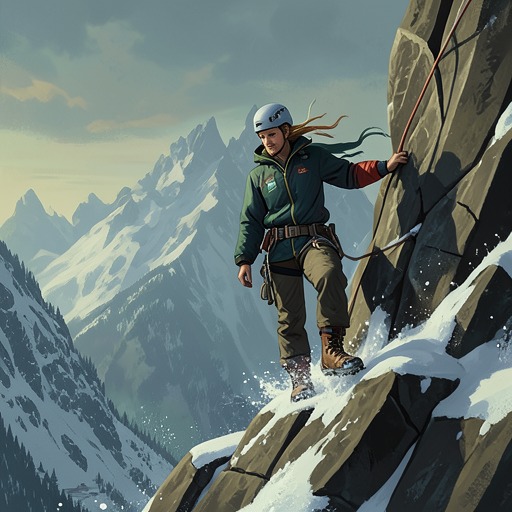
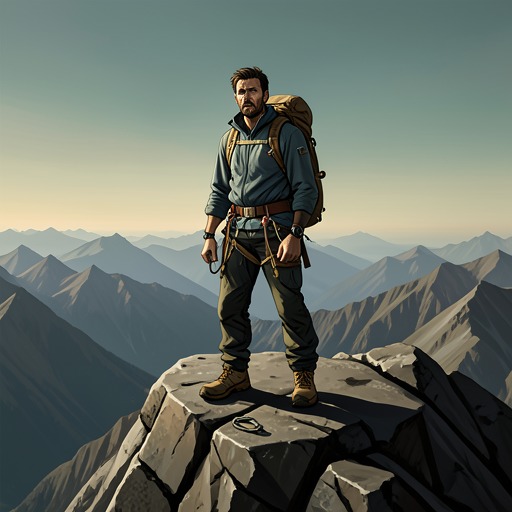
The mountain’s uncontrollability and final say
The ClimbThe mountain’s uncontrollability and final say is the idea that Everest remains beyond human command, however carefully climbers plan or expensively they prepare. In the account of the Mountain Madness expedition, weather can make a summit attempt impossible before the clients are ready, and no guide can insure the team against high winds or sudden change. The mountain is not merely a setting for human ambition: it determines the limits within which ambition can act, and can overturn the plans built around it.
The mountain beyond prediction
The principle is stated bluntly in the epigraph attributed to Bruce Barcott: “The mountain doesn’t play games. It sits there unmoved.” The phrasing denies the mountain a human motive. It does not trick climbers or negotiate with them; its indifference is precisely what makes it dangerous. Human plans and expectations shift, but the mountain remains, and its conditions cannot be made to answer to a timetable.
That uncertainty shadows the expedition from its first acclimatization excursion. On the morning of April 11, conditions were clear and promising, with several days of stable weather and moderate winds. Yet this favorable day offered no reliable forecast for the later summit window, when the clients would be acclimatized and ready to climb. By then, the mountain might not be. The expedition could return home without a summit, with no refund for the opportunity lost. The contrast between an inviting morning and an unknowable future makes the weather more than background: it is an independent force that can decide whether the expedition’s purpose remains attainable.
Planning against conditions no one controls
At Camp I, Anatoli Boukreev considered what success would require. Scott Fischer, Neal Beidleman, and Boukreev would have to time the ascent so that qualified clients reached Camp IV when an attempt could be made. Getting that schedule right, however, would not settle the matter. The team would still depend on the weather, and none of its members could protect against high winds or dramatic changes in conditions. Planning could coordinate the climbers; it could not command the mountain.
Boukreev considered whether an unlucky attempt might be followed by a descent and another try when conditions improved. Even that alternative was conditional. A second attempt would require desire, time, and strength; the clients might not remain strong enough to wait at high altitude, and the expedition might not have enough oxygen left. The apparent flexibility of postponement thus concealed its own limits: waiting could consume the physical reserves and supplies on which another attempt depended. Boukreev’s conclusion was not that planning was useless, but that its reach ended before the decisive uncertainties did. Ultimately, he knew, the mountain would make many of the decisions for them.
Preparation, privilege, and risk
The mountain’s authority also complicates the commercial promise of a guided expedition. Boukreev reflected that the climbers would be privileged to reach high camps, often with Sherpas carrying their loads, but privilege was not security. Above eight thousand meters, he observed, mistakes were magnified in the rarefied air; even a swallow of hot tea from a thermos could make the difference between life and death. The money paid for the expedition could not guarantee success. Access bought an opportunity, not control over the conditions or the consequences of error.
That distinction led Boukreev to question what clients were paying for and what forms of preparation they might be bypassing. He contrasted the cash price of access with the physical price of developing body and spirit through progressively harder climbs, from lower peaks toward the eight-thousand-meter mountains. In his account, oxygen, technology, and a proliferation of services made it possible for less-prepared climbers to go higher. The question was not simply whether these aids could get people up the mountain, but whether reaching higher through them had displaced the slower process by which climbers learned to meet its demands. The mountain’s final say exposed the limit of that transaction: services could ease the approach, but no payment could purchase safety or a summit.
Human ambition under an indifferent verdict
The mountain’s uncontrollability does not erase human ambition. Each climber, Boukreev acknowledged, wanted to reach the summit, overcome obstacles, and accomplish what many considered impossible. Instead, the principle places that aspiration inside a larger uncertainty. A well-timed plan could still meet bad weather; a client ready to climb could find the mountain unready; and waiting for a better chance could leave the team short of strength or oxygen. The outcome belonged neither to ambition alone nor to preparation alone.
The idea therefore serves as a limit on the confidence invited by commercial climbing. Boukreev’s reflections do not present Everest as a rival that can be defeated by sufficient money, technology, or organizational skill. Its “final say” means that human decisions matter, but remain provisional: climbers can prepare, choose, descend, and reconsider, while conditions beyond their control determine which choices remain possible. The mountain’s stillness is not reassurance. It is the fixed fact against which the expedition’s plans—and their limits—become visible.