Yasuko Namba
The ClimbYasuko Namba was an Adventure Consultants client whose 1996 Everest summit ended in a fatal collapse on the descent. Although Neal Beidleman and Tim Madsen struggled to get her off the fixed ropes and down to the South Col, she was left in the storm-stranded group and did not reach Camp IV. Her death, less than five hundred yards from shelter, became a measure of how narrow the distance was between attempted rescue and survival—and remained a source of sorrow for Anatoli Boukreev, who later covered her body with stones and gathered belongings for her family.
Identity and Summit
Namba was climbing with Rob Hall’s Adventure Consultants expedition. On May 10, she summited after the last of the Mountain Madness clients. During the descent she was separated from Mike Groom, a guide who had been climbing near her. By the time she reached the final fixed ropes above Camp IV, the delay and the strain of descent had left her unable to make her way down independently.
Collapse on the Fixed Ropes
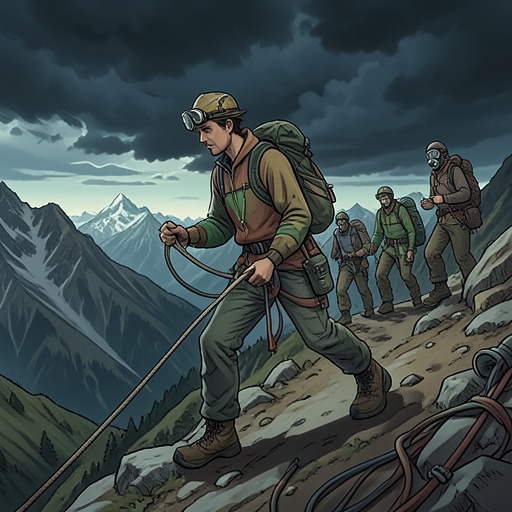
Descending at about 8,350 meters, Neal Beidleman saw a motionless figure sitting facedown on the line. He first thought it might be Lene Gammelgaard, then recognized Namba. He tried to get her moving by speaking to her and adjusting her oxygen mask, but she was not responding in a way that allowed her to descend under her own power. Beidleman grabbed her harness and hauled her down, sliding, standing, or rolling with her as the terrain changed.
The route crossed crevasses beneath the fixed lines, and Namba was frightened and reluctant to commit to crossing them. Beidleman and Madsen lifted, pushed, pulled, and carried her over. She did not physically contribute much to the descent, and her crampons repeatedly pierced Beidleman’s suit and struck his back. The rescue cost the group time, but it brought her off the ropes and onto the South Col.
The Storm and the Dogpile
At the bottom of the fixed line, the storm intensified. Camp IV’s light was visible only intermittently before disappearing; the climbers could no longer maintain a clear bearing. Namba joined a cluster that included Beck Weathers, Madsen, Charlotte Fox, Sandy Hill Pittman, Beidleman, Gammelgaard, Klev Schoening, Groom, and Sherpas. There was no settled leadership, and the climbers were buffeted by wind, following whatever headlight appeared ahead of them. Beidleman tried to keep the group together and guide it away from the steep Lhotse Face.
As they wandered, the climbers lost their orientation. Beidleman judged that the terrain ahead was dangerous and urged everyone to stay together and huddle. In the dogpile, people turned their backs to the wind, leaned against one another, checked each other’s fingers and consciousness, and beat on one another’s backs to stay awake and warm. Namba was among those sheltering there with the others, but the group remained lost in the storm rather than reaching the tents. Beidleman later estimated that they were about four hundred meters from camp; the distance was confirmed by the scattered gear and Namba’s body found the next day.
Rescue Efforts and Death
During his searches on the South Col in the early hours of May 11, Boukreev found Pittman, Fox, and Madsen huddled together, with Namba lying on the ground and apparently unconscious. Weathers was not with them. Boukreev brought oxygen and helped the surviving climbers toward Camp IV, but he did not have enough strength or help to carry out a further rescue of Namba. He sought assistance from members of Hall’s expedition, but none was available. By the time he returned, exhausted, to the tents, he could not do more for her.
The book’s retrospective account stresses the painful proximity of shelter. Namba had been helped off the ropes and brought to the South Col, but, like Weathers, she lacked the strength to follow those who made it to Camp IV. Groom was unable to recruit fellow Adventure Consultants members for a rescue after reaching camp. The account does not present her death as a simple consequence of the storm alone: the time spent on the summit and lost during the descent, including the effort to help Namba on the fixed ropes, left the Mountain Madness climbers more than an hour behind. Martin Adams argued that the decisive problem was time, not the storm in isolation.
Remembrance and Significance
In 1997, Boukreev returned to the South Col with an Indonesian team. He went to the edge near the Kangshung Face, where he had left Namba the previous year, and found her body partly covered by snow and ice. Her pack was gone, and its contents lay scattered among the rocks and ice. He collected small items for her family, slowly covered her body with stones, and left two ice axes nearby as markers. He described these acts as the respect he could offer Namba’s family and the family of Scott Fischer, whose loss he also mourned.
Namba’s death recurs in the account not merely as a confirmation of the disaster’s toll but as a starkly specific failure of distance, time, and physical capacity. Boukreev remembered that she had died “so close”: her tent was no more than five hundred yards from where she perished. The narrative holds that nearness against the sequence of rescue attempts—Beidleman and Madsen’s struggle on the ropes, the dogpile’s efforts to endure the storm, and Boukreev’s repeated searches. Namba’s presence in those scenes makes the limits of rescue concrete: people could reach her, move her, and try to keep her alive, yet the storm, exhaustion, and lack of available assistance prevented that effort from carrying her the final distance to shelter.