
The Cost of Witnessing
The Collini CaseLeinen’s encounters with violence, memory, and evidence reveal how detached legal work becomes when human suffering is made visible.
increasing Bearing strength in each event
 decreasing
Bearing strength in each eventdecreasingThe Autopsy Room
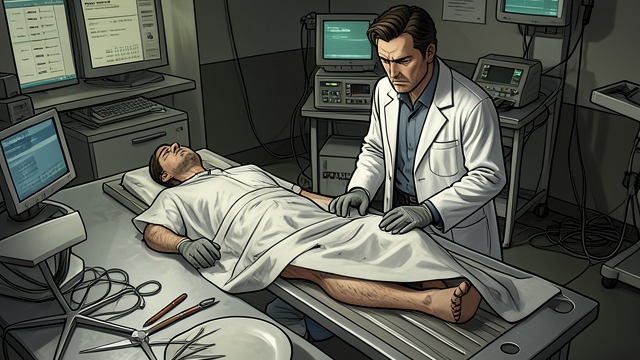
The Autopsy Room
A body made evidence
Leinen attends Meyer’s autopsy and struggles with the exposed corpse, wounds, and clinical examination. Professor Wagenstett insists on systematic description and respect for the dead.
Knowledge has a cost
The lawyer gains detailed evidence but cannot remain emotionally untouched by it. The case becomes physical and immediate in a way that paperwork cannot reproduce.
Counting Stripes
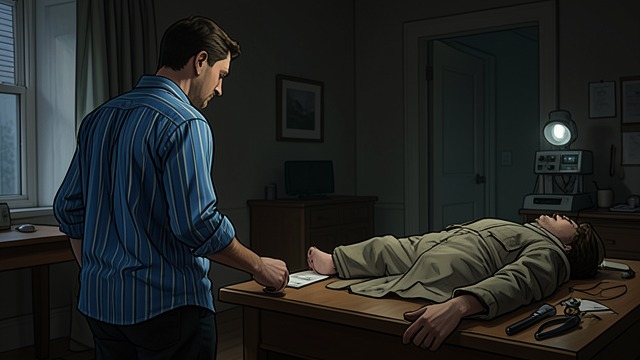
Counting Stripes
A moment of dislocation
Unable to process the autopsy, Leinen focuses on the stripes of a police officer’s shirt. He uses the pattern to steady himself as he leaves the institute.
The body’s afterimage
His reaction reveals how witnessing violence can exceed professional composure. The lawyer’s work depends on evidence, but the evidence also enters his private consciousness.
The Trial’s Images

The Trial’s Images
A picture built in words
Mattinger guides the forensic pathologist through wounds and photographs, ensuring that the judges and lay judges imagine the brutality clearly. The method is controlled, but its effect is forceful.
Evidence shapes judgment
The courtroom’s understanding of Collini forms through selected images before the defense’s historical account is heard. What is made vivid can influence judgment as powerfully as a legal argument.
Reading a Childhood Into Court

Reading a Childhood Into Court
Documentary narration
Leinen reads from records and Collini’s account in a restrained legal voice. Fields, family life, imprisonment, and execution emerge through the details he presents.
The past becomes present
A courtroom used to classify evidence becomes a place where an audience imagines another era. The testimony changes not only what people know, but what they can feel they have witnessed.
A Photograph After Death
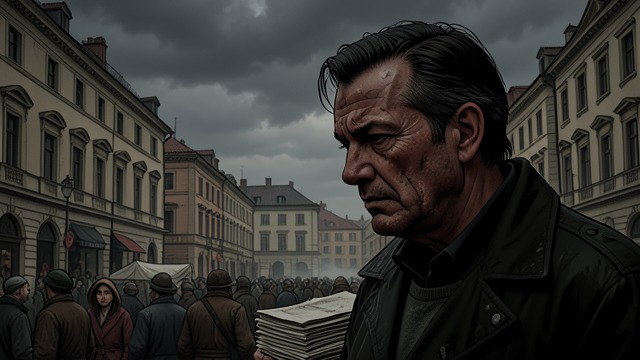
A Photograph After Death
A small surviving image
Collini’s sister appears in a faded photograph enclosed with his final note. The private image counters the impersonal scale of files, charges, and courtroom procedure.
Memory made concrete
The photograph cannot restore her or settle the case. It gives Leinen a specific face to associate with the family losses behind the evidence.
The day after Collini’s confession
Immediately after the autopsy
The first five days of testimony
During Leinen’s wartime statement
At the end of the trial
