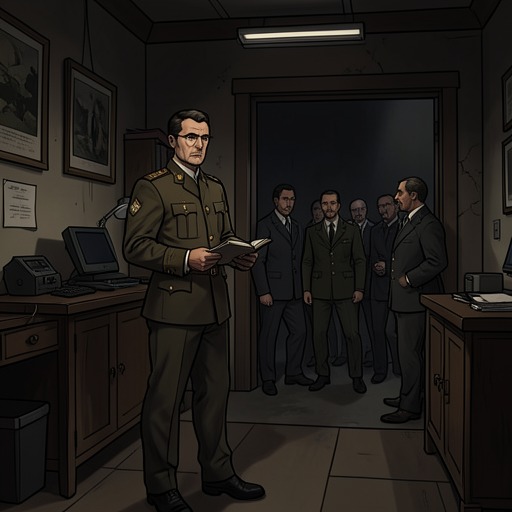
“It was human beings killing other human beings, that was all.”
The Collini CaseThe expression “It was human beings killing other human beings, that was all.” is the interpreter’s stark recognition during a reprisal execution in wartime Italy. It strips away the language of military necessity and procedure without diminishing the responsibility of those who carried out the killings. Its force lies in the distance between the ordinary words and the organized violence they name.
The Scene Behind the Expression
At Marassi Prison, the interpreter was ordered to call out numbers from a list of twenty prisoners. The men had no connection to the bombing that prompted the reprisals, yet they understood that they were being taken to their deaths. The operation proceeded through assigned roles: German officials gave instructions, marines guarded the prisoners, and the interpreter translated. The men were transported from the prison and executed in a ravine.
The interpreter’s sentence comes as he watches the execution and sees a young marine who has fired before the order. One prisoner had looked toward the sky and cried “Viva Italia!” The interpreter registers the young soldier’s face and the reality of what has taken place. His recognition is not an argument that the killing was impersonal or unavoidable; it is a refusal to let the categories of war conceal that people were killing other people.
Against the Language of Reprisal
The killings are surrounded by language that turns them into an operation. Hans Meyer explains the reprisal in terms of a one-to-ten ratio, referring to the shooting of German soldiers in Rome and General Kesselring’s order for the execution of civilians in the Ardeatine Caves. The prisoners at Marassi were not implicated in the bombing, but they were included in the response. Later, the daily bulletin would describe the operation as successfully completed, with no incident of note.
Against that language, the expression is deliberately spare. Its repetition of “human beings” gives the victims and their killers the same human status, while the final words, “that was all,” reject the appearance of a higher or cleaner explanation. The sentence does not erase differences in power, choice, or responsibility. Rather, it insists that military labels cannot turn an execution into something other than human beings killing human beings.
Memory, Administration, and Responsibility
The interpreter carries the memory beyond the ravine. He does not go home immediately; later, he tells his wife what happened and gives her the list of names he brought from the prison. The first name on it is Nicola Collini. The list, with its identifiable names, stands against the numbering used to summon the prisoners and the impersonal bulletin that records the operation as routine.
The expression also resonates with the novel’s later account of legal administration. The Introductory Act to Administrative Offences altered the treatment of certain accessories to murder, making their acts subject to a statute of limitations and ending the possibility of prosecution. The interpreter’s words and that legal account concern different moments and different forms of responsibility; the sentence does not itself explain the law. Their juxtaposition nevertheless sharpens the book’s contrast between the human reality of violence and the administrative categories through which institutions describe, classify, or leave it unpunished.