Conditional legality of reprisal executions during the Second World War
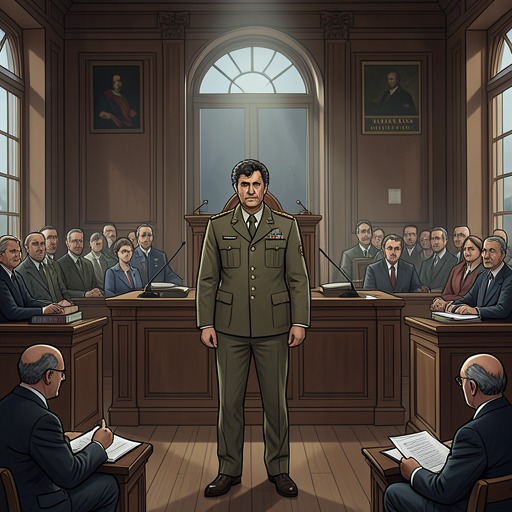
The Collini CaseConditional legality of reprisal executions during the Second World War is presented in The Collini Case as a restricted legal doctrine, not a general license to kill civilians. Through Dr Sybille Schwan’s expert testimony, the trial examines the conditions under which wartime reprisals could be considered legitimate, then applies them to Hans Meyer’s order to shoot twenty Italian partisans. The testimony’s significance lies in keeping several questions distinct: whether a reprisal could meet the law of its time, whether the particular shooting did so, and whether postwar authorities ever properly investigated Meyer’s responsibility.
The limits of reprisal
Schwan explains that both German forces and the Allies shot civilians during the Second World War as reprisals for attacks on their own forces. Such shootings were also used to deter the population from carrying out further attacks. That explanation describes the practice and its asserted purpose; it does not make every reprisal lawful. The court’s general rule, as Schwan recounts it, was that such a killing could be legitimate only in extreme cases and within limits.
Those limits were concrete. Women and children could not be killed in reprisals. The execution itself could not be cruel, and no one could be tortured before being executed. Authorities were required to make serious efforts to find and capture the people actually responsible for the attack. The rules therefore addressed both the choice of victims and the conduct of the authorities: a reprisal could not simply substitute a convenient group for the perpetrators, nor could the method of punishment disregard basic restraints.
Publicity was another condition. The facts of a reprisal shooting had to be made publicly known afterward; in Schwan’s account, disclosure was intended to deter further attacks. The number killed also had to be considered in relation to the attack, but international law supplied no fixed ratio that applied in every case. Schwan notes that in 1941 Hitler demanded that one hundred people be killed for each German soldier killed, a ratio she identifies as impermissible under international law. At the same time, she says there was no universal formula for determining the highest permissible number: the reprisal could not be excessive. The framework thus imposed a limit without converting proportionality into a simple arithmetic rule.
Application to the Genoa bombing
Richard Mattinger tests the doctrine against the events recorded in the Hans Meyer file. In 1944, Italian partisans detonated a bomb in a café in Genoa, killing two German soldiers. Schwan agrees that the bombing counted as an attack for purposes of the criteria she has described. The German Security Service then tried to locate the partisans responsible but could not track them down, satisfying, in her view, the requirement to attempt to find the actual perpetrators.
On orders from his superiors, Hans Meyer had twenty partisans shot. The ratio was one to ten: ten partisans for each German soldier killed. Asked whether that number made the shooting excessive or legitimate, Schwan does not claim to give a definitive answer. She says it would probably have to be regarded as legitimate. Her qualified assessment is important: she neither declares the rule straightforward nor treats the numerical ratio alone as conclusive. The account leaves room for legal judgment while identifying the likely assessment under the criteria discussed at trial.
Mattinger also asks whether the victims included women or children. Schwan answers that the file contains no evidence that they did. That is a statement about what the file establishes, not proof beyond the file that no such victims were present. On the separate requirement of public disclosure, she points to reports of the shooting in three local newspapers and says that this should satisfy the basic principles of international law. Taken together, the failed effort to find the bombers, the absence of evidence in the file that women or children were killed, and the newspaper reports support her cautious view that the documented reprisal may have met the principal conditions.
Legal possibility and the unresolved case
The trial applies the general rules to Meyer without turning Schwan’s assessment into a final judicial finding about every aspect of his conduct. Asked how courts might have viewed the shooting in the 1960s, she calls the question theoretical. Comparing Meyer’s actions with similar incidents of the period, she thinks the courts would not have considered the shooting cruel. This places the likely historical legal assessment in its period rather than treating later judgments as if they had always been the same.
That distinction becomes crucial when Mattinger asks whether legal proceedings were brought against Meyer. Proceedings were initiated by the Stuttgart Public Prosecutor’s Office, but Meyer was not questioned, and the investigation was discontinued on 7 July 1969. During Mattinger’s examination, the sequence creates the impression that the authorities had assessed the shooting against the reprisal criteria and that Meyer was therefore no longer a murderer. Schwan later clarifies that the reason for discontinuing the investigation was different: the statute of limitations had come into force under a law effective on 1 October 1968. There had been no further investigation of Meyer’s guilt or innocence.
Caspar Leinen draws out the consequence for the case before the court. Fabrizio Collini had named the man who ordered his father’s shooting, laid a charge, supplied the evidence he had, and trusted the authorities; the investigation nevertheless ended because the conduct had become subject to a statute of limitations. The reprisal doctrine and the later limitation rule answer different questions. A shooting’s possible legality under wartime international law does not establish that a postwar investigation actually resolved the commander’s responsibility; conversely, discontinuance on limitation grounds does not amount to an adjudication that the shooting was lawful.
The doctrine’s significance in the trial
The testimony gives the reprisal rules a double function. They provide a framework for evaluating the historical order against the standards discussed by the expert, while also exposing how a formally closed proceeding can be mistaken for a decision on guilt. Mattinger’s argument depends on the apparent force of the first issue; Leinen’s questioning restores the missing explanation for the second. The difference between a likely legal assessment of the shooting and the actual reason the investigation ended is therefore central to understanding what the file can, and cannot, establish.
The case also places legal judgment in time. Schwan distinguishes what courts might have concluded in the 1960s from judgments formed later, and her testimony identifies the termination of proceedings under the 1968 law as a separate institutional consequence. The novel later became one point of reference when, in January 2012, the Federal Minister of Justice appointed a committee to reappraise the Ministry of Justice’s Nazi-era legacy. In that wider context, the reprisal rules are not presented as a self-sufficient answer to Meyer’s case. They are a bounded legal test whose application must be separated from the procedural history that prevented a later inquiry into his guilt or innocence.