Genoa
The Collini CaseGenoa is the setting where the Collini family’s rural tragedy becomes entangled with the systems of German occupation. In the city, Fabrizio’s uncle learns where the boy’s father has been taken; in Marassi Prison, German authorities hold him as a partisan; and in the Café Trento, a bombing precipitates the reprisal execution of Nicola Collini. The city is at once a place of ordinary domestic and commercial life and a staging ground for violence administered in the language of orders, lists, and official reports.
Wartime City and the Collini Family
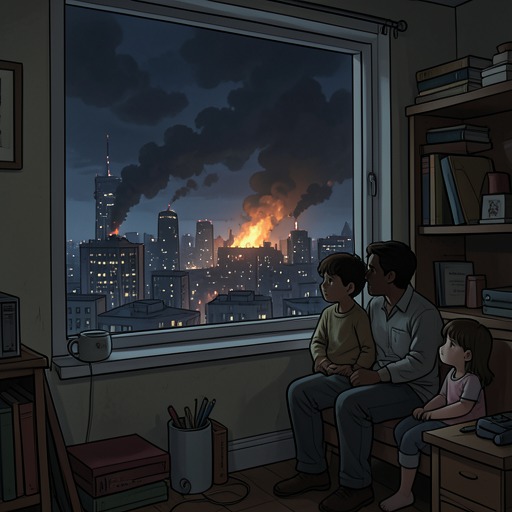
Genoa enters Fabrizio Collini’s childhood from the distance between the city and his family’s farm. Relatives from Genoa sometimes visit the village, bringing reports that the Germans are taking what they need from the factories. Their gloomy expressions and hushed talk of partisans and assassination attempts reach the children even as adults try to keep the danger from them. The war thus arrives at the farm partly through the city: as news of occupation, industrial extraction, and resistance, before it comes directly to Fabrizio’s home.
After German soldiers take Fabrizio’s father, his sister says their only living relative who might know what to do is Uncle Mauro, whose farm is almost ten kilometres away. Mauro goes to Genoa the following day, dressed in his best suit and carrying eggs for relatives in the city. He stays four days. When he returns, his suit is stained and hangs crookedly from his shoulders; he has not been allowed to see Fabrizio’s father, but he has found out where he is being held. He brings back a thin official paper marked with two swastikas. It identifies the prison in the Marassi district and says that the arrest was ordered by the security-service detachment posted in Milan. The page makes the distant city’s institutions legible to the family, but offers no means of reaching or rescuing the prisoner.
Marassi Prison and the Occupation Apparatus
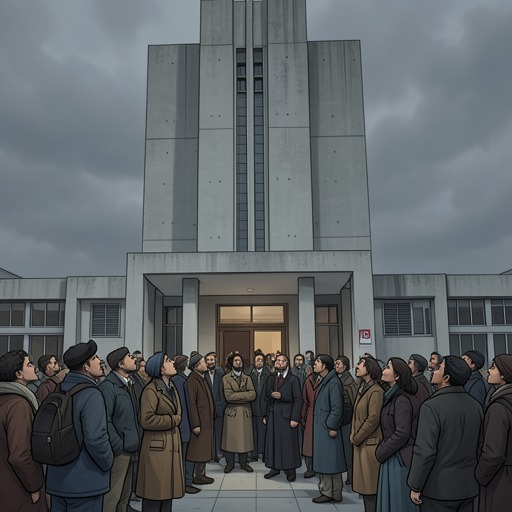
Marassi is not just a place named in an official document: it is the prison through which the occupation authorities classify and control people taken as partisans. The interpreter, living in Genoa with his wife and children, is ordered to report there before a quarter to three one morning. He understands what the Germans intend before they explain it. Earlier attempts to assassinate German soldiers have been followed by talk of uncompromising measures, and the bombing at the Café Trento makes a response inevitable in the occupiers’ eyes.
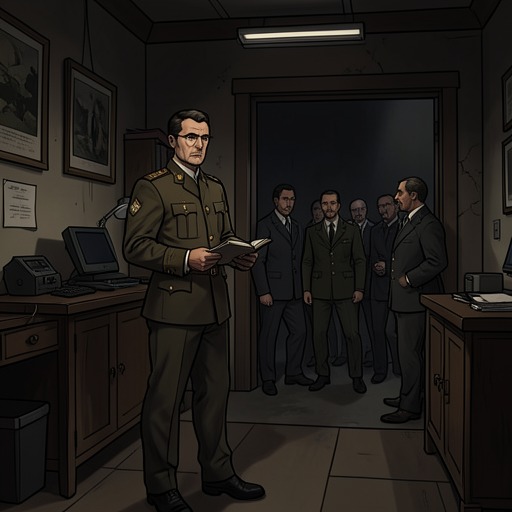
At three in the morning, the interpreter receives a list of twenty names. In the prison corridor he is told to call out numbers, not names. The prisoners are told they are being moved and may leave their possessions behind; the explanation is a mistake, because they understand that they are being taken to die. A German officer checks the numbers on their cell doors and crosses them off the list. In the brightly lit prison yard, the prisoners board a truck guarded by four marines with sub-machine guns. Hans Meyer joins the interpreter and the officer in a jeep at the prison gate. His references to Hitler’s orders, General Kesselring, and a one-to-ten reprisal ratio connect the prison’s numbered prisoners to the retaliatory policy being carried out beyond the city.
The interpreter returns to Genoa by bicycle after the killings, with the sun already well up. He cannot bring himself to go home immediately and instead lies on the beach, looking out at the waves. That movement from the prison and its execution detail to the open shore does not undo what has happened; the ordinary city remains the place to which he must return, carrying knowledge of the massacre into his family life.
The Café Trento Bombing
The Café Trento stands on the narrow Via di Ravecca, where on the evening of 16 May 1944 all fourteen tables are occupied. Its customers are German soldiers, most of them serving in the marines. They have unbuttoned their uniforms; some are already drunk and others are playing cards. Against this crowded, habitual scene, a man in a lance corporal’s uniform enters with a bag weighing only a kilogram. He places it beside him at the bar, orders a small beer, and nudges the bag partly underneath the counter.
Before entering, the bomber has crushed an ampoule at the end of a brass tube. As he drinks, copper chloride corrodes an iron wire inside the bag. The device has been designed to delay the explosion: the English detonator releases a spring when the wire is eaten away, allowing a bolt to strike a percussion cap and create a spark. After setting the mechanism in motion, the man pays for his beer and leaves. Eighteen minutes later, the explosive detonates with a force greater than TNT. Two men die instantly; fourteen more are injured. The blast throws furniture through the room, breaks bottles, glasses, and ashtrays, shatters the windows, and tears the door from its hinges. The violence is both precise in its preparation and indiscriminate in its effects on the people inside.
Work, Home, and Aftermath
Genoa is also the interpreter’s adopted home. He came there after following his future wife from a mountain village above Merano, where they met at her parents’ inn. Their life had once gone well, but her father’s illness forced the family to sell its possessions to pay medical bills. During the war the interpreter dealt on the black market in food, cigarettes, and sometimes jewellery. When German searches for partisans drove him into hiding at a warehouse, he encountered a wounded woman partisan and was captured. The Germans took his goods and made him choose between prison and work as an interpreter because he spoke South Tyrolese German.
By the time Hans Meyer takes over the German office in Genoa, the interpreter sleeps on the sofa rather than wake his wife and children in their small apartment. Meyer is described as running the Nazi office like a business venture and is responsible for ending local strikes because the industries are needed for war production. The contrast between that administrative purpose and the deaths set in motion by the bombing gives the city’s occupation a double face: factories and offices organized for production, and a prison from which men are dispatched to be killed.
After the reprisal, the interpreter drinks, comes home, and tells his wife what happened in the ravine. She listens, then strikes him repeatedly until she is exhausted. He gives her the list he has brought away from the prison. She reads the names aloud; the first is Nicola Collini. Four days later, news reaches the village where the Collinis live. Through Genoa, therefore, the novel links a public act of reprisal to a family’s private loss: the city’s paperwork and prison identify the machinery of violence, while the name on the list confirms who has been taken from Fabrizio’s family.