Green House
The Collini CaseThe Green House is the Meyer family estate at Rossthal, a house and park that frame both Caspar Leinen’s childhood among the Meyers and his later return with Johanna Meyer to investigate Hans Meyer’s private papers. First remembered as a landscape of games, family comforts, and a grandfather’s attention, it is revisited in winter as a quiet house of dust sheets and carefully preserved records. The contrast gives the estate a particular significance: it is at once a childhood world and an archive of the people who inhabited it.
Estate and Grounds
The estate grew from a large tract of marshland outside the city, bought by Hans Meyer’s father at the beginning of the twentieth century. Architects and landscape gardeners from Berlin were brought in to drain the land and arrange it as a park. Its designed landscape combined paved drives, gravel and woodland paths, lawns, exotic trees, and an avenue of chestnuts. A dammed stream formed three pools; the largest held an artificial island reached by a pale-blue Chinese bridge. The grounds also included a red-sand tennis court, an open-air swimming pool, a nursery garden, a guesthouse, and a house for the chauffeur and his family.
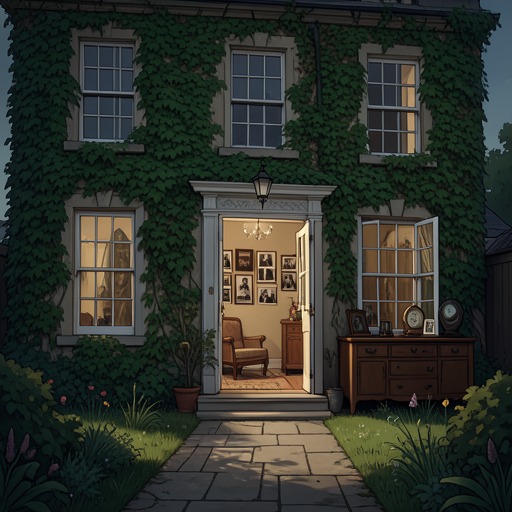
A path past lilac bushes led to an orangery whose glass panes were set in lead frames. The main house, built in 1904 on a small rise, stood above a stone terrace reached by an outside flight of steps. Despite its more than thirty rooms and six garages in the side wings, it was described as seeming to belong naturally in its landscape. Its dark-green shutters, ivy-covered side, and eight old chestnut trees helped give it the family name Green House. On summer weekends, the family ate beneath the chestnuts’ tall crowns. The grounds thus joined deliberate grandeur to recurring domestic routines: paths, pools, and formal gardens were also the setting for ordinary family life.
A Childhood Landscape
Hans Meyer remained at the center of the estate’s life as both head of the family firm and the adult who made time for the children. His grandfather had founded the Meyer Engineering Works in 1886; after the Second World War, Hans built it into an international concern manufacturing machinery, surgical instruments, plastics, and packaging. At Rossthal, however, the children encountered him not only as an industrialist but as a patient companion. On alternate afternoons, while Philipp had extra coaching, Caspar spent time with him in his office. They played chess on an old board, and Hans sometimes let Caspar win and gave him money afterward.
Hans also taught Philipp and Caspar how to build tree houses without nails and where to find worms for fishing bait. He gave them knives with birch-wood handles and showed them how to cut whistles. The boys imagined using the whistles to protect the family from burglars, a childhood game that places the estate’s spacious security alongside their make-believe fears. They spent their time at Rossthal with little concern for anything beyond the day: fish that would not bite and girls who would not kiss seemed to them the limits of trouble. The Green House and its grounds therefore belong to a distinctly bounded period of childhood, remembered as a world in which the adults largely left the boys to themselves and Hans was the notable exception.
The House in Winter
Years later, Rossthal remained a holiday destination for Caspar and Philipp; at Christmas, Caspar found it more enjoyable than his father’s cold house. During one snowy visit, the cleared paths through the park looked like mazes. In the entrance hall, the boys sat before a tall fireplace, while the family’s three dogs slept on the stone floor, barred from the upper storeys. Philipp wore a yellow dressing gown bearing a large crest, found in an attic wardrobe; the two boys smoked Hans’s cigars and planned the next few days. The details preserve the house as a place of inherited objects, playful trespass, and seasonal comfort.
When Caspar and Johanna returned in winter to look through Hans’s private papers, the estate had changed in atmosphere, though it remained maintained. Snow covered the grounds, and the wintry light appeared blue. Frau Pomerenke, Hans’s last housekeeper, greeted Johanna tearfully and welcomed Caspar back. A fire burned in the large hearth, and supper waited in the kitchen; afterward, Frau Pomerenke withdrew to her two rooms beside the housekeeping office, where the sound of her television later reached them. Her continued presence distinguishes the quiet house from an entirely deserted one.
Inside, furniture and lamps were hidden beneath white dust sheets, the shutters were closed, and the rooms were cool and still. The grandfather clock in the library continued to tick because someone was winding it every day. In Hans’s study, a narrow break between the curtains cast bands of light across the desk. The room retained the traces of its former routine: Hans had read the newspapers there daily, after they were ironed in the kitchen to keep them crisp and prevent ink from marking his hands. The familiar study remained physically ordered, but its usual occupant was gone.
Records and Remembrance
The search made the Green House more than a setting for recollection. Caspar and Johanna uncovered two unlocked desk drawers containing only notepaper and matching envelopes, pencils, two old fountain pens, and a dictating machine with empty cassettes. On the shelves, files were arranged and labelled by subject and year, with household records and business and private correspondence among them. The house’s ordered interiors offered evidence through accumulated documents rather than through a single revelation.
The photograph albums, arranged chronologically, carried another kind of record: family parties, safaris in Africa, and hunting trips in the Austrian mountains, populated by faces Caspar and Johanna knew. Among the papers was a cuttings book labelled with Caspar’s name. Hans had kept items sent to him from Caspar’s youth, including National Youth Games certificates, swimming certificates, and a certificate for second place in a boarding schools’ downhill skiing championship. Later, he had his company’s legal department send him Caspar’s essays and discussions of verdicts published in legal journals. Hans had highlighted sentences and added question marks to paragraphs. The discovery connects the child who played in the estate’s park with the adult lawyer whose work Hans continued to follow. In this return, the Green House holds both the visible architecture of family memory and the carefully filed traces of an intellectual life.