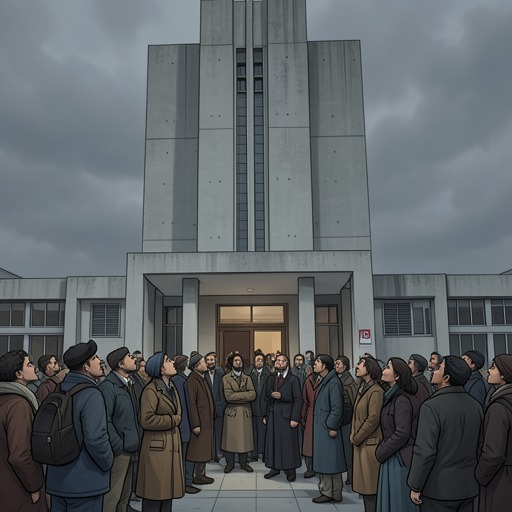
Marassi Prison
The Collini CaseMarassi Prison, in the Marassi district of Genoa, is both a place of detention and the threshold of a reprisal operation. The narrative first locates Fabrizio Collini’s imprisoned father there; later, German officers use the prison to assemble twenty prisoners for removal and death. The same address thus carries two kinds of knowledge: a family learns where a loved one has been taken, while prisoners and their escort recognize what the institution is about to set in motion.
Identification and Family Search
After Uncle Mauro spent four days in Genoa trying to find Fabrizio Collini’s father, he returned to the farm with an official-looking sheet bearing two rubber stamps and the words “Security Service.” The document named Marassi Prison as the place where the father was held. Mauro had not been allowed to see him, but at least the family now had a location and could understand that the arrest had placed him in German custody.
The paper also connected the detention to the security service detachment posted in Milan, whose order had led to the arrest. It identified Hans Meyer, a German SS-Sturmbannführer, as the man then in charge of the prisoners. The details turned the prison’s name into more than a destination: it situated the father within a chain of command, while leaving the family without access to him.
The Nighttime Roll Call
Marassi Prison reappears during a later account of German reprisals. An interpreter, ordered by the head of Department V to report there by 2:45 in the morning, had not been told what would happen. He had guessed that the bombing at Café Trento would bring a response, because the Germans had spoken of taking uncompromising measures.
At three in the morning, the interpreter received a list of twenty names with numbers beside them. In the corridor he was instructed to call only the numbers, not the names. The prisoners stood outside their cells in the half-awake quiet of the prison; a German officer told them through the interpreter to dress because they were being moved and could leave their belongings behind. The assurance that they would be sent on did not persuade them: they understood that they were going to die that day. The officer checked the numbers against the cell doors and crossed them off his list.
From Cells to the Yard
The prison yard was brightly lit by floodlights, which made the prisoners’ faces appear white. A truck waited in the middle with its tarpaulin folded back, benches ready inside. The prisoners climbed aboard without resisting, watched by four armed men in marine uniforms. The departure was conducted without shouted orders, but its procedure and armed guard made the danger plain.
At the prison door, Hans Meyer joined the officer’s jeep, with the interpreter seated beside the driver. Meyer spoke of Hitler’s orders, General Kesselring, and reprisals at a ratio of ten dead partisans for each German soldier killed. The interpreter understood that the twenty men on the list had nothing to do with the Café Trento bombing. Marassi was therefore not the site of the killings described in this passage; it was where the selected prisoners were identified, brought into the yard, and placed on the route to their deaths.
Narrative Significance
The prison’s two appearances create a sharp contrast between the search for a single detained man and the administrative handling of twenty prisoners. In the first, an official paper gives a family a place to look, even though it does not grant access. In the second, numbers replace names as the prisoners are called, checked, and prepared for transport. Marassi’s role is consequential precisely because the violence begins there as an organized process of custody and removal, before the convoy reaches its destination.