Meyer Engineering Works
The Collini CaseMeyer Engineering Works is the Meyer family’s industrial company, transformed under Hans Meyer from an established family business into an international enterprise. After Hans Meyer’s murder, the firm’s scale, commercial ambitions, and concern about publicity shape its response to the case. Its lawyers seek a role in the proceedings, investigate whether the company had any connection to Fabrizio Collini, and later try to persuade defense lawyer Caspar Leinen to withdraw from the trial or bring it to a quiet end. The company thus connects family history and corporate power to the novel’s conflict over what the murder investigation should be allowed to uncover.
Origins, products, and family setting
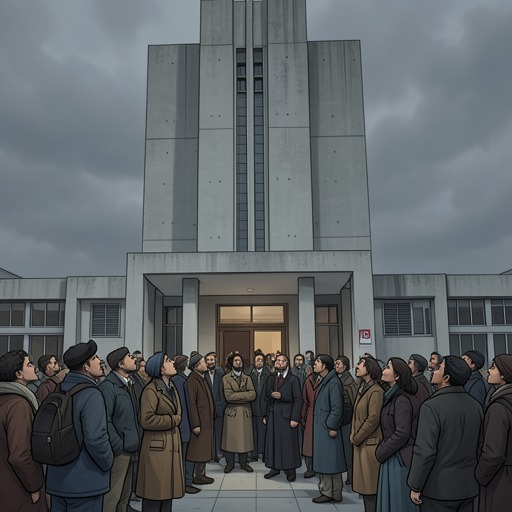
The business had been founded in 1886 by Hans Meyer’s grandfather. After the Second World War, Hans Meyer built it into an international concern. Its output ranged widely: machinery, surgical instruments, plastic, and packaging. The company’s development therefore appears not as a single specialized trade but as an expanding industrial operation under the leadership of the family patriarch.
That business history is set against a family landscape of considerable wealth. Hans Meyer’s father had bought extensive marshland outside the city at the beginning of the twentieth century and had it drained and laid out as a park. The property included wooded and gravel paths, lawns, exotic trees, an avenue of chestnuts, three pools, an artificial island reached by a pale blue bridge, a tennis court, and an open-air swimming pool. The family’s main house, completed in 1904, had more than thirty rooms and six garages in its side wings. Known within the family as the Green House, it stood among old chestnut trees and ivy. The novel distinguishes this landscaped family world from the company’s industrial activity, while placing both within the same inheritance of Meyer wealth and authority.
The firm after Hans Meyer’s murder
When Hans Meyer is murdered, he is both the company’s former chairman and its main shareholder. The news reaches the firm as a business crisis as well as a family catastrophe. Holger Baumann, the company lawyer, tells Richard Mattinger that the enterprise employs more than forty thousand people worldwide, earns profits almost four per cent above the industry average, and is close to completing the largest deal in its history. Baumann argues that the murder’s appearance in the press could damage the firm’s interests.
Baumann also recalls the company’s prior experience of unwelcome publicity: several years earlier, a subsidiary had been involved in a bribery case, and Mattinger had represented a leading employee in the resulting trial. This history helps explain Baumann’s sensitivity to public attention, but it does not establish that the company or its current business had any connection to Hans Meyer’s murder. Indeed, Baumann says that nobody at the firm knows why Hans Meyer was killed and insists that he is sure it had nothing to do with the business. Mattinger is struck by the confidence of that conclusion, given that only a few hours have passed since the crime.
Legal representation and the search for a connection
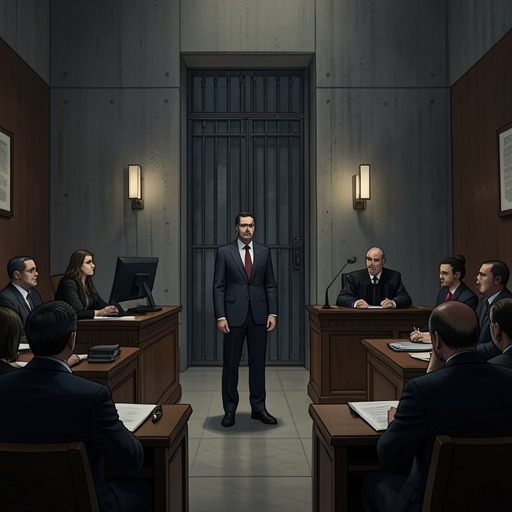
The company’s board wants Mattinger to represent the firm in the murder trial. He explains that he cannot simply act as accessory prosecutor on the board’s request: under the rule he describes, only a family member can ask him to take that role. Baumann undertakes to address the problem, and a fax arrives from Hans Meyer’s granddaughter and sole heir, Johanna Meyer, who is in London. Mattinger promises her that he will handle the matter and says he will contact the Berlin public prosecution office the next day. The sequence shows the company using its legal advisers to establish a place in the proceedings, while the formal route depends on the victim’s family.
The firm’s archives are also searched for evidence of a relationship with Fabrizio Collini. At a meeting in the Munich branch, the company lawyer tells Caspar Leinen that the search has yielded nothing—not even an invoice to or from anyone named Collini. He cannot supply an explanation for the murder or useful information about the defense. Leinen understands that the meeting has been called chiefly to find out what the defense intends to do; once it becomes clear that neither side has an answer, the discussion ends quickly. The negative archival result narrows what the company can offer, but does not solve the murder’s underlying question.
Baumann’s pressure on the defense
Baumann later approaches Leinen with an offer designed to get him out of the case. He proposes that Meyer Engineering Works pay for mandated defense counsel, whom the company already has in mind; under the arrangement he describes, Leinen would then be automatically released from the trial. Baumann presents this as an easy way for a young lawyer with a future—and, in his view, a connection to the Meyer family—to relinquish the brief.
The offer gives way to a more direct appeal to contain the proceedings. Baumann says that the company does not want to know what Leinen has been investigating in Ludwigsburg, but wants the trial to end quickly because each day of publicity is damaging. He presses Leinen to make no plea in court and let the trial end quietly. Leinen refuses to accept responsibility for the company’s publicity problem. In this exchange, Baumann’s friendly manner and his proposal of paid replacement counsel frame corporate pressure as practical assistance; the stated objective, however, is to shorten a public trial whose disclosures the firm fears may harm its standing.
Narrative role and limits
Meyer Engineering Works is neither presented as the explanation for the murder nor shown to possess the missing answer. Its archives reveal no documented dealings with Collini, and its lawyer’s early assurance that the crime is unrelated to the firm sits uneasily beside the speed and certainty of that claim. The company’s role instead emerges through its attempts to manage exposure: it wants representation in the proceedings, worries about press attention, and seeks to remove Leinen or induce him to bring the case to a quiet end.
That corporate response forms a contrast with the trial’s wider historical inquiry. The novel later explains how the Introductory Act to Administrative Offences altered the treatment of certain accessories to murder and made some Nazi-era crimes impossible to prosecute once the limitation period had expired. That legal history is not attributed to Meyer Engineering Works. Its relevance to the company’s portrayal is structural: the firm’s preference for a swift, discreet conclusion belongs to the contemporary pressure surrounding the trial, while the courtroom account insists on examining the consequences of a past that institutions and legal rules had allowed to escape public reckoning. The distinction matters: the company’s conduct is evidence of its concern for reputation, not proof that it caused, concealed, or understood the historical crime at the center of the case.