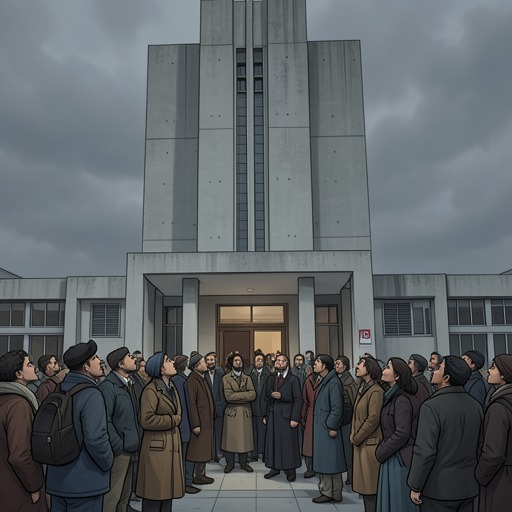
Retaliatory Execution of Twenty Italian Prisoners
The Collini CaseThe Retaliatory Execution of Twenty Italian Prisoners is the wartime atrocity at the center of Fabrizio Collini’s family history and, decades later, of the legal argument in the Collini murder trial. The prisoners had no connection to the bombing that prompted the reprisal. An unnamed interpreter was forced to assist the German authorities, witnessed the execution, and carried away a list that linked the dead to the Collini family. The event thus survives both as an act of organized killing and as a record whose later treatment tests whether procedural closure can amount to historical accountability.
Background and Selection
The immediate pretext was the bombing at Café Trento. German authorities had already faced attacks on their soldiers, but the interpreter understood that they would answer this bombing with what they called uncompromising measures. At Marassi Prison, at three in the morning, he received a list of twenty names. He was instructed to call out the numbers beside the names in the corridor, not the names themselves. None of the prisoners had been involved in the bombing.
The prisoners were told they were being moved and could leave their belongings behind. The interpreter recognized that this explanation was false: in the circumstances, their possessions would not be sent after them. The prisoners understood what the announcement meant. This was not a transfer to another facility but a selection for death, carried out through a sequence of ordinary administrative instructions that concealed its purpose only briefly.
Hans Meyer joined the interpreter and the officer in charge of the marines at the prison. In the jeep, Meyer referred to orders from Hitler and General Kesselring and described a reprisal ratio of ten deaths for each German soldier killed. He also spoke of the killing of thirty-three German soldiers in Rome’s Via Rasella and of the subsequent shooting of 335 civilians in the Ardeatine Caves. The interpreter understood the execution as part of this system of retaliation, in which prisoners unconnected to the original attack were made to pay for it.
Removal and Execution
A truck carried the prisoners from Marassi Prison under armed guard. The interpreter travelled in a jeep with the German officer and Meyer. After roughly an hour, the vehicles stopped on a narrower road, where German marines and two buses were waiting. The prisoners were taken from the truck and tied together in pairs by their left arms, arranged so that one person had to walk forward while the other walked backward. The account presents their removal as controlled and deliberate: the guards did not need a public struggle to bring the condemned men to the execution site.
The interpreter remained with the prisoners to translate the orders, then followed Meyer and the marines into a ravine. At the bottom was a pit, reinforced with boards and apparently dug by other prisoners. The execution was conducted in successive groups. Ten marines formed a firing line, and five prisoners at a time were brought to a wooden plank beside the pit. No explanation was offered to them, and no priest was present. The officer gave the commands to prepare and fire. After each group, an older non-commissioned officer entered the pit and shot two men who had survived the firing. The account’s restrained sequence of commands and tasks emphasizes the operation’s organization without turning it into a battle.
One prisoner broke from the imposed routine by looking upward and raising his arms. His cry of “Viva Italia!” was followed by a premature shot from a young soldier, who had fired before the command. The interpreter remembered the soldier as little more than a child and retained this moment as an encounter with the reality of human beings killing other human beings, rather than an abstract military engagement. Afterward, the marines covered the pit and placed a large rock over it. The daily bulletin would describe the reprisal as successfully completed, with no noteworthy incident—a bureaucratic formulation at odds with the interpreter’s lasting memory.
The List and the Collini Family
The interpreter did not go home immediately. That evening, after getting drunk, he told his wife what had happened. She struck him repeatedly, then stood with him in the dark. He switched on the light and gave her the list of prisoners’ names that he had brought away from the prison. The first name she read aloud was Nicola Collini. The list, initially used to organize the prisoners’ removal, had become a surviving record identifying one of the victims.
Four days after the execution, news reached the village where the Collinis lived. Uncle Mauro bent over the sleeping boy Fabrizio and kissed him on the eyes; he then told the child that from that moment he was his son. In this way, the reprisal did not end with the execution or the burial. Nicola’s death altered the family’s future, and the child left behind became Fabrizio Collini, whose later silence and violence bring the wartime event into the courtroom narrative.
Legal Afterlife and Significance
Decades later, testimony about the investigation into Hans Meyer gave the massacre a second, legal history. Dr Sybille Schwan confirmed that the proceedings initiated by the Stuttgart Public Prosecutor’s Office had been discontinued, and that Meyer had not even been questioned. Richard Mattinger used this outcome to argue before the court that Meyer’s actions met the criteria for a legitimate shooting of hostages; he announced that the proceedings had been dropped on 7 July 1969. The discontinuation did not establish that the prisoners had participated in the bombing. It closed the investigation without resolving their innocence or Meyer’s guilt through a trial.
Caspar Leinen then focused on the consequence for Fabrizio Collini’s father. Collini had reported the name of the man responsible for his father’s shooting, given the authorities the evidence, and relied on the legal process. A year later, he received a one-sheet letter saying the proceedings had ended because the conduct was subject to a statute of limitations, under a law that came into force on 1 October 1968. The episode therefore places the reprisal beside the later failure to investigate it fully: the prisoners were first reduced to numbered entries on a list, while the legal record ultimately left their deaths without a completed determination of responsibility.
The novel’s historical reach extends beyond the courtroom. In January 2012, a few months after the original German publication, the Federal Minister of Justice appointed a committee to reassess the mark left on the Ministry of Justice by the Nazi past, and the novel became one of its points of reference. The execution’s significance lies not only in what happened at the ravine, but in the long passage from witness to family memory, from a preserved name to a discontinued investigation, and from a private criminal case to a public reckoning with institutional history.