Rossthal
The Collini CaseRossthal is the Meyer family estate and the setting for two sharply different kinds of return: the remembered summers in which Caspar Leinen and Philipp move freely through its grounds, and the later winter visit in which Leinen and Johanna Meyer search Hans Meyer’s house for evidence about Fabrizio Collini. The estate’s gardens, rooms, and orderly archive preserve a vivid record of family life and of Hans Meyer’s investment in Leinen, yet they yield no answer to the crime that brings the younger pair back.
Estate and grounds
The main house, known within the family as the Green House, stood on a rise amid a park developed from marshland. Hans Meyer’s father had bought the land early in the twentieth century and had it drained and laid out with the help of architects and landscape gardeners from Berlin. Paved drives and gravel paths crossed lawns and woodland; a dammed stream formed three pools, including one with an artificial island reached by a pale blue Chinese bridge. The grounds also held a tennis court, an open-air swimming pool, a nursery garden, a guesthouse, and a house for the chauffeur and his family.
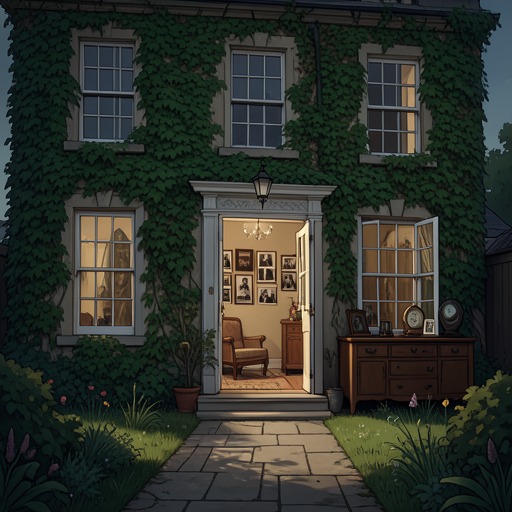
A path beside lilac bushes led to an orangery with glass set in lead frames. Built in 1904, the Green House had more than thirty rooms and six garages in its side wings, but its position in the landscape gave it a natural, settled appearance. Dark-green shutters, ivy covering one side, and eight old chestnut trees behind the house helped make its name feel apt. On summer weekends the family ate beneath those trees. The estate was not simply a grand residence: its park, paths, and outdoor spaces formed the boys’ everyday world.
Childhood at Rossthal
At twelve, Leinen attended the same boarding school as Philipp on Lake Constance and spent time at Rossthal during the holidays. One late-summer afternoon, the boys stayed in the shade of old trees planted by Philipp’s great-grandfather, even as the cook called from the terrace. Between them stood a thermos of cold tea in a faded rattan cover, brought back from Africa by Philipp’s grandfather. The unhurried afternoon, and Leinen’s private anxiety about ever kissing a girl, establish the estate as a sheltered place where childhood seems to proceed at its own pace.
That shelter contrasted with the house Leinen would otherwise have returned to: his father’s cold, dark forester’s home in Bavaria. After his parents’ marriage broke down, Leinen remained with his father there until he left for boarding school at ten. Rossthal offered not only warmth and company but a different kind of adult attention. During Philipp’s extra coaching, Leinen spent alternate afternoons with Hans Meyer, who played chess with him on an old board, sometimes letting him win, and gave him money. Meyer was the only person at Rossthal with time for the children. He taught Leinen and Philipp to build tree houses without nails, find worms for fishing, and cut whistles from birch wood with knives he gave them. The boys imagined using the whistles to defend the family from burglars; in their small world, the central disappointments were that fish did not bite and girls would not kiss them.
The house as a family world
Four years later, Rossthal again frames a childhood holiday, this time at Christmas. Snow had fallen for two weeks, and cleared paths through the park resembled mazes. Leinen and Philipp sat by the tall fireplace in the entrance hall, smoking their grandfather’s cigars and making plans. The family’s three dogs slept on the stone floor, barred from the upper storeys. Philipp wore a yellow dressing gown with a large crest, found in an attic wardrobe. When Johanna arrived from Munich, she entered through a side door and silently signalled to Leinen not to alert her brother before creeping up to cover Philipp’s eyes. The encounter places the house’s rooms and thresholds within the boys’ intimate family rituals, before the estate becomes associated with loss and adult uncertainty.
Return and the failed search
Years later, Leinen and Johanna drove from Munich to Rossthal to examine Hans Meyer’s private papers for clues to Collini’s actions. The drive took about an hour, but the snowbound grounds seemed to belong to another world. At the circular forecourt they parked below the house steps. Frau Pomerenke, Hans Meyer’s last housekeeper, came down unsteadily, embraced Johanna in tears, and welcomed Leinen home. She had lit the fire and left supper for them to warm in the kitchen before withdrawing to her rooms beside the housekeeping office.
Inside, white dust sheets covered furniture and lamps, the shutters were closed, and the grandfather clock in the library continued to tick because someone still wound it every day. In Hans Meyer’s study, a narrow band of light fell between the curtains across the desk where he had read newspapers, ironed first in the kitchen so ink would not mark his hands. The drawers held stationery, pencils, two fountain pens, and a dictating machine with empty cassettes. Nearby, neatly labelled files contained household records, accounts, invitations, and business and private correspondence, ordered by year and alphabetically. The house’s careful arrangement made its contents feel potentially legible, but the papers did not disclose what Leinen and Johanna had come to learn.
Among the chronological photograph albums, Johanna found a file labelled with Leinen’s name. Hans Meyer had kept documents from Leinen’s childhood, including National Youth Games certificates, swimming certificates, and a second-place certificate from a boarding-school downhill skiing championship. Later, he had arranged for his company’s legal department to send him Leinen’s essays and discussions of verdicts published in legal journals. He had preserved these too, sometimes highlighting a sentence or adding a question mark. The collection connects the boy whom Meyer had taught to fish and play chess with the adult lawyer whose work he continued to follow; it also makes the failure of the search more pointed, since such meticulous attention still provides no explanation for Collini’s act.
The return also brings Leinen and Johanna into a conversation about her marriage, which had ended after years of living apart, she in London and her husband in Cambridge. They eat roast beef and warm bread in the kitchen, then move through the empty house: Johanna plays the out-of-tune Blüthner grand piano, and they spend the night in her childhood room. On the following morning they search the attics, cellars, folders, cupboards, and chests without finding an answer. As Leinen leaves, he looks back through the melting frost on his rear-view window and sees Johanna blurred against a white entrance pillar, looking toward the bright winter sky. Rossthal has returned him to places and objects dense with personal memory, but the investigation departs without the explanation it sought.