Second World War
The Collini CaseThe Second World War is the historical frame linking Fabrizio Collini’s childhood in occupied Italy to the later courtroom dispute over Hans Meyer’s wartime actions. In the novel, the war is at once a distant political upheaval that a child only partly understands, a local threat that changes daily life, and a legal and moral problem that postwar institutions fail to resolve cleanly.
Italy in 1943
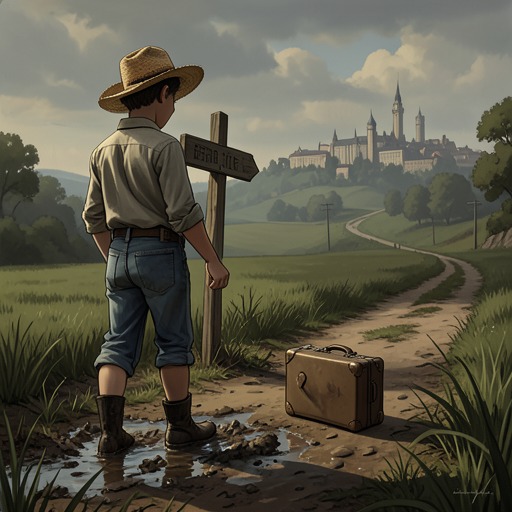
On 14 November 1943, nine-year-old Fabrizio Collini is returning from confirmation class to his father’s farm near Corria. The country has undergone rapid political change: after the Allied landing in Sicily and Benito Mussolini’s removal from power, an armistice took effect between the Allies and the new Italian government. Adolf Hitler then ordered Mussolini’s rescue, and Mussolini became head of the Italian Social Republic, a Fascist government under the German Reich’s protectorate. Fabrizio knows little of these events, but German uniforms have become a familiar presence.
The war reaches the family through loss and secrecy as well as politics. Fabrizio’s two paternal uncles had died in the Italian campaign against Greece; his father grieved and called war madness, a word the boy remembered without fully understanding. His father sometimes put on a grey coat and beret and left the farm at night. Fabrizio’s sister told him that their father was a partisan. Among the children, play had shifted from cops and robbers to partisans and Germans, while adults tried to shield them from whispered reports of partisan activity and attacks. The conflict thus enters the boy’s life not as a history he can explain, but as altered play, anxious departures, and a father whose actions remain partly hidden.
Reprisal shootings
The trial testimony places partisan shootings within a broader wartime practice. Dr Sybille Schwan explains that both German and Allied forces shot civilians as reprisals for attacks on their own troops, partly to deter further attacks by the population. Such shootings were frequent: her account cites 30,000 people shot in France alone and totals reaching hundreds of thousands. The scale makes clear that reprisals were not presented as an isolated feature of Hans Meyer’s case.
The testimony also describes limits that, in some circumstances, could make a reprisal shooting legally permissible. Women and children could not be killed; the killing could not be cruel, and those executed could not first be tortured. Serious efforts had to be made to find and capture the actual perpetrators, and the facts of a reprisal shooting had to be made public afterward. The appropriate ratio between an attack and a reprisal remained controversial. These conditions become crucial in court because the existence of wartime reprisals does not by itself settle whether a particular shooting was lawful.
Meyer’s case and the limits of prosecution
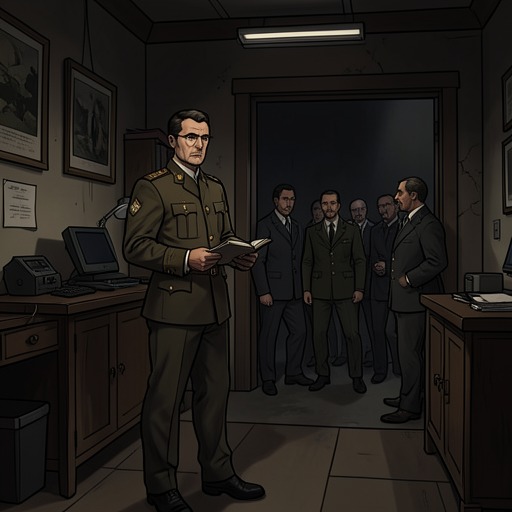
During the trial, Richard Mattinger draws attention to the Stuttgart Public Prosecutor’s Office investigation of Hans Meyer. Although proceedings had been initiated and a file prepared, Meyer had not been questioned, charged, or convicted. Mattinger presents the discontinuation of the proceedings as decisive to his argument that Meyer had met the criteria for a legitimate shooting of hostages. On 7 July 1969, the Stuttgart Public Prosecutor’s Office dropped its investigation. At that point, Mattinger has won the courtroom exchange, and Fabrizio Collini weeps with his head bowed.
Caspar Leinen then establishes what that legal closure meant for Collini. Collini had named the man who had his father shot, laid charges, and supplied the evidence to the authorities. A year later, he received a letter saying the proceedings had been discontinued because the matter was subject to a statute of limitations. The reason was a law that came into force on 1 October 1968. The case therefore joins wartime violence to a later failure of legal accountability: the investigation did not reach a finding on Meyer’s guilt or innocence before it was terminated.
Changing judgments of the past
The novel distinguishes the legal assessments made in the 1950s and 1960s from those that became possible later. Dr Schwan says that the Auschwitz trials of 1963–1965 brought much of the population into contact with the horror of the past, while a broader shift in public attitudes came only toward the end of the 1970s. She identifies the television series Holocaust, watched and discussed by millions each Monday, as part of that change. In her account, judgments about wartime conduct are historically situated rather than constant.
That shift matters when Schwan considers the partisans’ execution on Meyer’s orders. They were taken for hours to the execution site, were not blindfolded, and could see those who had already been shot and hear their comrades being killed. They were shot where they would fall into a pit. Schwan contrasts her view of what courts of the period would have considered cruel with the judgment she believes the Federal Supreme Court would reach later: Meyer would be regarded as an accessory to murder. The contrast does not erase the earlier termination of the investigation; it reveals the distance between procedural closure and a later legal assessment.
The war’s aftermath also reaches beyond the trial. In January 2012, a few months after the novel’s original German publication, the Federal Minister of Justice appointed a committee to reassess the Ministry of Justice’s legacy from the Nazi past, and the novel was one of its points of reference. The Second World War therefore remains present not only in the remembered events of 1943, but in continuing scrutiny of how postwar law and public institutions dealt with them.