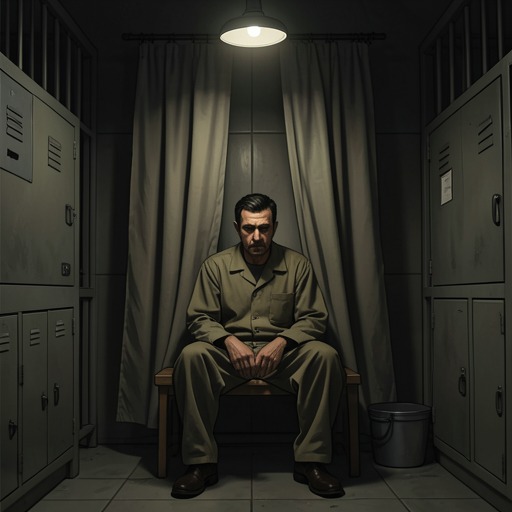
Silence and refusal to explain
The Collini CaseSilence and refusal to explain are central to the defense of Fabrizio Collini: he admits to killing Hans Meyer, yet withholds the reason, leaving his lawyer and the court to work with an act whose motive remains undisclosed. His silence is not absolute. Rather, it separates acknowledgment of responsibility from explanation, and turns the timing of speech into a force that shapes the trial. For months, the question of why Collini acted remains open; when he finally answers, the explanation alters how the courtroom understands his delay.
Admission Without Explanation
At their first meeting, Caspar Leinen introduces himself as a lawyer. Collini says he does not need one and does not want to be defended. He nevertheless tells Leinen that he killed the man. When Leinen asks whether he has already told the police, Collini says no. Leinen advises him to keep silent for the moment, until he has learned more about the case file. The exchange establishes a distinction that persists throughout their relationship: Collini acknowledges the deed to his lawyer, but does not offer an account that could explain or contextualize it.
That distinction becomes explicit when Leinen later asks why he killed Hans Meyer. Collini points to his own hands as the means by which he acted, but refuses to discuss why. For Leinen, the refusal presents a practical problem as well as a personal one. He tells Collini that he cannot defend him by giving the court no explanation. Collini’s silence therefore leaves Leinen without the motive that might make the case intelligible, even as the admission narrows what is in dispute.
Silence as a Continuing Practice
During the months after Collini’s arrest, Leinen visits him in remand prison once a week. Collini makes no requests or complaints and remains calm and courteous, but does not answer questions about his motive. Leinen repeatedly explains that this makes it impossible to construct a sensible defense. At times Collini remains mute; at others, he says that nothing can change what has happened. The pattern is sustained rather than momentary: regular access gives Leinen repeated opportunities to ask, but not the answer he needs.
The trial begins with the court explaining Collini’s right to remain silent. When the presiding judge asks whether he wishes to make a statement, Leinen tells the court that Collini does not want to speak at that time. Asked whether he might speak later, Leinen says they have not decided. The carefully provisional wording keeps that possibility open without promising a change. It also makes silence part of the trial’s public procedure: the court records that Collini has been informed of his rights, while the defense leaves the timing of any statement unresolved.
The Courtroom’s Competing Accounts
During the first five days, witnesses and experts present evidence about the crime. Richard Mattinger’s questioning of Professor Wagenstett gives the court a detailed account of the forensic evidence, presented in accessible language. In the absence of an explanation from Collini, this account exerts considerable influence: the events appear to describe a brutal, apparently senseless killing, and newspaper coverage characterizes Collini as possibly insane. The silence does not erase the evidence; it leaves the evidence without Collini’s account of why he acted.
Leinen’s first major plea offers a different kind of account. He reads slowly from what he has heard from Collini and found in the Ludwigsburg files, using the restrained language of law. The account brings people, places, and landscapes into the courtroom, and Leinen recognizes that criminal proceedings concern abused human beings as well as legal charges. Yet the plea does not amount to a full explanation spoken by Collini himself. His withheld motive remains a gap between the material Leinen can present and the answer the court still lacks.
The Explanation and Its Effect
The silence breaks when Mattinger asks why Collini waited so long before killing Hans Meyer. Leinen is preparing to say that Collini will answer in writing, but Collini rises and asks to handle the matter himself. He explains that his aunt, Giulia, died on 1 May 2001. She had found it difficult to bear that he had gone to Germany to find work; Collini says that the thought of him imprisoned there would have killed her. He waited until after her death before killing Meyer, and presents that as the whole story. He then sits down carefully, and the court is adjourned.
The disclosure gives the delay a concrete personal circumstance: Collini says he postponed the killing until his aunt could no longer be distressed by his imprisonment. It does not undo his admission or remove the fact of the killing. Instead, it changes the question before the court from whether he acted to how his motive bears on guilt. The presiding judge later allows Leinen to question Dr Sybille Schwan about Collini’s earlier complaint against Hans Meyer, ruling that the matter concerns motive and could affect the determination of guilt. Collini’s eventual speech thus opens a line of inquiry that his prolonged refusal had kept out of view.
Narrative and Legal Significance
The pattern of speech and silence governs what can be known, and when. Collini offers the bare admission early, withholds motive during repeated prison visits, remains silent when the trial formally begins, and speaks only when Mattinger’s question makes the waiting itself a subject of examination. Each stage changes the available account without changing the underlying act. Leinen must first defend someone who will not explain himself; later, he can place Collini’s stated reason alongside the documentary and expert evidence.
The trial also distinguishes legal procedure from the human meaning of testimony. Collini is informed of his right to remain silent, while Leinen’s difficulty is that a formally protected refusal leaves the defense unable to explain motive in the way he believes the case requires. Once the court considers whether historical and documentary questions bear on guilt, silence gives way not to a simple exoneration but to a wider inquiry. The concept’s significance lies in that tension: refusing to explain protects the boundary around what Collini will say, yet it also shapes how others describe him, how Leinen can represent him, and which questions the court eventually permits.