Suspension of the Investigation into Hans Meyer
The Collini CaseThe Suspension of the Investigation into Hans Meyer is the 1969 termination of proceedings that began after Fabrizio Collini accused Meyer of responsibility for his father’s death. Its decisive significance emerges during the trial of Collini: the case against Meyer was not resolved through a finding on the evidence, but discontinued because the statute of limitations had come into force. When that history reaches the courtroom, it changes the meaning of Collini’s silence and makes the handling of past crimes part of the question of his motive.
Background and Opening of the Investigation
The investigation took place in 1968–1969 and was conducted by the Stuttgart Public Prosecutor’s Office. During Collini’s trial, Dr Sybille Schwan confirms that this office investigated Hans Meyer, but also that Meyer was neither questioned nor found guilty. The proceedings generated an investigation and a file, yet did not advance to an examination of Meyer’s guilt or innocence.
The timing matters. The proceedings were discontinued after a law that came into force on 1 October 1968 made Meyer’s alleged conduct subject to the statute of limitations. Schwan identifies that legal change as the reason the investigation ended. The decision therefore did not establish that Collini’s accusation was false; equally, the trial evidence does not establish that Meyer was guilty. The distinction between an untested accusation and a conclusion reached after investigation becomes central to the courtroom dispute.
Discontinuation and Notice to Collini
The Stuttgart Public Prosecutor’s Office discontinued the investigation on 7 July 1969. Collini received notice of the decision on 21 July. Leinen draws attention to the interval and to the form of what Collini received: a single sheet informing him that the proceedings had ended because the conduct was now subject to a limitation period. Collini had named the man he believed responsible for his father’s death, set out the evidence, and turned to the authorities. The result was not a decision on the substance of that accusation but an administrative and legal termination.
The consequences are specific. Meyer was not tried or convicted, and, as Schwan confirms, was not even questioned. At the same time, the statute’s operation meant that the investigation could not simply resume later to reach a judgment on the allegation. When Leinen asks whether the limitation ruling could be repealed, Schwan explains that a basic principle of a constitutional state governed by the rule of law bars reversing a limitation period once a criminal offence has become time-barred. The legal protection of finality thus forecloses a later inquiry, even as the absence of an inquiry leaves the historical accusation unresolved in court.
Disclosure at Collini’s Trial
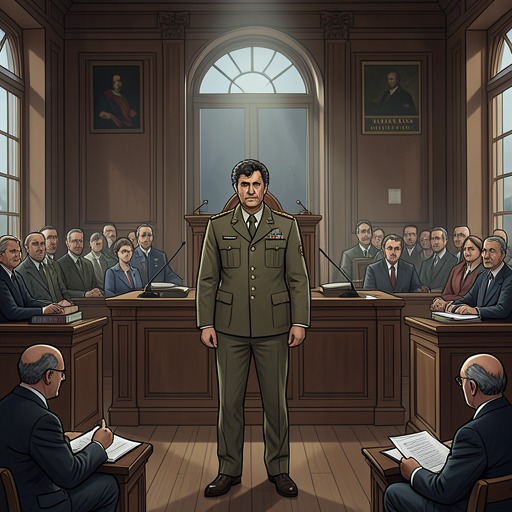
The old investigation is disclosed in a trial that has so far given the prosecution a commanding narrative. Richard Mattinger has led the questioning of the forensic pathologist, using clear language and detailed evidence to shape the judges’ and courtroom audience’s understanding of Collini’s crime. The presiding judge has noted that no motive has been found despite lengthy investigations. With the trial apparently settling into routine, the case against Collini risks being understood without the history that explains why Meyer’s name matters to him.
During Dr Sybille Schwan’s testimony, Mattinger establishes that the Stuttgart office opened proceedings against Meyer, that Meyer was never questioned, and that the investigation was discontinued. He presents the discontinuation as closing the matter and argues that the Bundestag of the time intended Nazi crimes to become subject to limitation. Leinen then asks who initiated the accusation. Schwan identifies Collini. That disclosure changes the courtroom’s understanding: those present had not known that Collini himself had reported Meyer to the authorities. Leinen also establishes that Collini was notified of the termination after it had been decided.
Mattinger objects that the history is irrelevant to a criminal trial of Collini. Leinen does not dispute that Collini killed a man; he argues that the background bears on whether the act was arbitrary or understandable. The presiding judge allows the inquiry because the defendant’s motive may affect the question of guilt. The exchange shifts the proceedings from the act alone to the institutional history that preceded it, without treating that history as proof that Collini’s killing was justified.
Meaning and Afterlife
For a moment, Mattinger’s presentation makes the discontinued case appear to settle Meyer’s standing: he tells the court that Meyer is no longer a murderer. But that rhetorical conclusion exceeds what the investigation established. The office had not questioned Meyer, and the proceedings ended because of the limitation period, not because an inquiry found him innocent. Leinen’s intervention exposes the difference between procedural closure and a factual judgment, while keeping Collini’s own criminal responsibility in view.
The disclosure also gives Collini’s earlier refusal to speak a different context. He had declined to comment on the charge, but the trial now reveals a prior act of turning to the law: he filed the complaint and trusted the authorities with the accusation. After the testimony, Collini tells Leinen that he does not think they have won and reflects on the difference between the living and the dead. His response does not undo the termination or resolve Meyer’s guilt; it underscores that a courtroom disclosure is not the same as justice for those implicated in the past.
The novel’s concern with the decision extends beyond the trial. In January 2012, a few months after its original German publication, the Federal Minister of Justice appointed a committee to reassess the Nazi-era legacy of the Ministry of Justice, and the novel became one of the committee’s points of reference. The investigation’s termination therefore resonates both as a personal history revealed in court and as part of a later public examination of how legal institutions dealt with the Nazi past.