
Migration, Dispossession, and Diaspora
The Color PurpleThis thread connects the family's movement across the United States and Africa with histories of forced separation, colonial displacement, and the search for home.
increasing Bearing strength in each event
 decreasing
Bearing strength in each eventdecreasingA Family Broken by Violence

A Family Broken by Violence
Racial Terror
Celie's biological father and his brothers are killed after their business threatens white commercial interests. The family loses a provider, a home, and a secure place in its community.
The attack contributes to the confusion and concealment that shape Celie's childhood.
Separation Across Generations
Celie's children are taken from her, and Nettie later leaves home. The family's movements arise from violence and survival rather than free choice.
The story links private separation to larger histories that push Black families away from safety and ownership.
Nettie's Atlantic Passage

Nettie's Atlantic Passage
Crossing the Ocean
Nettie travels through England and West Africa before reaching her mission. She reflects on the routes that connect the continent, the Americas, and the history of slavery.
The journey is both a personal departure and a return toward a place her ancestors were forced to leave.
Complicated Belonging
Nettie encounters Africans who do not necessarily recognize her as kin or understand the American experience of enslavement. Her expectations of immediate belonging are challenged.
Diaspora is shown as connection shaped by distance, memory, and unequal histories.
Olinka Land Taken
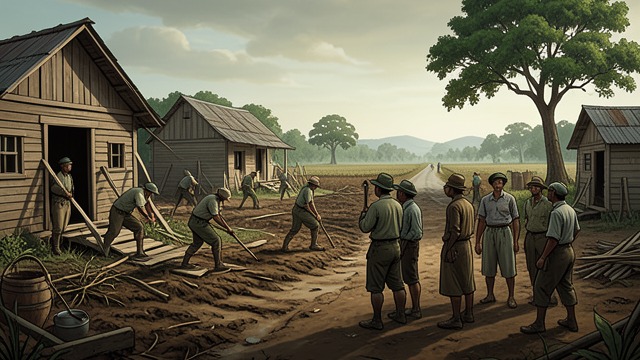
Olinka Land Taken
Forced Change
Colonial builders destroy Olinka homes and fields to make way for a road and rubber plantation. The people are displaced from land their community has occupied for generations.
Their new settlement makes them dependent on purchased water and plantation-controlled work.
Displacement Without Consent
The villagers' relocation is described as development by those who control the land, but experienced as loss by those who live there. Some join the Mbeles rather than accept the new order.
The conflict extends the novel's concern with property, autonomy, and who has the power to name a place as home.
A Home Built in Memphis
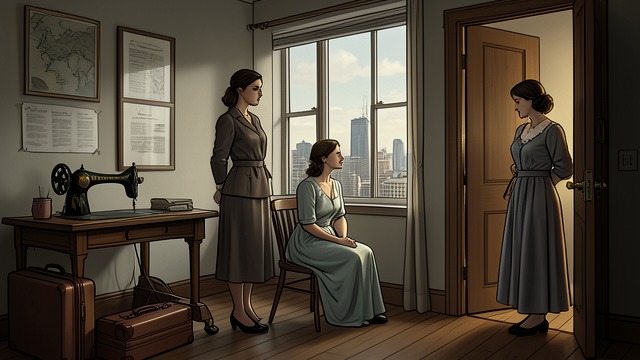
A Home Built in Memphis
Moving by Choice
Celie leaves the farm and goes to Memphis with Shug. Unlike the displacements imposed on her family, this move is chosen as a route away from abuse.
In Memphis, she finds space to work, make clothes, and imagine a home of her own.
A New Center
The inherited house later gives Celie a place to prepare for Nettie's return. Home becomes not merely a location but a resource she can offer to others.
The contrast between forced separation and chosen movement reveals how agency changes the meaning of migration.
Return Across the Ocean

Return Across the Ocean
A Family Comes Back
Nettie and her family return to the United States after years in Africa. Their movement brings together American and African experiences within one household.
The family carries grief, new knowledge, and relationships formed far from Celie.
Home as Reunion
Celie's home receives people separated by violence, secrecy, migration, and colonial rule. Their gathering does not undo the past, but gives them a place to continue together.
The return makes home a shared achievement rather than a fixed inheritance alone.
Before Celie and Nettie understand their parentage
During Nettie's voyage from England to Africa
When the plantation road reaches the village
After Celie moves north with Shug
At Nettie's arrival near the ending
