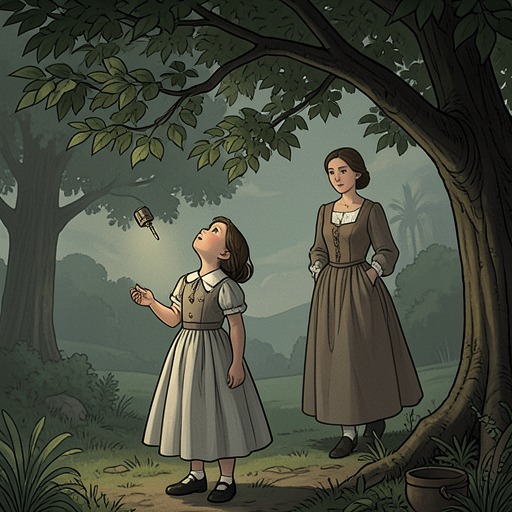
“Dear God. Dear stars, dear trees, dear sky, dear peoples. Dear everything.”
The Color PurpleCelie’s closing salutation, “Dear God. Dear stars, dear trees, dear sky, dear peoples. Dear everything.”, distills the novel’s movement from spiritual estrangement toward an expansive, immanent understanding of God. Its widening address joins the divine to the natural world and human community, making gratitude itself a form of attention.
From religious silence to a new address
The expression answers an earlier break in Celie’s religious practice. Writing to Nettie, she declares, “I don’t write to God no more. I write to you.” The change redirects her words toward the sister from whom she has been separated, making the letter a means of sustaining connection where prayer has ceased to feel possible. Shug Avery’s question about what happened to God opens that silence to discussion rather than treating it as a settled loss.
That crisis takes shape against the church’s public language about Shug Avery. When the preacher turns Shug’s illness into a sermon condemning her, Celie recognizes the attack, while Albert remains silent. The contrast places institutional judgment beside the more intimate process through which Celie later reconsiders what God might mean. The final expression does not repeat the preacher’s terms of condemnation; it replaces a narrow religious authority with an address capacious enough to include people and the world around them.
Shug Avery’s theology of an indwelling God
Shug Avery describes God as present within Celie and within everyone, something people may discover by searching inwardly or encounter through trouble and sorrow. She rejects the idea that God is necessarily male, calling God “It.” Her account shifts spiritual understanding away from a distant authority and toward an inward presence available within ordinary human lives.
This theology also makes attention to beauty spiritually consequential. Shug Avery says that God loves what a person loves, and especially values admiration—not vanity, but the sharing of what is good. Her example of passing a purple field without noticing it turns perception into an ethical and spiritual act: the world offers beauty, and people answer by recognizing it. Celie’s final address to stars, trees, sky, and people gives this idea a compact, memorable form.
The closing salutation and its significance
The final address appears after Celie gives thanks for Nettie and the children coming home. Its sequence moves from God outward through the natural world and human beings, then gathers them into the encompassing phrase “Dear everything.” Rather than separating the sacred from the ordinary, the expression makes the entire field of life worthy of address.
Its placement also brings spiritual renewal into the novel’s domestic ending. Celie sits on the porch with Shug Avery and Albert; conversation, quiet, and plans for a family reunion accompany her gratitude. The salutation therefore joins belief to restored relationships and shared life without reducing divinity to any single person or institution. The words complete the movement begun when Celie redirected her letters to Nettie: connection, attention, and love have become ways of addressing the sacred.