Adam
The Color PurpleAdam is Celie’s son, but he grows up far from her, cherished and educated in the household of Corrine and Samuel in Africa. His story turns on the distance between biological kinship and lived family: separated from his mother as an infant, he becomes Samuel and Corrine’s child and Nettie’s close responsibility, then returns with them to meet Celie after decades apart.
Identity and Parentage
Adam’s origins reach Celie through Nettie’s letters and Samuel’s account rather than through any memory of his own. Samuel tells of a widow whose health and circumstances deteriorate after she remarries; two years before her death, she has a baby girl she is too ill to keep, and then a baby boy. The children are Olivia and Adam. Samuel recognizes the story as that of a woman he once knew, and explains that the man who brought the children to him was an old companion from before Samuel found Christ. Unable to refuse the children, Samuel feels that their arrival answers his and Corrine’s prayers.
Nettie makes the concealed family connection explicit to Celie: Olivia and Adam are Celie’s children, and Nettie is their aunt. Their parentage changes the meaning of the family Samuel and Corrine have built. The couple had longed for children; Adam and Olivia are raised as theirs, while Nettie, who comes to Africa to help them, sees herself as their aunt and protector. The story does not present these bonds as mutually exclusive: Adam belongs to the family that raises him and to the sisterhood and motherhood that Celie has been denied the chance to share with him.
Childhood and Education in Africa
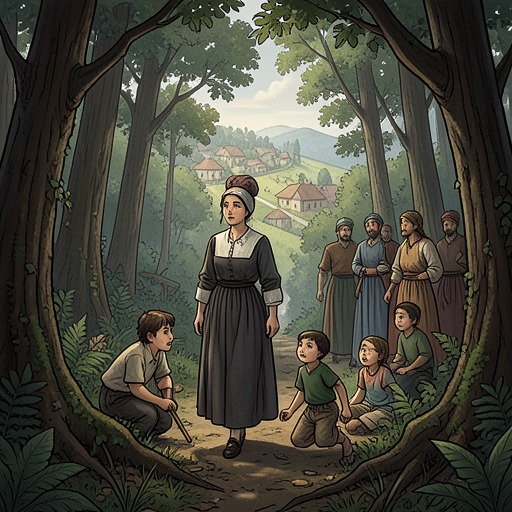
Adam grows up with Olivia in the household of Corrine and Samuel, who are described as religious and generous toward Nettie. Their home stands beside the church where Samuel preaches, and the children are brought up with Christian teaching and affection. Nettie says they are being raised in love, charity, and awareness of God, and regards watching over and cherishing them as part of the purpose she has found in Africa.
After five years in Olinka Village, Adam and Olivia are nearly as tall as Nettie and doing well in their studies. Adam has a particular aptitude for figures. Samuel worries that he may soon have nothing left to teach him in that subject, having used up his own knowledge. The detail gives Adam an individual presence within the family story: he is not only the child whose identity is disclosed, but a student whose ability is already testing the limits of his teacher’s instruction.
The children also thrive in village life. They enjoy the open surroundings and living in huts, and are fascinated by the men’s hunting skills and the women’s ability to raise crops. At home, they study maps with Nettie and roast groundnuts on her stove. Later, the children rehearse Shakespeare plays; Adam is particularly good as Hamlet, performing the “To be or Not to Be” soliloquy. His education thus joins formal study to shared domestic and cultural life, rather than being confined to lessons at the mission.
Family Bonds and Separation
Nettie describes the children as a source of comfort during periods when she feels deeply low: a hug from Adam or Olivia restores her ability to function. Her relation to them changes from helper to something increasingly like an aunt’s, even as Corrine and Nettie grow less close than they once were. The children still visit Nettie’s hut and sometimes spend the night there when their parents want time alone. These everyday acts of companionship give substance to Nettie’s role in their lives.
Adam and Olivia also form a close attachment to Tashi. When Tashi leaves to join the Mbeles, both children are heartbroken because they love her and miss her; they also know that nobody who has gone to join the group has returned. Their grief unfolds amid a larger crisis in Olinka Village. Rubber planters have replaced the yam crop with canned and powdered foods, and the resulting loss of yams leaves people more vulnerable to malaria and chronic blood disease. Nettie fears for the children’s health, though Samuel believes they will probably be all right because they have already endured bouts of malaria. The letters place Adam’s childhood affection and security alongside the dangers reshaping the community around him.
Return and Narrative Significance
As Nettie and Samuel prepare to return to the United States, Adam and Olivia ask endless questions about Celie, and Nettie admits that she can answer few of them. Nearly thirty years have passed without a word between the sisters. Adam’s return therefore carries more than the arrival of a long-raised child: it brings Celie into contact with a son whose life has been formed elsewhere and whose place in the family has been kept from her.
At the reunion, Nettie introduces Samuel, Olivia, Adam, and Tashi to Celie, identifying Tashi as Adam’s wife. The meeting brings the separated family into one scene, but does not erase the years of distance that preceded it. Adam’s presence makes visible the novel’s distinction between biological descent and the daily work of kinship: Celie is his mother, Corrine and Samuel have raised him, Nettie has loved and cared for him as his aunt, and Tashi is his wife. His return joins these relationships without reducing them to a single version of family.