Birds
The Color PurpleBirds in The Color Purple are observed as living presences whose song belongs to the landscape, not simply as decoration for human scenes. They recur in Celie’s attention to the created world and in Albert’s recollection of her early vulnerability, linking independent natural activity with changing human ways of seeing and caring.
Appearance and Setting
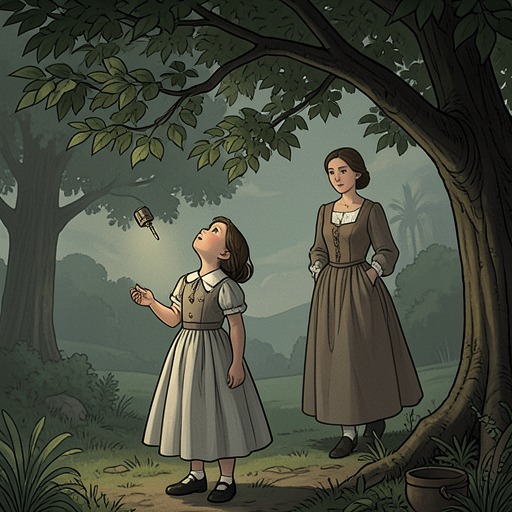
At the house Celie and Shug Avery visit, flowering trees surround the building and extend behind it. Celie guesses that the trees look like peach, plum, apple, or cherry, while lilies, jonquils, and roses grow over the grounds. Birds from across the county perch in the trees and sing with energetic abandon. Their presence fills a seemingly unoccupied place with sound and movement; when Celie guesses that nobody is home, Shug Avery suggests that the residents may be at church on a bright Sunday.
The birds are not identified by species, and the scene gives them no individual names or actions beyond perching and singing. Instead, their abundance matters: they belong to the flowering landscape as a lively collective presence. The human visitors look and listen, but the birds’ activity is not presented as something that begins for their benefit.
Song and the Journey Away
The birds’ song continues as Celie and Shug Avery leave the house, sounding as sweet as it did when they arrived. The change comes after they turn back onto the main road: the singing stops, and by the time they reach the cemetery the sky has turned gray. The narrative places the birds’ music between the garden’s profusion and the cemetery’s search for Celie’s parents, giving the movement away from the house a distinct sonic and emotional passage.
At the cemetery, Celie and Shug Avery find weeds, cockleburrs, and fading paper flowers rather than a marker for Celie’s mother and father. The contrast is between the richly flowering grounds where the birds sang and the neglected graves they encounter afterward. The text does not explain the birds’ silence as a reaction to the travelers or assign them a human intention; its force comes from sequence. Their song remains audible through the departure, then falls away as the scene moves toward loss and uncertainty.
Attention to the Natural World
Birds belong to a larger change in Celie’s attention. In conversation with Shug Avery about God, Celie reflects that she had been so occupied with the image of an old white man that she failed to notice what was made around her: a blade of corn, the color purple, and wildflowers. This moment does not name birds specifically, but it places the natural world in the foreground of the spiritual reconsideration that the bird scenes help make tangible. The flowering trees and their noisy visitors offer particular instances of the living creation Celie is beginning to see.
That shift changes the scale of what can command attention. The birds’ song is neither an argument nor an explanation of God; it is an ordinary, perceptible part of a world Celie had overlooked. Alongside flowers, trees, and color, birds help give substance to the idea that spiritual awareness may begin in noticing what is already present. Their place in the novel therefore connects observation of nature with Celie’s effort to look beyond the damaging human image of divinity that has occupied her thoughts.
Celie as a Bird in Albert’s Memory
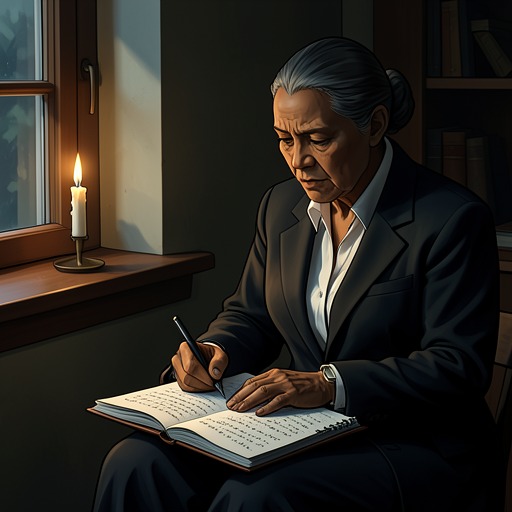
Much later, when Albert asks whether Celie has a favorite thing, she answers that she loves birds. He tells her that, when she first came to live with him, she reminded him of one: she was so thin and seemed ready to fly away whenever anything happened. Celie asks whether he noticed, and Albert admits that he did, but was too much of a fool to let himself care.
The recollection gives the bird image a sharply personal meaning. Earlier, birds are visible and audible in a landscape flourishing around a house; in Albert’s memory, the comparison registers Celie’s precariousness in the period when she entered his household. The bird is not simply a symbol of freedom here: the image also conveys how easily she seemed to startle and escape. Albert’s admission distinguishes seeing from caring. He had recognized her fear but failed to respond to it, and his words make that failure explicit without erasing the harm it implies.
Across these scenes, Birds connect the sensory richness of the natural world with the limits and possibilities of human attention. Their song accompanies a movement from abundant gardens toward neglected graves; their image later gives Albert a way to name what he once saw in Celie and failed to protect. The bird motif thus carries both delight in living creation and a measure of remembered vulnerability, while remaining rooted in concrete acts of singing, perching, noticing, and recollecting.