Catherine
The Color PurpleCatherine is Tashi’s mother in Olinka Village, where she is first shown confronting her daughter’s growing independence and later supporting her education. After her husband dies, Catherine becomes closer to Tashi, refuses to marry again, and eventually leaves with her daughter to join the Mbeles. Her story links maternal care to women’s work and mutual support, while showing how family life is transformed by gendered expectations and colonial pressure.
Family Life and Tashi’s Friendship with Olivia
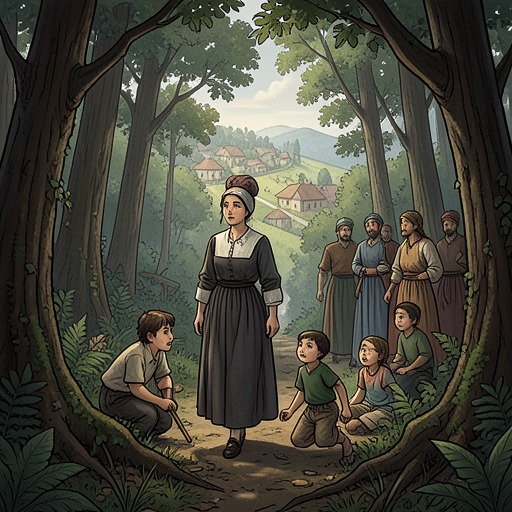
Catherine and Tashi’s father worry that Tashi spends too much time with Olivia. They describe her as becoming quiet and thoughtful, as if she is becoming someone else. Their fear draws on a family precedent: an aunt was sold to a trader after refusing the marriage chosen for her and refusing to bow to the chief. The comparison casts Tashi’s friendship not as a trivial distraction but as a possible departure from the role expected of a girl in the village.
When Nettie asks whether Tashi is lazy at home, Catherine answers that the opposite is true. Tashi works harder than most girls her age and finishes quickly, chiefly so she can spend her afternoons with Olivia. Catherine also observes that Tashi learns everything her mother teaches her as though she already knows it, yet the knowledge does not enter her soul. Her account registers both Tashi’s ability and her unease about what that ability means. The father is angry and the mother puzzled and afraid, but Catherine’s description makes clear that Tashi’s attachment to Olivia does not keep her from her work.
Widowhood, Work, and Women’s Solidarity
Catherine’s husband dies of malaria during the rainy season. He refuses the medicine used to treat it and will not let Samuel visit him; nothing the healer prepares saves him. His death brings Catherine and Tashi closer. Tashi is heartbroken, having spent her young life trying to please her father without understanding that, as a girl, she could never fully do so.
The funeral is Catherine’s first Olinka funeral as described by Nettie. Women paint their faces white, wear white garments like shrouds, and keen as they mourn. They wrap the body in barkcloth and bury it beneath a large tree in the forest. Catherine remains in mourning and keeps close to her hut, but grief does not end her involvement in the life around her. Nettie says Catherine comes to feel like one of their group, including Nettie, the children, and sometimes Samuel.
Catherine says she will not marry again because she already has five sons and can now do what she wants; Nettie describes her in this position as an honorary man. The phrase identifies the unusual latitude Catherine gains through motherhood without suggesting that the ordinary constraints on women have disappeared. Catherine is also the most industrious of her husband’s widows. Her fields are praised for being clean, productive, and attractive, and Nettie considers helping her with the work. Work is not merely an obligation here: it is a way women come to know and care for one another. Catherine’s friendship with her husband’s other wives grew through working together, extending the solidarity that Nettie sees among the women around her.
Supporting Tashi’s Education and Independence
After her husband’s death, Catherine makes clear that Tashi must continue learning. This support gives practical force to the earlier account of her daughter’s education: Catherine had worried about Tashi’s absorption in her friendship with Olivia, but she does not respond to her husband’s death by withdrawing the permission to learn. Instead, she states that Tashi’s education should continue, even as Tashi’s choices move beyond the expectations that had unsettled her parents.
Catherine’s own circumstances place that decision within a gender hierarchy in which women’s lives and choices are constrained. Her refusal to remarry is possible because she has five sons, and the description of her as an honorary man makes the exceptional basis of that freedom visible. Her support for Tashi’s learning, by contrast, is a direct commitment to her daughter’s continued development. The narrative does not present Catherine as simply free of the customs around her: she works within them, gains a particular standing as a mother of sons, and nevertheless insists that Tashi keep learning.
Flight to the Mbeles
After Nettie and Samuel return from an unsuccessful appeal to the church and the Missionary Society, the grown children search for Tashi and find no sign of her. Catherine is said to be planting rubber trees at some distance from the compound, but no one has seen Tashi that day. After two days, the family learns that Tashi has deliberately hidden herself and undergone both facial scarification and the women’s initiation rite. The news deeply affects Adam and Olivia, who had hoped to find her.
Later, Nettie reports that Catherine and Tashi have run away to join the Mbeles. The people at the compound do not know whether the Mbeles exist with certainty; they are said to live deep in the forest, shelter runaways, and act against white plantations in pursuit of removing white rule from the continent. Catherine’s departure is therefore reported within uncertainty, but the choice to go with Tashi is clear. She does not leave her daughter to face the consequences of her decision alone.
Adam and Olivia are heartbroken by the absence, and Nettie says that no one who has joined the Mbeles has returned. After two and a half months, Adam finds Tashi, Catherine, and others from the compound near the village where a white woman missionary had lived. Tashi will not turn back, and Catherine will not either; Adam accompanies them to the Mbeles encampment. The account confirms Catherine’s presence on the journey and at the encampment, but does not separately establish what happens to her afterward. Her trajectory nevertheless closes on a consequential shift: the mother who once feared that Tashi was becoming someone else ultimately travels with her into an uncertain life beyond the compound.