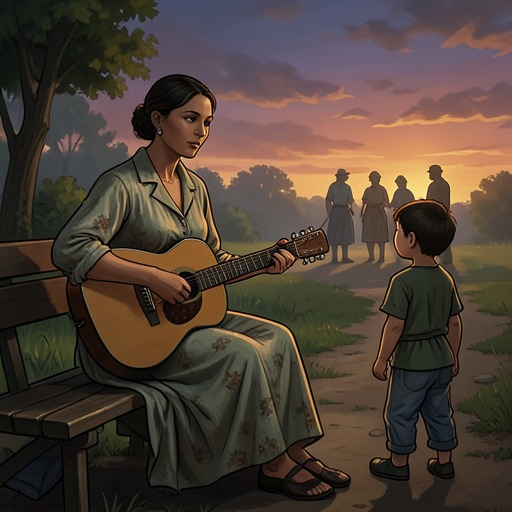
Celie cares for Shug after she falls ill
The Color PurpleCelie cares for Shug after she falls ill in an episode that reverses the distance between the women: the singer whom the town rejects arrives dependent on care, and Celie finds herself drawn to her through the intimate work of washing and grooming her. The illness exposes the cruelty of public judgment, while private gestures—trembling hands, a comb through Shug’s hair, her weight leaning against Celie’s knees—begin to make care a form of attachment.
Illness and Public Condemnation
Shug’s illness is introduced through rumor rather than a clear diagnosis. Celie hears women at church suggest that Shug is dying, perhaps of tuberculosis or a disease they call shameful, but she does not ask them to explain. The uncertainty matters: the town treats Shug’s sickness less as a reason to help her than as an occasion to repeat its suspicions about her character.
The women’s judgments are sharpened by the preacher’s sermon. He does not name Shug, yet his descriptions of a woman who wears short skirts, smokes, drinks gin, sings for money, and takes other women’s men make his target unmistakable. The sermon turns her illness into public evidence against her. The congregation answers against Shug, and Albert, sitting nearby, does not defend her. Celie notices his silence and the women smiling toward him; the contrast places Shug’s isolation beside the church’s approval of respectable male presence.
Albert Brings Shug Home
After the sermon, Albert returns home and calls Harpo over to hitch up the wagon. He asks Harpo to help him get Shug into the house. The action cuts against the town’s refusal to take her in: Albert does not leave her outside the household, although the scene does not erase his earlier silence or establish a simple change in his character. Shug and Albert have had three children together, but he is squeamish about bathing her. His willingness to bring her home and his discomfort with tending her body coexist.
Celie’s first view of Shug is charged with anticipation. She recognizes a foot before Shug climbs down between Albert and Harpo, dressed in a red wool dress, black beads, a glossy black hat with feathers, and a small snakeskin bag matched to her shoes. The vivid clothing makes the arrival emphatically unlike a passive image of illness: Shug is weak, but she comes into the house dressed with force and style.
Under her powder, Shug’s face is dark, with a long pointed nose, full lips, and large, feverish eyes. She looks Celie over and laughs before calling her ugly. The insult is a sharp first exchange, not a softened bedside welcome. Celie’s attention holds both facts at once: Shug is gravely sick, and she remains formidable enough to meet the people around her with hostility and a cutting assessment.
Washing and the Intimacy of Care
The turning point comes when Celie bathes Shug. Albert cannot bring himself to do it, and Celie is left alone with the physical closeness the task requires. Seeing Shug’s naked body gives Celie an unfamiliar intensity; she describes her hands as trembling and her breath as short. Washing is practical care, yet its bodily immediacy makes it feel to her like prayer. The scene joins vulnerability to desire without making either disappear: Shug is frail, but her sharp manner and deliberate self-possession persist.
Shug tests the situation rather than treating Celie’s attention as invisible. She asks whether Celie has ever seen a naked woman; Celie answers that she has seen Sofia, whom she experiences as a sister. Shug invites Celie to look, even while acknowledging how ill and thin she has become, and poses with a hand on her hip. Celie’s response is not merely dutiful service. The bath becomes one of their earliest intimate encounters, framed by Shug’s taunting confidence and Celie’s bodily astonishment.
Grooming, Recognition, and the Aftermath
As Shug gains enough strength to sit up in bed, Celie washes and combs her hair. She describes it as unusually short and tightly curled and says she loves every strand. She keeps the hair that comes out in the comb, imagining that one day she might use a net to make a hairpiece and give her own hair more height. The small act of saving what the comb removes extends the care beyond the immediate task: Celie attends closely to Shug’s body and carries away a tangible remnant of that attention.
Celie combs and pats Shug as she might tend a doll, Olivia, or her own mother. At first Shug urges her to finish; then she relaxes and leans back against Celie’s knees. She associates the comfort of the gesture with being cared for by her mother or perhaps her grandmother. The scene gives their closeness a tender, maternal register without reducing it to that alone: Celie’s earlier desire remains part of the encounter, now joined by reciprocal ease and physical trust.
While Celie tends her hair, Shug reaches for another cigarette and hums a tune she has made up. She tells Celie that Celie helped draw it out of her. The moment links grooming to a new form of exchange: Celie is not only the person who cleans and comforts Shug but also someone whose presence can contribute to what Shug creates. The episode does not resolve their relationship, but it changes its terms. A woman condemned and abandoned in public is received into care at home, and the work of caring gives Celie a closeness neither sermon nor rumor could define.