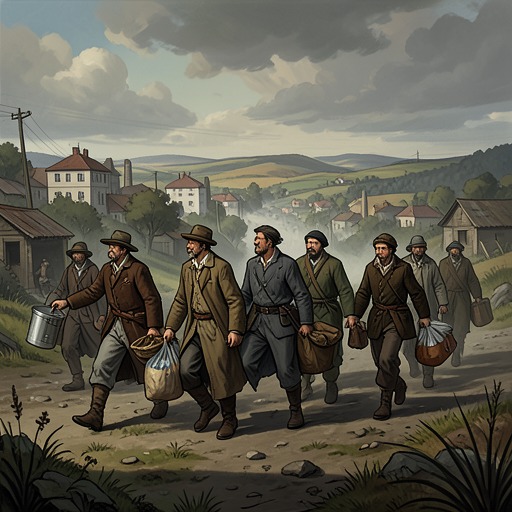
Celie's biological father and his brothers are lynched
The Color PurpleThe lynching of Celie's biological father and his two brothers destroys a prosperous Black family and exposes the deadly force used to defend white economic dominance. Recounted by Nettie through Samuel's story, the event connects racial violence in the American South to the novel's wider attention to land, labor, and dispossession.
The lynching and its economic cause
Samuel's account begins with a well-to-do farmer who owns property near town and prospers both at farming and in business. He opens a dry-goods store, persuades two brothers to help run it, and establishes a blacksmith shop behind the store. The enterprise draws Black customers away from white merchants, while the smithy also takes some white customers; the merchants complain that this competition cannot be allowed to continue. One night, the store is burned, the blacksmith shop is destroyed, and the farmer and his brothers are dragged from their homes and hanged. The attack converts commercial rivalry into racial terror: their success is answered not by fair competition but by the destruction of their property and lives.
The widow and the children left behind
The violence continued after the hanging through its effects on the farmer’s wife. When neighbors brought her husband’s mutilated, burned body home, the shock nearly killed her; she gave birth to their second daughter at that time. Although her body recovered, her mind did not. She continued setting out her husband’s plate and speaking of the plans they had made together, while neighbors increasingly shunned her. They found those ambitions difficult to imagine for Black people and pitied her attachment to a past that could not return.
The widow still owned land, but she did not know how to farm it, and she kept waiting for her husband to finish his meal and go to the fields. With no one to work the property, she and her young children came to depend on food brought by neighbors and whatever they could find in the yard. The family’s loss thus reached beyond the deaths of the three men: the attack left the widow unable to sustain the household or make use of the land.
While the second daughter was still an infant, a stranger arrived and lavished attention on the widow and her children; they soon married. She became pregnant almost immediately, but her mental health did not improve. In the years that followed, repeated pregnancies weakened her and intensified her instability. Two years before her death she had a daughter, Olivia, whom she was too ill to care for, and then a son, Adam. Samuel later recounted this family history to Nettie, whose account connects the lynching to the origins of Celie’s separated children.
A story carried across histories
Samuel recounts the family history to Nettie almost word for word, making the lynching part of a story passed between people rather than an isolated account of the past. Its economic logic reappears in Alphonso’s description of how he dealt with white power: he offered white men a share of the crop before planting and arranged for a white man to run the store using white people’s money. His account presents payment and accommodation as a way to keep a business operating within a racial order that had already destroyed the earlier family’s prosperity.
The novel places this American history alongside the seizure of Olinka Village for a rubber plantation. There, road construction and the demand for plantation headquarters displace villagers from the site’s dependable water supply; in Samuel’s account, white merchants answer Black economic success with arson and murder. The situations are not identical, but both show racialized power protecting commercial interests by making Black people bear the costs—in property, livelihood, security, and life.
Accommodation after the massacre
Alphonso’s later account makes the cost of avoiding a similar attack concrete: before planting, he promised white men one share in every three seeds, and he repeated the arrangement before grinding grain. When he reopened the store, he secured a white manager with white people’s money. His strategy differs sharply from the earlier family’s exposed independence: the lynching shows what white merchants did to Black-owned businesses they could not control, while Alphonso describes surrendering part of the proceeds and using white capital to keep his enterprise operating. The contrast does not make the violence less stark; it reveals how the threat of racial terror could shape the terms on which Black prosperity was permitted.