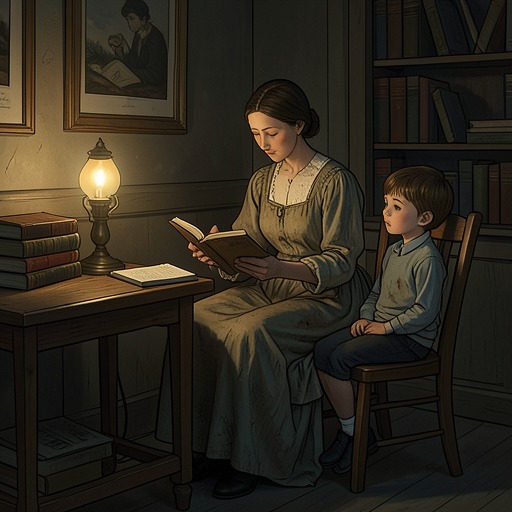
Corrine
The Color PurpleCorrine is a missionary, Samuel’s wife, and the adoptive mother of Olivia and Adam. Her home gives Nettie companionship and a place in the family, but the children’s hidden parentage becomes a source of growing suspicion and pain. When Nettie finally tells Corrine that Celie is their mother, Corrine moves from disbelief to recognition; her late acceptance reconnects the children’s adoptive and birth families shortly before her death.
Identity and Mission
Nettie describes Corrine as a religious woman who lives with Samuel in a comfortable house beside the church where he preaches. The couple involves Nettie in their household and church work, making a deliberate effort to keep her from feeling isolated. Their kindness is practical as well as devotional: they bring her into the activities of their shared life and, when asked, agree to take her along to help build a school in Africa.
Corrine and Samuel have no children at the beginning of their marriage, a sorrow they understand through their faith. They adopt Olivia and Adam, believing that the children have been sent to them by God. The family they create is loving, but it rests on a secret about the children’s birth that Corrine does not initially know. That concealed history makes her welcome to Nettie both generous and, later, emotionally complicated.
Corrine’s household belongs to a larger missionary project. Nettie and the couple study the Olinka dialect before beginning their work, and Corrine participates in the church-centered life they share. The mission’s institutional setting is not presented as uncomplicated: Nettie observes the white-run Missionary Society’s language of duty and its assumptions about African people. Corrine’s own characterization, however, is rooted in the daily fellowship and family life she offers Nettie, rather than in any stated defense of the Society’s attitudes.
A Household Built on Care
When Nettie first describes the family, she emphasizes that Corrine and Samuel are good to her and include her in everything. Their welcome gives Nettie a place in a household where she can take part in church business and feel less alone. She misses Celie intensely, but the warmth of Corrine’s home helps sustain her during her separation from her sister.
Corrine’s relationship with the children is also shaped by care. She and Samuel raise Olivia and Adam as their own, and Nettie comes to love them as the sister and aunt who watches over them. The children are not told that they are adopted. Their family life therefore contains an asymmetry: Corrine understands herself as their mother, while Nettie knows that they are Celie’s children and that her own bond to them carries a different history.
That difference becomes harder to contain as the children grow. Corrine notices that Olivia and Adam resemble Nettie, and she begins to question what the resemblance means. Her insistence that Nettie be treated as Samuel’s sister, not as another wife, also reveals concern about how the household is understood in the village. She asks that the children stop calling Nettie Mama Nettie even in play. The request tries to preserve clear family roles, but it also marks the pressure that the unspoken truth is placing on those roles.
Suspicion and the Crisis of Illness
Corrine’s unease develops without an outward break in her usual conduct. Nettie says that Corrine continues to work hard and remains sweet and good-natured, yet seems inwardly unsettled. The contrast matters: suspicion does not first appear as open hostility but as a private disturbance within a relationship that has otherwise offered Nettie kindness.
When Corrine becomes ill, Nettie takes on her work and nurses her, although Corrine resents being cared for. During one intimate moment, as Nettie changes her in bed, Corrine asks why the children look like Nettie and says that they could have been born to her. Nettie’s response does not resolve the question. Corrine’s illness and dependence intensify the strain, while her rejection of the children leaves them confused because they do not know they were adopted.
The crisis unfolds alongside the worsening conditions around the household. Nettie reports that the Olinka hunting territory has already been destroyed and that the village is due to be planted with rubber trees. The men must travel farther to hunt, while women spend their time tending crops and praying. These circumstances do not explain Corrine’s suspicions, but they place her family’s private distress within a community facing material upheaval and an uncertain future.
The Disclosure and Corrine’s Recognition
Nettie eventually tells Corrine that she is the children’s aunt and that their mother is her older sister, Celie. She explains the whole story, but Corrine is not convinced. She suspects that Nettie and Samuel are lying, and even after Nettie identifies the truth, Corrine demands evidence of the children’s birth. The dispute turns the concealed history into a direct challenge to the family Corrine has built and the identity she has lived as their mother.
A particular set of cloth patterns unlocks what argument alone could not. Nettie points to a flowered square and a checkered bird; as Corrine traces them with her finger, her eyes fill with tears. She remembers that Olivia looked so much like Nettie that she feared Nettie might want the child back. Corrine admits that she tried to forget that resemblance and instead fixed on the humiliation of being treated like any ordinary Black woman by a clerk, despite being Samuel’s wife and a Spelman Seminary graduate. She recognizes that anger over that insult consumed her attention, leaving her unable to face the implication of the children’s likeness to Nettie.
This confession makes Corrine’s acceptance an act of painful self-recognition as well as a change in what she believes. She acknowledges that she forgot Celie and the possibility of the children’s true parentage while dwelling on her own injured pride. Nettie tells her that Celie was glad Olivia had lived and that Celie had thought both children dead. Samuel and Nettie hold Corrine’s hands as she cries; later that night, Corrine tells Samuel that she believes, and dies anyway.
Family Legacy and Narrative Significance
Corrine’s death comes after, not before, her recognition of the truth. Her final acceptance cannot undo the years in which the children were raised without knowing Celie was their mother, but it changes the meaning of the family secret: the birth connection is no longer denied by the person who had adopted them. Corrine’s acknowledgement joins grief for the truth she missed with love for the children she raised.
The eventual reunion makes that expanded kinship visible. Nettie introduces Samuel, Olivia, Adam, and Adam’s wife, Tashi, as her family, while Celie identifies Shug and Albert among her own people. Corrine is absent from the reunion, but her role remains part of its history: she gave Olivia and Adam a home, and her final act of belief allowed their adoptive and birth stories to stand together. Through Corrine, the novel distinguishes biological parentage from the care that makes a family, while showing how secrecy can keep those forms of belonging painfully apart.