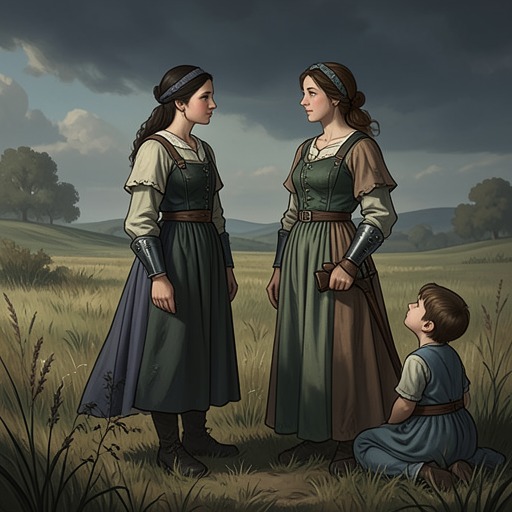
Corrine accepts the truth and dies
The Color PurpleCorrine accepts the truth and dies in a scene where recognition arrives through a quilt, bringing a buried family memory into view just before her death. Reported in Nettie’s letter to Celie, the episode turns a question of resemblance and parentage into a painful recovery of what Corrine had forgotten, and ends with her acceptance rather than a chance to live with what she has learned.
The Search for Recognition
For a week, Nettie has tried to help Corrine remember meeting Celie in town. Nettie believes that recalling Celie’s face will make Corrine believe that Olivia is Celie’s child, even if the question of Adam remains uncertain. The resemblance is plain to Nettie: Olivia has Celie’s face and eyes, and Nettie says she herself looks like her sister. What seems inexplicable to Nettie is that Corrine had not recognized that likeness earlier.
Nettie first prompts Corrine with the setting of the encounter: the town’s main street, the hitching post outside Finley’s dry goods store, and its smell of peanut shells. Corrine remembers those details, but not any men speaking to her. The recollection is therefore incomplete; the familiar place comes back without the social encounter Nettie hopes will unlock the family connection. Instead of pressing the same details further, Nettie turns to a material record of Corrine’s life with the children.
The Quilt as Evidence
The Olinka men’s quilts, patterned with animals, birds, and people, had inspired Corrine to make quilts of her own. Her design alternated a square of appliqued figures with a nine-patch block, using clothes the children had outgrown and some of her old dresses. Nettie searches Corrine’s trunk, while Corrine protests that her belongings should not be touched and insists that she is not yet gone. The exchange gives the search urgency, but it also makes the quilts tangible possessions Corrine still claims as her own.
Nettie holds the quilts up to the light, trying to find the earliest one she remembers Corrine making. In doing so, she is also trying to remember what Corrine and Olivia wore during the first months Nettie lived with them. She finds the quilt she is looking for and lays it across the bed. Pointing to a flowered square and a checkered bird, she asks Corrine whether she remembers buying the cloth. The patterns bring the past closer than the remembered street has: Corrine traces them with her finger, and her eyes slowly fill with tears.
The quilt works as more than a prompt to recollection. Its squares preserve traces of the household and the children’s outgrown clothes, making a shared history visible in an object Corrine herself created. Nettie’s method is specific and patient: she searches the trunk, compares the patterns with remembered clothing, and offers Corrine recognizable details rather than demanding that she accept an explanation. The emotional change comes when Corrine sees the resemblance she had previously failed to face.
Confession and Death
Corrine’s recovery of the past includes an account of why she had not remembered it. She says that Olivia resembled Celie so strongly that she feared Celie would want her child back. Corrine had therefore forgotten the meeting as quickly as she could. Her attention had fixed instead on the clerk’s treatment of her: she had expected recognition as Samuel’s wife and a Spelman College graduate, but felt humiliated at being treated like any ordinary Black woman. On the way home, she spoke to Samuel about that injury and her anger, not about Celie, whose name she had not retained.
Her confession changes the meaning of the earlier silence. Corrine had not simply overlooked a likeness; she had been afraid of what recognizing it might mean for her bond with Olivia. The hurt of the encounter with the clerk had occupied her thoughts and conversation, while the more threatening memory of Celie remained unspoken. Once the quilt restores the connection, Corrine cries openly. Nettie and Samuel hold her hands. Nettie reassures her that Celie had been glad to see Olivia with them and glad that the child was alive, because Celie had believed both her children were dead. Samuel joins them in grieving for Celie’s loss, and the three sit together talking and holding one another until Corrine falls asleep.
In the middle of the night, Corrine wakes, turns to Samuel, says that she believes, and dies. Her final recognition resolves the question that has driven Nettie’s effort: Corrine accepts the truth about Celie and Olivia. Yet the scene offers no extended reconciliation or future in which Corrine can act on that understanding. The sequence moves from doubt, through tactile recognition and confession, to belief and death, placing emotional resolution and irreversible loss side by side.
The Letter’s Framing
The event reaches Celie through Nettie’s letter, so its account is both intimate and shaped by the needs of the absent sister. Nettie records the careful search for memory, Corrine’s explanation, the family’s hands joined around her, and her final words. The letter makes the quilts and the remembered town details part of a message about kinship: objects and particulars restore a connection that fear and hurt had obscured.
For Celie, Nettie’s report confirms that Corrine came to believe the family truth, while also telling her that this recognition arrived too late for a renewed relationship with Corrine. The death does not erase the connection the scene establishes; instead, it gives that connection a narrow, poignant form. Corrine’s last act is to acknowledge what she had resisted remembering, and Nettie preserves that moment in writing for the sister whose face had been present in the story all along.