Nettie and Samuel marry
The Color PurpleNettie and Samuel marry in a simple church ceremony in London, turning a long-standing bond of shared work and family life into a declared marriage. The event is also a moment of disclosure: before the ceremony, Nettie tells Olivia and Adam that Celie is their mother and that Nettie is their aunt. Their wedding therefore joins two forms of kinship—the couple’s chosen partnership and the blood relationship that has been hidden from the children.
Background and Family Ties
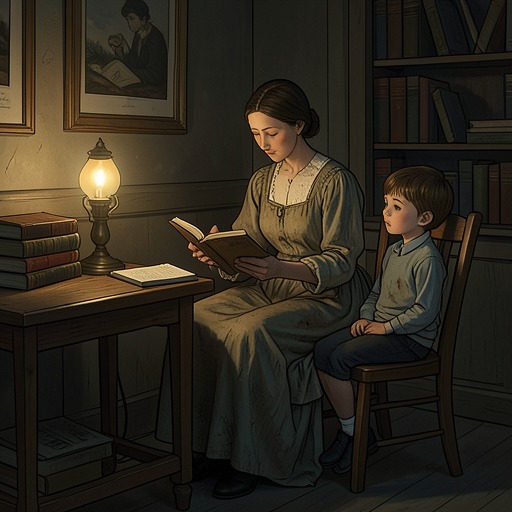
Nettie’s love for Samuel emerges within a family life already shaped by care, loss, and concealed origins. Corrine and Samuel had been unable to have children. They adopted Olivia and Adam after Samuel’s former associate brought the children to their home. The children had been born to a widow whose health and stability deteriorated after she married a stranger; she died after years of repeated pregnancies and declining strength. Olivia and Adam had been born when their mother was too ill to care for them. Samuel and Corrine received them as an answer to their prayers and raised them in a household Nettie describes as loving.
Nettie had entered that household as a missionary and teacher. She accepted Corrine and Samuel’s invitation to help build a school in Africa on the condition that they teach her what she needed to become useful as a missionary and a friend. Their promise began what she calls her real education. In time, she also became a caregiver to the children, whom she loved as family while keeping her own connection to them unspoken. To Celie, Nettie had already explained the concealed truth: Olivia and Adam were Celie’s children, and Nettie was their aunt. That knowledge makes the later disclosure to the children a crucial step toward restoring relationships divided by separation and secrecy.
Recognition of Love
The turn toward marriage occurs in a moment of shared distress. Samuel is crying because he and Nettie have tried to show the children their love, yet the children reject them and question their connection to their African home and past. Their questions concern why the couple cannot speak the children’s language, remember old ways, or be content in America, where people have motorcars. Samuel’s grief gives Nettie an occasion to comfort him physically: she puts her arms around him and strokes his head and face.
In recounting the moment to Celie, Nettie describes affection that had been buried within her and then comes to recognize as passion. She had loved Samuel as a brother and respected him as a friend, but now understands that she loves him as a man. Her account is intimate and emphatically physical: it attends to his walk, size, shape, smell, hair, palms, inner lip, nose, brows, feet, and eyes. The detailed inventory marks a change in how Nettie understands a relationship that was already close. She does not present their love as suddenly appearing from nowhere; the new recognition gives a different meaning to the affection and companionship that preceded it.
Nettie also anticipates that Celie might judge her revelation harshly, but describes the experience as joyful and ecstatic. The confession to her sister is part of the event’s emotional shape: the marriage is not only a public change of status but an intimate truth Nettie must first acknowledge and communicate. Samuel, too, makes their intention explicit to the children, telling them that they love each other and intend to marry.
Disclosure and Ceremony
Before the wedding, Nettie insists that the children must hear more about her life, Corrine, and the other woman connected to their family. She tells them about Celie, explains that Celie is their mother, and identifies herself as their aunt. This disclosure places the children’s adoptive family and their birth family in the same account rather than requiring one relationship to erase the other. It also gives the marriage a wider familial setting: the couple’s decision is shared with the children who have been central to their life together.
Olivia asks where Celie is. Nettie explains Celie’s marriage to Mr. ____, while Samuel reassures Adam that they will return to America soon and see about her. Adam is alarmed by what he hears, and Nettie describes him as sensitive to what is left unsaid. The exchange shows that the truth about Celie is not a detached family history for the children; it immediately raises questions about the mother they have not known and the circumstances that separated her from them.
The children stand with Nettie and Samuel at their simple church wedding in London. The ceremony makes their intention concrete in the presence of Olivia and Adam, whose participation follows the revelation of their parentage. Later, after the wedding dinner, Olivia tells Nettie that Adam misses Tashi and is angry because Tashi had planned to have her face scarred when the family left. Nettie had believed that she and the others had helped prevent the cutting of tribal marks on young women’s faces. This concern belongs to the unsettled family future surrounding the wedding: marriage brings Nettie and Samuel together, but it does not resolve the children’s separations, anxieties, or conflicts over cultural practice.
Significance in the Family Story
Nettie’s marriage changes the terms of a relationship that had long been expressed through friendship, shared work, and care. Its emotional center is her recognition that her love for Samuel is bodily as well as familial, while its public center is the church ceremony attended by the children. The event joins private feeling to an explicit commitment without making either dimension a substitute for the other.
The timing of the disclosure also makes the wedding a hinge in the family story. Nettie tells Olivia and Adam who Celie is before they stand with the couple at the ceremony; marriage thus takes place alongside the recovery of a kinship truth, not apart from it. The children’s adoptive bond with Corrine and Samuel remains part of their history even as their connection to Celie and Nettie becomes known. In Nettie’s letters, the marriage is therefore both a beginning for her and Samuel and one step toward a larger reunion: she has already assured Celie that she is alive, that Olivia and Adam are well, and that the family will come home.
The later reunion makes that promised return visible. When Nettie and Celie meet again, Nettie introduces Samuel, Olivia, Adam, and Adam’s wife, Tashi, to the people gathered around Celie. That encounter does not belong to the London ceremony itself, but it completes the family movement the marriage helps set in motion: a union first declared to the children becomes part of the family Nettie eventually brings back to Celie.