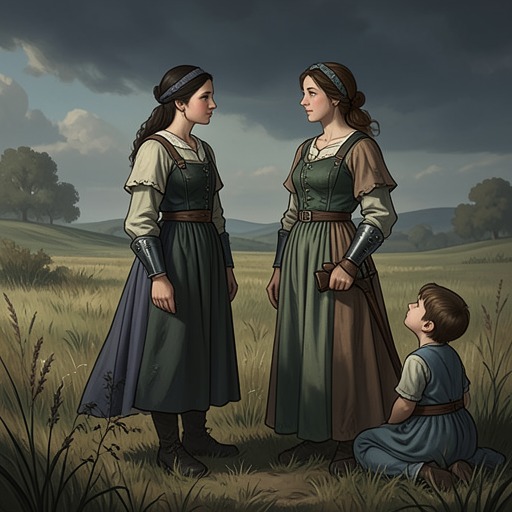
Samuel and Corrine's marriage, adoption, and reconciliation after a misunderstanding
The Color PurpleSamuel and Corrine's marriage, adoption, and reconciliation after a misunderstanding show how family bonds in The Color Purple are made through marriage, adoption, and years of care, but can be strained by concealed history. Samuel and Corrine build a loving household around Olivia and Adam, unaware at first that the children’s biological mother is Celie and that Nettie is their aunt. The secret becomes a source of suspicion between Corrine and Nettie; its eventual disclosure brings Corrine to accept the truth, though only shortly before she dies.
Marriage and the Children
Nettie describes Samuel and Corrine as having a wonderful marriage, with their inability to have children as their initial sorrow. They understand Olivia and Adam as children sent to them, and raise them in a home Nettie characterizes as loving, Christian, and attentive to faith. The children’s arrival gives their marriage a shared family life, while the circumstances of their adoption remain hidden from Corrine.
Samuel’s account of the children’s beginnings explains both the adoption and the secret. A stranger arrived in a community where a widow was struggling to care for her children. The widow married him, became pregnant repeatedly, and grew increasingly ill and mentally unstable. Two years before her death, she had Olivia, whom she was too sick to keep; Adam followed. The stranger who had married her was one of Samuel’s old companions. When he brought Olivia and then Adam to Samuel’s house, Samuel felt unable to refuse them and regarded their arrival as an answer to his and Corrine’s prayers.
Samuel did not tell Corrine about his old companion or the children’s mother. He wanted no sadness to intrude on her happiness. His decision protects the household from painful knowledge in the short term, but leaves Corrine without the history needed to understand why Olivia and Adam resemble Nettie and why Nettie’s connection to the family feels so immediate. The secret thus becomes part of the marriage’s foundation as well as the source of its later crisis.
Nettie in the Household
When Samuel and Corrine invite Nettie to help build a school in Africa, she agrees on the condition that they teach her what she needs to become a useful missionary and a friend they would not be ashamed of. She later describes her education under them as a sustained effort of study. Their household is both a family setting and a place where Nettie gains knowledge and purpose.
Nettie’s place in the family is complicated by a truth she initially does not disclose: Olivia and Adam are her sister Celie’s children, making Nettie their aunt. She becomes their guardian and pours into them the love she feels for Celie. From Nettie’s perspective, this care is a way of loving her sister through the children. Corrine, however, does not know their parentage, and the children’s resemblance to Nettie eventually makes her question the relationships within her own household.
The misunderstanding surfaces while Corrine is ill and Nettie is caring for her. Corrine asks why her children look like Nettie, then asks when Nettie first met Samuel. Nettie recognizes that Corrine suspects she and Samuel had a relationship and that Olivia and Adam are their children. The resemblance has troubled Corrine for years. Her questions turn an unspoken doubt into a direct challenge to the trust between the two women and to Samuel and Corrine’s account of their family.
The Misunderstanding and Its Resolution
Nettie answers Corrine’s suspicion by insisting on the truth. She places her hand on a Bible and swears that she is not lying. Corrine then summons Samuel and makes him swear that he met Nettie on the same day she did. Samuel apologizes to Nettie for the suspicion, but the oaths do not immediately convince Corrine. The scene makes clear that her doubt has endured too long to be dismissed by reassurance alone.
Nettie eventually tells Samuel and Corrine the whole story: she is the children’s aunt, and their mother is her older sister, Celie. Corrine remains unconvinced at first. The revelation does not erase her years of uncertainty, but it gives the family the missing history that Samuel’s silence had kept from her.
A memory helps Corrine face what she had tried not to acknowledge. Nettie points to a flowered piece of cloth and a checkered bird. Corrine traces the patterns with her finger and recalls that Olivia had looked so much like Nettie that she feared Nettie would want her back. To protect herself from that fear, Corrine forgot Olivia as quickly as she could. She remembers that, on the journey home, her anger over being treated as an ordinary Black woman had occupied her thoughts instead of the child’s connection to Celie. Her recognition gives the concealed family history an emotional shape: the resemblance had once threatened Corrine’s sense of security, and her response to it had left Olivia’s origins unspoken.
Corrine cries as Nettie comforts her, explaining that Celie was glad Olivia was alive because she had thought both her children were dead. Samuel and Nettie hold Corrine’s hands. In the middle of the night, Corrine wakes, turns to Samuel, and says that she believes. She dies anyway. Her final acceptance resolves the misunderstanding between her and Nettie, but the timing makes reconciliation inseparable from loss.
Family After Corrine
The children’s family story extends beyond Corrine’s death. Nettie once writes to Celie that she is alive, that Olivia and Celie’s son are well, and that they are all coming home. The letter places Samuel, Nettie, and the children within the family Celie has long been separated from, even before their return makes that relationship visible to her.
At the eventual reunion, Nettie introduces Samuel as her husband and Olivia and Adam as their children; she also introduces Adam’s wife, Tashi. Samuel’s presence beside Nettie confirms their marriage within the family gathering, while Olivia and Adam stand as both the children raised in Samuel and Corrine’s home and Celie’s long-lost children. The reunion does not undo Corrine’s death or the years of uncertainty, but it brings the separated branches of the family together. In this account, marriage and adoption establish real bonds of care, while the disclosure of biological kinship allows those bonds to be understood without cancelling them.