Shug Avery
The Color PurpleShug Avery is a singer whose life resists the moral labels imposed on her and whose care for Celie becomes a source of intimacy, practical support, and spiritual change. The novel presents her both as a public figure whom others condemn and as a woman who speaks frankly about desire, God, and the obligation to notice beauty. Her home in Memphis offers Celie room to recover and build a life of her own; her eventual return makes their attachment visible in a final embrace.
Identity and Public Reputation
Shug is known in town as a singer and as a woman who has taken other women’s men. When she becomes sick, nobody in town wants to take her in. Her mother says she had warned her; her father calls her a tramp. At church, women speculate about her illness, including whether it is tuberculosis or a sexually transmitted disease. The uncertainty matters: the community does not know what is wrong with her, but that does not prevent it from treating her condition as confirmation of its judgment.
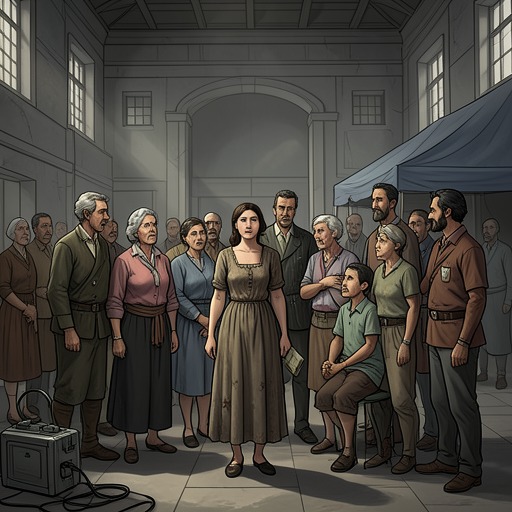
The preacher turns her illness into a sermon against a woman who wears short skirts, smokes, drinks gin, sings for money, and takes other women’s men. He does not name her, but everyone understands the target. His language reduces Shug to sexual insults, and the congregation answers with agreement. Celie looks toward Albert, who remains silent and turns his gaze away. The scene sets public piety against private conduct: those who condemn Shug do not offer her care, while Celie recognizes that somebody ought to stand up for her.
Desire and the Body
Shug describes her sexuality as a lasting part of herself, not as the disgrace her family and the church make it. She says that her mother resented how much she loved sex and disliked physical affection, turning away when Shug tried to kiss her. Her mother called her Lillie, the name Shug identifies as her real one. By contrast, Shug’s father welcomed her kisses and embraces, although her mother disapproved of the sight of them. Her memories connect adult desire to a childhood in which affection was both welcomed and policed.
Shug says that once she was in Albert’s arms, she could not be made to leave, and that the relationship was pleasurable. She points to having three children with him, despite his weakness, as evidence of that pleasure. All three were born at home, with a midwife, a preacher, and church women present. When Shug was in intense pain, the women urged her to repent. The births thus bring the conflict between bodily experience and religious judgment into the home: even at a moment of physical vulnerability, other people interpret her life through condemnation.
Celie, Care, and Song
Shug’s connection with Celie includes attention that Celie has rarely received. When Celie is ill and cold, Shug stays beside her through the night, holding her close and talking. In another account of illness, Shug credits Celie with recovering a song from her head while she was sick. When Shug later sings it, she names it Miss Celie’s Song. She begins by humming before singing its words; although the song concerns a man who has wronged her, Celie attends instead to Shug’s voice and hums along. Naming the song for Celie turns a private act of care into public recognition.
In Memphis, Celie asks to accompany Shug on the road and offers to press her clothes and do her hair, imagining a return to their earlier life around the performances at Harpo’s juke joint. Shug refuses. She explains that performing before strangers, many of them white, is easier than acting before Celie, and insists that Celie was not brought there to serve as her maid. She brought Celie to love her and help her get on her feet. The distinction is practical as well as intimate: Shug refuses to let Celie’s place in her house be defined by domestic service.
Faith and the Natural World
Shug’s ideas about God challenge the image of a white, male deity that Celie has encountered through the Bible and church. She says that God is inside Celie and inside everyone, but that people have to search within themselves to find it. The presence may emerge even when a person is not looking, especially through trouble and sorrow. When Celie asks whether God is an it, Shug affirms that God is neither male nor female. Her account relocates spiritual authority from a distant, gendered figure to an inward presence shared among people.
For Shug, that inward God is also present in the world people encounter and love. God loves what people love, as well as many things they do not, and wants to share what is good. Shug gives the example of walking past purple in a field without noticing it: overlooking such beauty would anger God. She adds that God makes something else and is always trying to please people back. The purple field makes her theology concrete. Attention to the natural world becomes a form of recognition, and ordinary beauty offers a counterweight to the narrow religious judgment directed at women like Shug.
This vision contrasts sharply with the preacher’s use of Shug’s illness as an occasion for public shame. Where the sermon makes her body evidence against her, Shug’s spiritual account treats embodied life, feeling, and perception as possible ways of encountering God. Her beliefs also meet Celie at a turning point: Celie says she no longer writes to God and writes instead to Nettie. Shug’s question about what happened to God opens a conversation in which inherited religious language can be reconsidered rather than simply obeyed.
Memphis, Independence, and Return
Shug’s Memphis house is large and pink, with the shape of a barn. Space that might have held hay contains bedrooms and toilets; there is also a ballroom where she and her band sometimes work. The grounds include monuments and a fountain, with elephant and turtle figures throughout the house—in the curtains, bedspreads, and around the rooms. Shug gives Celie a large back bedroom overlooking the backyard and bushes by the creek. This particular room, and Shug’s reminder that Celie is used to morning sun, make the house more than a setting: it is a place arranged to accommodate Celie.
While Shug is away on the road for two weeks, Celie remains in the house with Grady and Squeak and continues making pants. The work has grown beyond a single design: she varies the fabric, print, waist, pockets, hems, and fullness, producing pants in many colors and sizes. Shug returns, kisses her, steps around the scattered patterns and cloth, and asks how much money she needs for the week before leaving again. Her support is not abstract encouragement; it includes giving Celie a room, refusing to make her a servant, and providing money while Celie develops her work.
At the novel’s close, Celie has come to accept that she can be happy if Shug returns and content if she does not. Shug steps out of the car dressed like a moving star, tells Celie that she missed her more than her own mother, and embraces her. The reunion does not erase the independence Celie has built. Instead, its force lies in bringing affection back into a life that can now hold both longing and self-sufficiency. Shug’s narrative significance rests in that combination: she offers care without demanding submission, articulates a faith grounded in shared life and attention, and returns to Celie as a loved companion rather than as the answer to Celie’s entire existence.