The Olinka are forced to leave their village
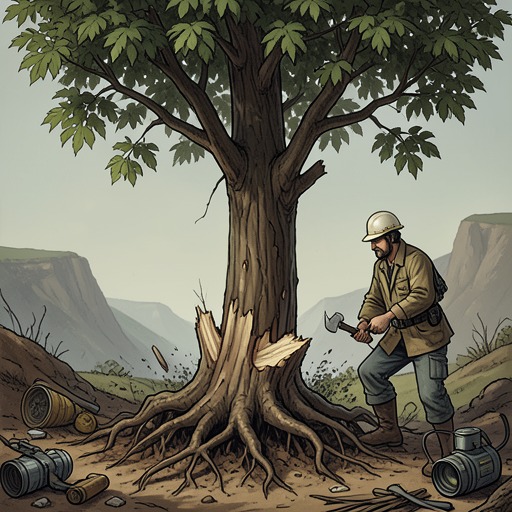
The Color PurpleThe Olinka are forced to leave their village through a colonial land seizure that turns a promised road into a route for rubber extraction. Reported by Nettie in a letter to Celie, the displacement is not a single act of removal but a sequence: armed roadbuilders destroy the village, the people are moved away from their water source, and the plantation’s destruction of roofleaf and yam crops undermines both cultural practice and health.
Land, road, and the promise of access
The Olinka initially treated the road as a possible benefit. Builders spoke of easier travel to the coast, and the villagers imagined the road would connect them to the wider world. That expectation collapsed when construction continued beyond the village, following a plan to extend the road another thirty miles through Olinka Village. The road began cutting through Catherine’s newly planted yam field before the Olinka were fully awake. The builders carried guns and had orders to shoot, while the villagers, who rarely thought of fighting since the era of tribal wars, could only watch as their crops and homes were destroyed.
The destruction was systematic rather than incidental. The roadbuilders did not alter the route: every hut in its path was leveled, along with the church, school, and Nettie’s hut. The village was left gutted by a tarmac road through its center. The chief went toward the coast to seek explanations and reparations. Two weeks later he returned with news that the whole territory, including the village, belonged to an English rubber manufacturer. The road’s real function was now plain: it served a plantation project, not the people who had expected to use it.
The chief’s journey exposed the scale of the transformation beyond the village. Near the coast, he saw hundreds of villagers clearing forests and planting rubber trees. Giant mahogany and other trees, along with the forest’s game, were being destroyed as land was flattened for production. The governor who had directed the roadbuilders knew the Olinka only from a map. The contrast between the chief’s attempt to speak for his community and the distant administration’s abstract claim to the territory makes the imbalance of power concrete: local presence and use counted for less than a company’s claim and a plan drawn elsewhere.
Removal from the water source
For as long as they could, the Olinka ignored the road and its builders. They had to confront the project when the builders ordered them to move, intending to use the village site as headquarters for the rubber plantation. The site was valuable not merely for its central position but because it was the only place for miles with a steady supply of fresh water. The people were driven, along with the missionaries, to barren land without water for half the year. In the dry months they had to buy water from the planters; during the rainy season they relied on the river and tried to dig cisterns into nearby rock. Discarded oil drums brought by the builders served as makeshift water containers.
This change in location turned dispossession into continuing dependence. The Olinka lost not only their homes and fields but access to the resource that had made the village site habitable. The new settlement offered no equivalent supply, and the people had to pay the plantation for water on land to which they had been moved. The removal therefore reorganized daily life around the needs of the rubber enterprise: the company took the dependable source, while the displaced community bore the cost of obtaining what it had previously accessed at home.
Roofleaf and the cost of survival
The loss of roofleaf made the coercion cultural as well as material. In the Olinka’s tradition, roofleaf is revered as a god and is used to cover their huts. The planters first put up separate barracks for men and for women and children, but left them uncovered because the Olinka would not live in a dwelling without a roof of their sacred material. The builders then plowed under the village and the surrounding land, including every remaining stalk of roofleaf. The people’s refusal was not met with accommodation; the material that made their customary homes possible was eliminated.
Nettie’s account of the welcoming ceremony gives this destruction a longer history. In the village’s traditional story, a greedy chief took common land for his own crops and trade, cultivated the land where roofleaf grew, and bought off the elders with goods from coastal traders. A great rainy-season storm later destroyed the village roofs, revealing that roofleaf had disappeared beneath food crops. That remembered story warns of the consequences of treating shared land as a source of private surplus. The plantation’s destruction is different in scale and power: it removes the village and its sacred material altogether, leaving the Olinka with no land on which to restore what has been lost.
After weeks in the sun, a truck arrived carrying corrugated tin sheets. The Olinka had to pay for them. The purchase exhausted their meager savings and nearly wiped out the money Nettie and Samuel had set aside for the children’s education when they returned home. As the people struggled to build roofs from the metal, the women’s ululation of sorrow echoed across the cavern walls. The tin provided temporary shelter, but it did so at the cost of savings, future plans, and a material and spiritual relationship to home. Nettie marks this day as the moment the Olinka acknowledged temporary defeat.
Aftermath and significance
Displacement continues to damage the Olinka after the immediate destruction ends. The planters plowed under the yam crop and substituted canned and powdered food. Yams had been part of the Olinka’s diet for thousands of years and helped protect against malaria and control chronic blood disease. Without enough of them, the remaining people began falling ill and dying at an alarming rate, as malaria spread. The account links land seizure to bodily harm: taking fields and changing what can be eaten also removes knowledge and resources on which health depends.
The Olinka no longer asked Nettie and Samuel for help beyond teaching their children, because they could see how powerless the missionaries and their God were against the plantation. Nettie and Samuel nevertheless decided they must act, and traveled with the children to England to seek relief for the Olinka from churches and the Missionary Society. At the same time, some people close to them fled to join the mbeles, forest people said to shelter runaways and resist white rule and plantations. The community’s responses thus ranged from education and petition to flight and resistance, while none could restore the lost village.
The event’s force lies in the way its consequences accumulate. A road presented as access becomes an instrument of seizure; the village’s water source becomes plantation property; sacred roofing material disappears; and the replacement settlement brings expense, food insecurity, and illness. The Olinka are not simply moved from one place to another. Their capacity to sustain a community—through land, water, crops, shelter, and shared belief—is progressively dismantled in the name of rubber production.