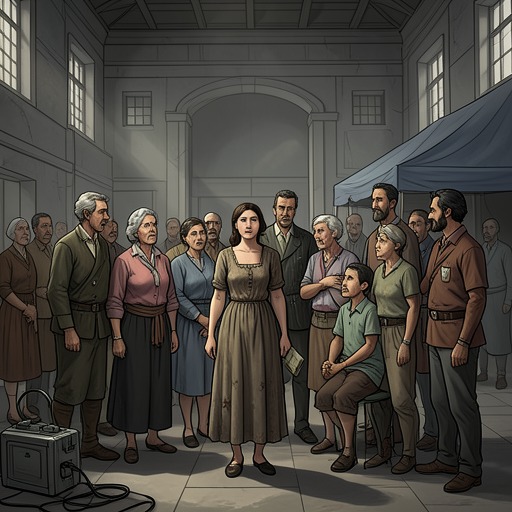
The house inherited by Celie and Nettie
The Color PurpleThe house inherited by Celie and Nettie transforms a family secret into a material home. Passed from their real father to their mother and then to the sisters, it gives Celie not only a house but land and a store—resources she can claim for herself and share with Nettie. Its meaning changes as Celie learns who owns it: what first seems like an unwelcome bequest connected to Alphonso becomes the basis for a future built around her own choices and a family reunion she has long awaited.
Inheritance and the Hidden Title
The sisters’ claim emerges after Alphonso’s death, when Daisy tells Celie that the stepfather has been dead for over a week and that the will has just been read. Celie had thought Daisy would inherit the house too. Instead, Daisy explains the chain of ownership: Celie and Nettie’s real father owned the land, house, and store; he left them to the girls’ mother; and, after their mother died, the property passed to the two sisters. Daisy does not know why Alphonso never told Celie.
The revelation alters the meaning of a life shaped by what Alphonso concealed. Celie initially refuses the inheritance in spirit, saying that she wants nothing coming from him. But the property did not originate with him: his silence had kept the sisters from knowing what their parents had left them. Shug prompts Celie to consider that Nettie might not reject it, and Celie begins to see the inheritance differently. The house is not a gift from Alphonso; it is a right rooted in her parents and shared with her sister.
A Rebuilt House and Its Contents
The place Celie inherits is not the old house she remembers. Daisy says Alphonso tore that building down and had the present house designed by an Atlanta architect. Its tiles came from New York City and appear throughout the building: in the kitchen, toilet, and back porch, as well as around the fireplaces in both the back and front parlours. These details establish a substantial, extensively finished residence rather than the remembered dwelling.
The transfer also separates the house from its furnishings. Daisy says she took the furniture Alphonso had bought specially for her. Celie accepts that arrangement; the new ownership does not depend on taking Daisy’s possessions. Daisy leaves Celie with the keys, and Celie runs from room to room, calling Shug’s attention to what she sees. The keys make the change concrete: title and possibility become a place Celie can enter and explore for herself.
Home, Work, and Renewal
The estate includes more than a residence. Celie realizes that she and Nettie own a dry-goods store, then wonders what they will sell. Shug suggests pants, connecting the inherited property to the pants-making work Celie can develop. The store gives the inheritance an economic dimension: the family’s property can support an enterprise shaped by Celie’s own skill and decisions.
The house also offers space for a family that has been divided. Celie writes to Nettie that it is big enough for Celie and their children, Nettie and her husband, and Shug. The invitation answers years of separation with a specific promise: Nettie will have a home to return to. The property’s importance lies not simply in its size or value, but in Celie’s ability to imagine it accommodating the people whose connection to her had been hidden or interrupted.
Shug and Celie mark the transition through a house-cleansing ritual. Shug lights cedar sticks and gives one to Celie; together they begin in the attic and smoke their way down to the basement, chasing out evil and making a place for good. Their movement through the whole building turns possession into a deliberate act of welcome and renewal. The house is no longer only an estate transferred by a will; it is a space Celie and Shug prepare for the life Celie hopes to share with her family.
Reunion and Family Belonging
The eventual reunion gives that hope a human counterpart. After years apart, Celie and Nettie recognize one another by name and hold on to each other. Nettie introduces Samuel, their children Olivia and Adam, and Adam’s wife Tashi; Celie introduces Shug and Albert. The introductions place the sisters’ enlarged family in relation to one another, including children whose identities and history connect back to Celie. The house’s earlier promise of room for the family thus belongs to a larger restoration of kinship: the inheritance has given Celie a home to offer, while the reunion brings the people she hoped to welcome within reach.
As a story object, the house binds property, memory, and belonging without reducing them to a single inheritance. Its title exposes what Alphonso’s concealment had obscured; its store suggests a livelihood; and its rooms become the setting Celie imagines for a returned family. The old dwelling is gone, but the sisters’ claim survives through the land and rebuilt house. For Celie, learning that the property is hers and Nettie’s changes the prospect of home from something denied into something she can claim, prepare, and share.