17–18 July 1935
The Colour Out of SpaceThe night of 17–18 July 1935 is the uncertain climax of Nathaniel Wingate Peaslee’s Western Australian expedition: a solitary walk into buried ruins that, in his later account, brought his lifelong-seeming nightmares into contact with material evidence. Its decisive revelation was a book in his own handwriting, apparently preserved in an ancient metal case. Because Peaslee returned without the case and repeatedly allowed that the experience might have been a hallucination, the night remains both the strongest confirmation of his fears and an event without independent proof.
Background and Stakes
The expedition had been drawn to scattered masonry in the desert after reports from a mining engineer identified unusually ancient blocks near Pilbarra. The stones included sandstone, granite, and a block thought to be made of cement or concrete; their water-worn surfaces suggested that the region had been submerged and exposed again long after their construction. Peaslee’s party eventually found about 1,250 blocks, many carved and some shaped as if they had formed part of arches or vaulted structures. Their number and distribution suggested a buried architectural complex, though excavation did not reveal its arrangement.
The ruins mattered to Peaslee because their forms resembled buildings from his disturbing dreams and were entangled with legends of dominant races predating humanity. Those accounts described many civilizations across immense spans of planetary and cosmic time, but placed special emphasis on the Great Race of Yith, which had mastered the projection of minds across time and gathered knowledge from different eras. In the history Peaslee assembled, the Great Race had also driven the Elder Things beneath the earth and sealed passages leading to their caverns. This lore gave the buried structures a menacing historical context, but it did not establish what Peaslee would encounter on his walk.
The Night Walk and the Camp
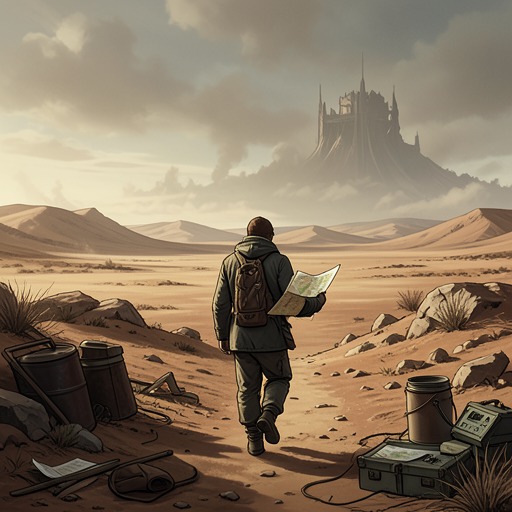
After a windy day, Peaslee went to bed early but could not sleep. Shortly before eleven, troubled by his recurring sense that the northeastern terrain drew him toward it, he left camp for one of his nocturnal walks. An Australian miner named Tupper was the only person he saw as he departed; Tupper later recalled seeing him walk rapidly toward the northeast across the dunes. The moon was slightly past full, and the night remained calm for nearly five hours.
At about 3:30 a.m., a violent wind rose, woke the camp, and brought down three tents. Peaslee’s absence was noticed, but his previous walks meant that the others did not immediately treat it as an emergency. Three Australian members of the party nevertheless felt uneasy. Mackenzie attributed their apprehension to local folklore about rare winds that, in the stories, issued from underground stone dwellings near marked stones. The gale subsided shortly before four, leaving the sand hills altered. The camp’s observations establish Peaslee’s departure and the unusual weather, but do not verify what he later said happened beyond the camp.
The Reported Discovery
In his account, Peaslee described continuing northeast among half-buried blocks, increasingly affected by the ruins and by memories that seemed to resist becoming clear. He presented the experience cautiously: he could not be certain that he had been awake or that the events were real, and he acknowledged that the expedition’s conditions and his own psychological history offered grounds for doubt. Nevertheless, he regarded the experience as a possible confirmation of the beliefs and fears he had spent years trying to dismiss.
The crucial object, as Peaslee described it, was a book inside a metal case in a buried megalithic space. Its brittle pages appeared extraordinarily old, yet the letters were those of the familiar alphabet and formed English words in Peaslee’s own handwriting. He understood this as the revelation on which the meaning of his earlier dreams and lost years depended. The apparent contradiction—his handwriting in a book he believed to have found in ruins untouched since before humanity—made the discovery more consequential than the stones themselves, while its dependence on his unverified recollection kept its truth unsettled.
Aftermath and Significance
The next day Peaslee took no part in the excavations. He asked his son, Wingate Peaslee, to survey the area from an aeroplane before taking him to Perth. The survey found no visible trace of the place his father had walked; shifting sand had erased the signs, as it had obscured other features of the desert. Peaslee later reflected that losing the object in his fright might have been merciful, since its recovery could have made the implications of his account harder to dismiss. The metal case was not brought back, and the underground corridors he feared remained undiscovered.
Wingate took his father to Perth on 20 July but declined to abandon the expedition. He stayed with Peaslee until 25 July, when a steamer sailed for Liverpool. Aboard it, Peaslee decided to tell his son what he believed had happened and leave him to judge, as a psychologist familiar with the case, whether the account should be shared more widely. The night therefore becomes a private testimony framed as a warning: Peaslee urges that efforts to excavate the primordial ruins be abandoned, even as he cannot offer proof that the danger he fears is real.