A Mocking and Incredible Shadow Out of Time
The Colour Out of SpaceIn The Shadow Out of Time, the phrase “a mocking and incredible shadow out of time” gives a name to the narrator’s most alarming possibility: that the terrors he has treated as dreams may preserve knowledge of a world far older than humanity. It is not a declaration that this history is true. The expression holds dread and doubt together, as the narrator warns of a danger he cannot prove and cannot dismiss.
The Phrase and Its Stakes
The image of a shadow makes the past feel present without making it fully visible. For the narrator, the possibility behind it is not merely that his memories are strange, but that they could disclose humanity’s small place in a vast history of time. He imagines that, during his amnesia, his body may have served as the vehicle for an alien consciousness from a hundred and fifty million years ago, and that his tormenting dreams may have been the residue of actual memories. These remain questions, not established facts; the phrase gathers their implications without resolving them.
The expression also carries a warning. At the start of his account, the narrator says that if the experience occurred, human beings must prepare for ideas about the cosmos and their place in it that are almost paralyzing. He urges the abandonment of attempts to uncover the primordial masonry his expedition set out to investigate, fearing that further exploration could expose others to a perilous truth. The “shadow” is therefore both an image of the past and a warning about what might still be hidden.
Doubt as Part of the Meaning
The narrator repeatedly places the experience between competing explanations. He hopes it was wholly or partly a hallucination, and later says that there is no proof the events were anything more than new phases of myth-born dreams. Yet the experience seemed hideously real to him, and he cannot find lasting comfort in the possibility that it was imagined. The phrase’s paired qualities—mocking and incredible—preserve this tension: the possibility seems too monstrous to accept, but too disturbing to put aside.
That uncertainty governs the warning’s tone. The narrator does not present the danger as a demonstrated fact; he asks readers to take seriously an experience whose reality he himself cannot vouch for. His appeal is consequential precisely because certainty is unavailable: if the abyss and what it contained were real, he believes there is no hope, but he can offer no conclusive proof that they were.
The Missing Proof
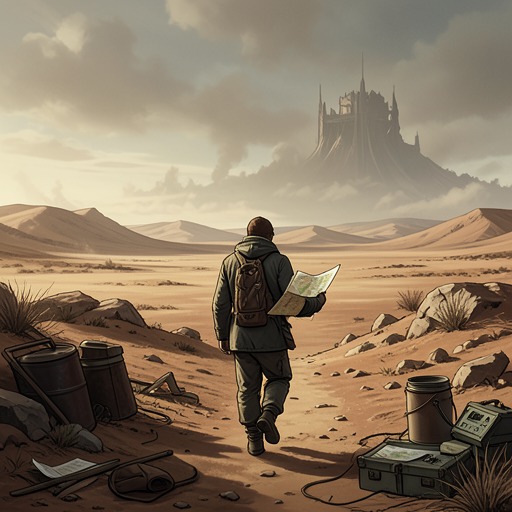
The narrator’s uncertainty has a concrete cause. In the buried ruins, he believes he saw a book inside a metal case, its brittle pages bearing English words in his own handwriting. That apparent discovery would connect his private dreams to the ancient world he fears, but he lost the case in his fright. The subterrene corridors have not been found, and the object that might have settled the question is absent.
The expression thus ends not in confirmation but in an unresolved appeal. The narrator intends to tell his son what he saw—or thought he saw—and leave him to judge its reality as a psychologist. The lost case, the still-undiscovered corridors, and the handwriting that may have been his all make the shadow at once more imaginable and less verifiable. Its power rests in that gap between a revelation that seems specific and evidence that cannot be recovered.