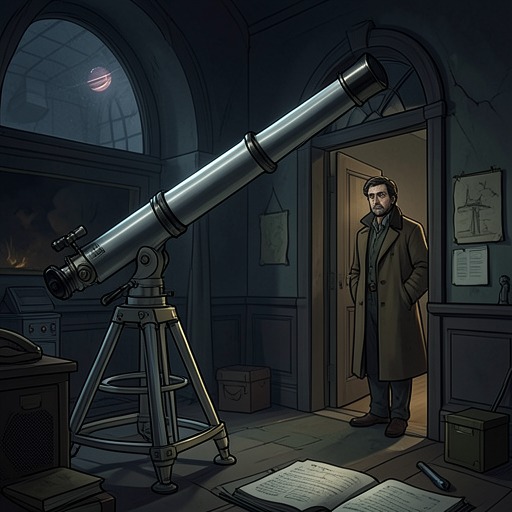
Akeley farmhouse
The Colour Out of SpaceHenry Wentworth Akeley’s farmhouse is both a recognizable rural home in the Vermont hills and the setting where that familiar domestic world gives way to an alien one. Its well-kept grounds and orderly rooms make the later discovery of the brain cylinders more disturbing: the farmhouse’s apparent quiet does not mean it is ordinary, but conceals a place connected to beings and journeys far beyond Earth.
Appearance and Setting
A photograph of the Akeley farmhouse shows a trim white house of two stories and an attic, about a century and a quarter old, with a well-kept lawn and a stone-bordered path leading to a carved Georgian doorway. Several large police dogs sit on the lawn near a pleasant-faced, close-cropped grey-bearded man whom Wilmarth takes to be Akeley. A tube-connected bulb in the man’s hand suggests that Akeley took the photograph himself. Other photographs include a blurred mark near the house, apparently made after a night of unusually violent barking, and views of swamp and hills that seem to bear traces of hidden habitation.
When Wilmarth reaches the property, its appearance is more expansive than the photograph suggested. A white, two-and-a-half-story house stands beside a lawn edged with whitewashed stones. Behind it and to the right are connected or arcade-linked barns, sheds, and a windmill. Beyond the house, marshy, sparsely wooded ground extends toward a steep, forested hillside whose jagged crest is the summit of Dark Mountain. The setting places the farmstead between cultivated land and difficult terrain, a threshold that suits the uncertainty surrounding what inhabits the hills.
Arrival and the Empty Farm
Noyes drives Wilmarth to the house, says that he has business elsewhere, and goes in to notify Akeley of his visitor. He explains that Akeley is suffering from asthma and will be a weak host for a day or two: the attacks bring fever, weakness, sensitivity to sunlight, swollen feet and ankles, and difficulty moving. Akeley is nevertheless eager to talk, and Wilmarth is directed to the study, where the blinds are shut.
After Noyes leaves, Wilmarth notices the property’s most immediate oddity: silence. The barns and sheds look prosaic, and Akeley’s battered Ford is in its shelter, but no farm animals can be heard. The absence of the hens and hogs seems especially strange; the cows might be out in pasture, and the dogs might have been sold, but neither possibility accounts for the complete lack of animal sounds. The contrast between an orderly working farm and its missing life makes the place feel wrong before Wilmarth has entered it.
He finds the door ajar and, after a moment’s hesitation, goes inside. The late-colonial hallway appears tasteful and wholesome rather than visibly sinister. What unsettles him is harder to identify: perhaps an unusual odor, though he recognizes that old farmhouses commonly smell musty. The unease is therefore not supplied by a dramatic change in the building’s appearance. It gathers in the discrepancy between its respectable domestic surfaces and the silence outside.
The Cylinders and Their Apparatus
In the study, one of the inert, wasted hands raises itself and points to a high shelf. More than a dozen unfamiliar metal cylinders stand there in a row. Each is about a foot high, somewhat narrower in diameter, and fitted with three sockets arranged in a triangle across its convex front. One cylinder is connected through two sockets to a pair of unusual machines; other intricate instruments, cords, and plugs are gathered nearby. The equipment makes the farmhouse’s hidden function materially visible: it is not merely a secluded home, but a place where alien technology is being kept and used.
The cylinders are described as containers for living brains, which can be connected to instruments reproducing sight, hearing, and speech. The collection at the farmhouse includes three human brains and six fungoid beings unable to travel through space in their physical bodies, as well as beings from Neptune and entities from a dark star beyond the galaxy. More specialized cylinders and devices are found at an outpost inside Round Hill. Together, these details connect the domestic study to a much wider network of interplanetary travel and communication, while the ordinary cords, sockets, and machines make that vast reach seem unsettlingly practical.
The Farmhouse as a Threshold
The farmhouse’s significance lies in the way it holds two incompatible impressions at once. Its lawn, Georgian doorway, barns, and farm vehicle mark it as a settled country home; its silent grounds, unexplained traces, and concealed cylinders reveal a place entangled with nonhuman presence and technology. Wilmarth’s arrival follows the disquieting signs from the photographs into a direct encounter with the property, where bodily unease and absence precede explanation. The house thus becomes the threshold through which a seemingly local Vermont mystery opens onto a cosmopolitan world extending across planets and beyond the familiar universe.