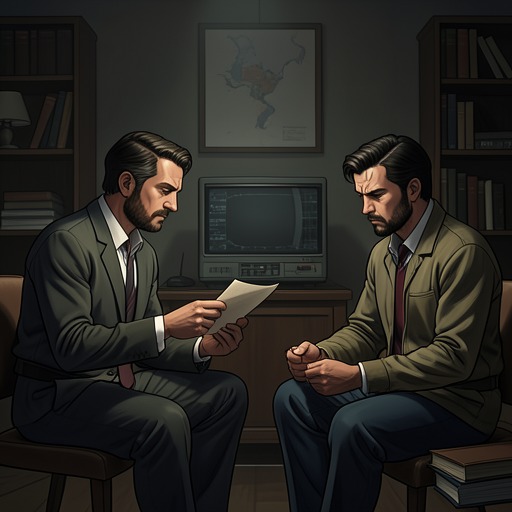
Akeley’s claim of reconciliation with the Outside Beings
The Colour Out of SpaceHenry Wentworth Akeley’s claim of reconciliation with the Outside Beings transforms a story of siege and terror into one of promised intellectual communion. In a letter dated September 6, 1928, he presents their apparent hostility as a misunderstanding, declares that they seek peaceful contact, and casts himself as the human intermediary chosen to make it possible. The announcement offers Albert N. Wilmarth relief, but its speed and strangeness make the supposed peace another source of alarm.
The Letter and Its Reversal
After Akeley’s earlier reports of danger, Wilmarth had urged him to go to Brattleboro and seek the authorities’ protection. He offered to bring the phonograph record and help persuade the courts that Akeley was sane. Wilmarth’s belief in the danger was nearly complete, despite his suspicion that Akeley’s failure to photograph a dead creature might have resulted from an excited mistake.
A new letter, dated Thursday, September 6, and received by Wilmarth on Saturday afternoon, September 8, reverses that expectation. It was postmarked Bellows Falls and typed, including its signature, on a new machine. Akeley did not retract his descriptions of the phenomena; he instead said that the error had been his fearful attitude toward them. This distinction lets the letter preserve the reality of the strange visitors while overturning the meaning Akeley had previously assigned to their presence.
Akeley explains that the visitors had begun attempting communication and that, in response to signals, he admitted a messenger to the house the previous night. He identifies the visitor as a fellow human being, not one of the alien beings themselves. According to his account, the messenger disclosed how badly Akeley and Wilmarth had misunderstood the purpose of the secret colony on Earth. The change is presented as the result of new information, but the letter gives no independent confirmation of what the messenger said.
Akeley’s New Account of the Outside Beings
Akeley attributes the sinister legends about the visitors’ intentions to a failure to understand allegorical speech shaped by radically different cultural backgrounds and habits of thought. He acknowledges that his own theories were as mistaken as those of the farmers and Indigenous people he had disparaged. What he had regarded as shameful and degrading, he now describes as awe-inspiring and intellectually expansive. The reversal does not make the beings ordinary or familiar: it changes fear of the alien into a claim that encountering it can enlarge human understanding.
He also recasts the earlier nightly skirmishes as wrongful aggression against the visitors. In his account, they bear him no grudge because their emotions differ from human ones, and they have never knowingly harmed people. Akeley blames the late Walter Brown, one of their human agents in Vermont, for prejudicing him against them. He further alleges that a secret cult of evil men, associated with Hastur and the Yellow Sign, seeks to track and injure the beings on behalf of powers from other dimensions. On this telling, the visitors’ precautions target those aggressors rather than ordinary humanity; agents of the cult, not the visitors, stole many of the letters that had gone missing.
Akeley presents peace, non-interference, and increasing intellectual rapport as the visitors’ aims. He argues that contact has become more urgent because human inventions and expanding capabilities make it harder for their necessary outposts to remain secret. The proposed exchange is reciprocal: the visitors wish to understand humanity, while a few human philosophical and scientific leaders are to learn about them. Akeley portrays this exchange as the route to a workable coexistence, rejecting the fear that the beings intend to enslave or degrade humankind.
The Interpreter and the Invitation
Akeley claims that the visitors have chosen him as their primary interpreter on Earth because he already knows so much about them. He says the messenger gave him extraordinary information and that further knowledge will come orally and in writing. Although he expects that he may eventually travel beyond Earth by unfamiliar means, he says no such journey is required yet. For the immediate future, he insists, the siege of his house is over and the dogs will have no further work.
The letter expands the apparent reconciliation into a cosmic prospect. Akeley identifies Yuggoth as the visitors’ still-undiscovered, nearly lightless abode at the solar system’s edge, beyond Neptune, while describing it as only a stepping-stone to a much greater habitation beyond human imaginative reach. He suggests that the visitors may direct thought toward Earth to assist mental rapport and that astronomers might then become sensitive enough to discover Yuggoth. He also claims that something of this vastness can be communicated to a very small number of human beings. These details make his new confidence depend not merely on safety at the farmhouse but on access to knowledge far exceeding ordinary human experience.
Having previously warned Wilmarth not to visit, Akeley now invites him to come before the college term begins. He asks Wilmarth to bring the phonograph record, their correspondence, and the available kodak prints, which he says will help them assemble the story; he adds that he has misplaced the negatives and his own prints. Akeley promises extensive discussion, says his house is no longer under surveillance, and asks that the matter remain private. The invitation turns the letter’s claims into a proposed test: Wilmarth is to travel to Vermont and judge the changed situation in person.
Wilmarth’s Doubt and the Letter’s Effect
Wilmarth receives the letter with relief mixed with profound uneasiness. The transition from Akeley’s frantic terror to cool assurance and even exultation seems too abrupt to explain easily, and for a moment Wilmarth wonders whether the whole distant drama might be dreamlike. Yet the phonograph record keeps the earlier reports present as material evidence, making the new account harder to dismiss as an unreal episode.
The change troubles Wilmarth not only as a change of opinion but as a change in Akeley’s apparent personality. He notices differences in word choice, spelling, manner, and the rhythm of the prose, and struggles to reconcile the letter’s author with the man who sent the previous frightened messages. At the same time, the letter retains what Wilmarth recognizes as Akeley’s longstanding passion for infinity and scholarly inquiry. The invitation to examine the claims in person weighs against the possibility of a forged or malign substitute, but does not resolve the larger question of what has happened to Akeley.
Wilmarth spends Saturday night turning between doubt and acceptance. By dawn, curiosity begins to replace his initial perplexity: whether Akeley is mad, sane, or profoundly changed, Wilmarth considers the possibility that he has encountered a real transformation that both reduces his danger and opens extraordinary vistas of knowledge. The letter therefore does not close the mystery of the siege. It shifts the suspense from whether Akeley fears the visitors to whether his new certainty can be trusted—and whether Wilmarth should follow him into the promised exchange.