Cosmic horror and the limits of human understanding
The Colour Out of SpaceCosmic horror and the limits of human understanding are expressed through encounters that can be observed but not assimilated into familiar accounts of matter, life, or the universe. From the vanishing meteor fragment in Nahum Gardner’s yard to the mechanical voice speaking through a brain cylinder, evidence accumulates without yielding mastery: each new fact enlarges the unknown rather than closing it.
Anomaly and the Failure of Classification
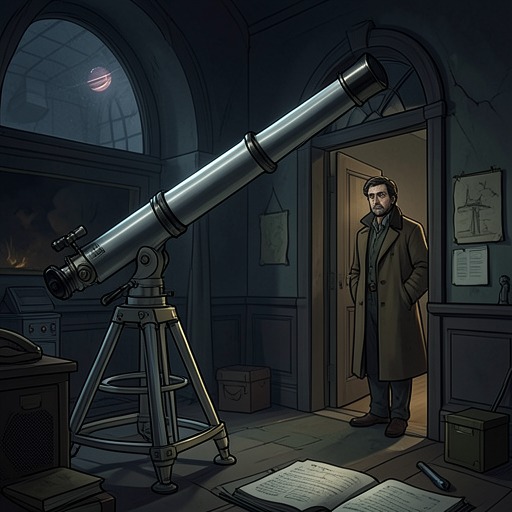
The meteor fragment initially seems available to ordinary scientific inquiry. Professors from Miskatonic University test its heat, malleability, magnetism, luminosity, and unusual spectrum, using tools and procedures meant to turn an unfamiliar substance into a describable one. Yet the fragment behaves in ways that frustrate those procedures. It resists reagents and extreme heat, steadily diminishes in air, and destroys itself alongside silicon compounds. Even its measurable properties fail to identify what it is. The scientists can say that it is not of Earth, but that conclusion marks the boundary of their knowledge rather than a successful classification.
The tests produce a sequence of partial discoveries, each of which deepens the problem. When a larger piece is removed, the professors find a glossy, brittle-looking coloured globule embedded inside it. A hammer blow makes the globule burst with a small pop; nothing emerges, and the object vanishes, leaving only a hollow space. The event can be described in terms of the blow and its immediate result, but those observations do not disclose what the globule contained or what its disappearance means. The supposedly solid meteor is therefore not simply an unfamiliar object. Its substance and its internal contents evade the assumptions by which objects are expected to persist and be examined.
That mismatch extends beyond the laboratory. During a thunderstorm, lightning repeatedly strikes the furrow where the meteor fell, and afterward the main mass is gone, leaving a ragged pit near the old well. The carefully preserved laboratory fragment lasts only a week before disappearing without residue. Instruments and expertise have not failed because no observations were made; they have failed to convert observations into an explanation. The meteor’s brief material presence leaves the scientists unsure, in retrospect, whether they truly witnessed it.
Evidence, Instruments, and Doubt
The stories make the production of evidence part of the horror. In the aftermath of the meteor’s fall, strange plants appear around Nahum Gardner’s farm, and their colours recall the anomalous bands recorded from the fragment. Dust samples later produce a similar spectrum, but lose that property within a month. The connection offers a scientific clue, yet its transience prevents the clue from becoming a stable basis for knowledge. The phenomena leave traces that are real enough to measure and too unstable to secure.
Institutional skepticism compounds the uncertainty. Professors visiting the farm dismiss the plants as strange but not unprecedented, propose that minerals from the meteor may have entered the soil, and treat reports of footprints and frightened horses as country gossip. Their caution reflects familiar standards of evidence, but it also keeps them from investigating a pattern that their own later analysis partially supports. When samples from the dead Gardner family are examined, they briefly show bands resembling those of the meteor before becoming ordinary alkaline phosphates and carbonates. Scientific procedure reveals a residue of the anomaly while also recording its disappearance.
In the Vermont account, recording and photography promise a different kind of proof. Henry Wentworth Akeley uses a phonograph to capture voices near a cave on Dark Mountain on May-Eve. The recording is fragmentary, and its most disturbing voice sounds inhuman despite speaking grammatical English. Later, photographs sent to Wilmarth appear to offer an impersonal check on Akeley’s claims: a clear claw-print, its scale fixed by visible pebbles and grass, seems difficult to dismiss as a trick. Such media strengthen belief because they appear to carry evidence beyond the witness’s fallible memory. Yet they do not settle what made the print or produced the voice; they make an otherwise distant claim feel nearer without making it fully intelligible.
The Body Beyond Ordinary Matter
The limits of understanding become bodily as well as intellectual. Akeley reports finding a dead creature near a kennel after a dog has brought it there. It vanishes within hours, and developed film shows only the woodshed where he saw it. His description of a crab-like body, with fleshy rings and feelers where a human head might be, gives the impossible encounter a concrete shape; the failure of the photograph denies him the lasting proof he hoped to provide. Sight and touch attest to a body, but the body will not remain available to other observers.
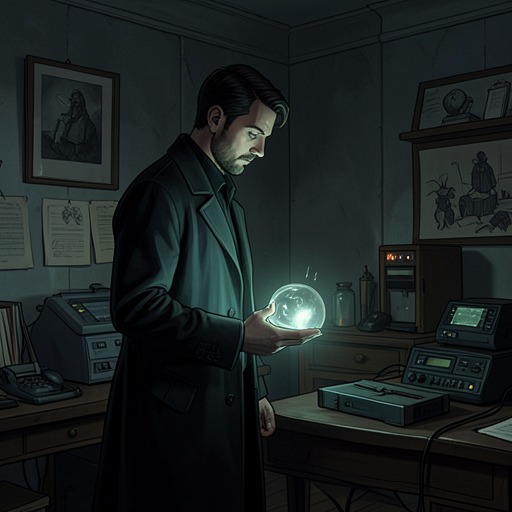
The brain-cylinder technology offers a more systematic crossing of the boundaries between body, mind, and place. Akeley explains that the Outside Beings can transport human brains through interstellar space in metal cylinders, keeping the organic matter in preserving fluid and connecting it to instruments that reproduce sight, hearing, and speech. The travelling person can thus receive sensory and articulate life without a travelling human body. This account turns the limits of ordinary travel into a technical problem, but its apparent precision does not make the process less uncanny: human presence becomes separable from flesh and dependent on an apparatus that imitates vital faculties.
The machine’s voice gives that proposition an immediate, unsettling form. A metallic speaker tells Wilmarth that its speaker is a human being whose body rests under treatment inside Round Hill, while the brain observes and speaks through electronic vibrators. The voice claims journeys across thirty-seven celestial bodies, including places outside the galaxy and beyond the curved cosmos of space and time. The machinery supplies a voice and a claim of presence, but not a familiar human body to confirm them. Technology, which might ordinarily guarantee communication, here exposes how uncertain the relation between identity, embodiment, and perception can become.
Knowledge as Temptation and Threat
The accounts also distinguish the desire to know from the ability to withstand what knowledge brings. After reading Akeley’s detailed letter, Wilmarth moves from attempts to explain away the reports toward belief. The accumulated evidence matters, but so does Akeley’s cool, scholarly manner: it makes extraordinary claims seem unlike the products of fanaticism or hysteria. Wilmarth’s change in judgment does not end in reassurance. Once he accepts the possibility that the reports are true, he becomes willing to help keep people away from the hills, because understanding the threat has made its danger more immediate.
Later, the possibility of travel to Yuggoth and beyond turns knowledge into an explicit temptation. Wilmarth is fascinated by the prospect of escaping the limitations of time, space, and natural law, even as he recognizes the risk to life, soul, and sanity. Akeley’s reported alliance with the Outside Beings has opened further vistas, but those vistas do not promise a humanly manageable truth. In another darkened-room conversation, the revelations attributed to Akeley range from cosmic origins to the nature of entities and the structure of ultimate infinity. Wilmarth refuses to put some of what he hears into words. The restraint is itself significant: speech and scholarship cannot make every discovery safely shareable.
The Cosmic Scale of the Unknown
The meteor narrator’s final account gives this epistemic crisis its starkest formulation. The force rising from the well may be called a gas in material terms, but it follows laws that do not belong to the known cosmos. Calling it a colour does not identify it; the name records the inadequacy of ordinary categories when faced with something outside familiar nature. The image of a message from realms beyond the observable universe captures the story’s central reversal: contact does not make the vast outside more knowable so much as expose how small the available human frame is.
Across these episodes, evidence and ignorance grow together. Spectra, photographs, recordings, physical traces, and mechanical speech narrow the space for easy disbelief, while their instability or incompleteness prevents them from restoring a dependable picture of reality. Cosmic horror therefore lies not only in the existence of strange beings or forces, but in the collapse of the assumption that observation must lead to comprehension. The more firmly the witnesses establish that something has happened, the more clearly they discover that its nature exceeds the systems by which human beings explain the world.