Dark Mountain
The Colour Out of SpaceDark Mountain is a steep, forested landmark south of Townshend whose inaccessible slopes anchor the uncanny reports investigated by Henry Akeley and Albert N. Wilmarth. In the story, the mountain is more than a remote setting: its woods conceal signs that challenge ordinary explanation, while the difficulty of reaching or exploring them helps preserve their menace.
Setting and reputation
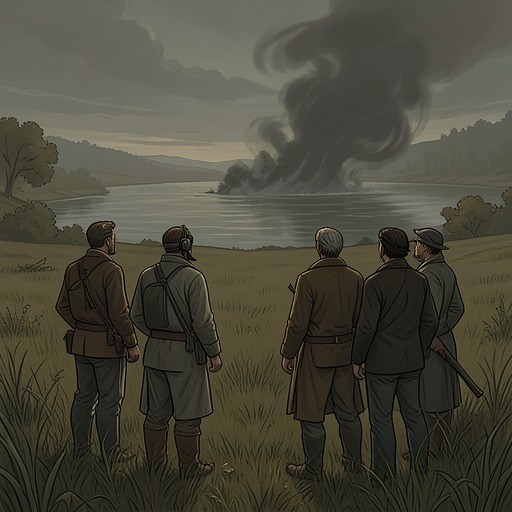
From the old Akeley place south of Townshend Village, Dark Mountain rises behind marshy, sparsely wooded ground. The farmhouse stands below its jagged, leafy summit, and the surrounding hillside is thick with forest. The landscape’s physical remoteness is matched by its reputation: Dark Mountain, like Round Hill, is widely regarded as haunted, yet no one Wilmarth questions has closely explored either place.
Reports associated with the mountain accumulate rather than resolve. Akeley tells Wilmarth that he has found footprints near his home, heard voices at particular points in the woods, and encountered signs of non-human watchers. He says he has not seen the strange shapes reported floating in rivers, but has seen similar things under circumstances he is afraid to describe. The mountain’s threat is thus first conveyed through traces, sounds, and withheld testimony, not a clear view of its inhabitants.
The recording on the western slope
Akeley’s most specific investigation takes place near a closed cave on the wooded west slope, where Dark Mountain rises out of Lee’s Swamp. At about one o’clock in the morning on May-Eve in 1915, he brings a phonograph, a dictaphone attachment, and a wax blank to record the voices that have repeatedly been heard there. His earlier experience leads him to expect that the traditional night will yield unusual results. It does, but the voices never recur at that particular spot afterward.
The resulting recording is fragmentary, partly because the equipment works unevenly and the ritualistic speech is distant and muffled. Akeley distinguishes a voice he cannot identify, apparently human and more cultivated than Walter Brown’s, from a second voice whose buzzing quality seems inhuman despite its grammatical, scholarly English. The recording turns the mountain’s disquieting reputation into material evidence that can be replayed, though it does not explain what produced the sounds.
A landscape of threat and withdrawal
The danger attached to the mountain reaches beyond the cave. After finding the black stone, Akeley’s house becomes the focus of increasingly suspicious sights and sounds; local people avoid the property, and the surrounding district has a history of disappearances that includes Walter Brown. One farmer believes he glimpsed a strange body in the flooded West River, but his account is too confused to establish what he saw. These reports extend the mountain’s influence into the nearby countryside without making its hidden presence fully visible.
After escaping the farmhouse, Wilmarth treats the wild Vermont hills as the outpost of a frightening cosmic race and resolves never to return to the state. That conclusion gives Dark Mountain its larger narrative force: a place initially approached through folklore and disputed reports becomes, for Wilmarth, evidence of an alien presence whose purposes remain uncertain. Its forests preserve the mystery even as recordings, tracks, and local testimony make dismissal increasingly difficult.