Elder Things’ ancient dominion (about 600 million years ago)
The Colour Out of SpaceThe Elder Things’ ancient dominion (about 600 million years ago) is presented as a period of planetary rule by beings whose nature lies beyond familiar terrestrial categories. Their defeat by the Great Race of Yith did not erase their presence: the sealed routes into the inner earth, the ruins associated with their rule, and the fear of their eventual return continued to shape the later history of the Great Race. The account is deliberately incomplete, assembled from obscure records and the impressions of minds displaced across time rather than from a continuous human history.
A Dominion Before Human History
The Elder Things are said to have come through space from immeasurably distant universes and to have dominated Earth and three other solar planets roughly six hundred million years ago. That timescale places their ascendancy far outside the span of human memory or civilization. The broader traditions surrounding the past likewise treat mankind as only one among many dominant races in Earth’s long history: some arose from terrestrial life, others came from the stars, and the succession of species unfolded across immense spans of time.
The account distinguishes this elder dominion from the later age of the Great Race of Yith. The latter is described as living until about fifty million years before humanity appeared, and as mastering time through the projection of minds into other eras. The Elder Things’ rule belongs to a far deeper past, but its defeat and the threat they continued to pose reached forward into the Great Race’s own history.
Nature and Cities
The Elder Things are described as half-polypous and wholly alien, only partly material in the human sense. Their perception did not include sight; instead, they experienced a non-visual pattern of impressions unlike that of terrestrial organisms. Though their senses could pass through material barriers, their substance could not. They could move through the air without visible wings or another apparent means of levitation, and certain forms of electrical energy could destroy them. Their minds were so unlike those of the Great Race that the two could not exchange consciousness.
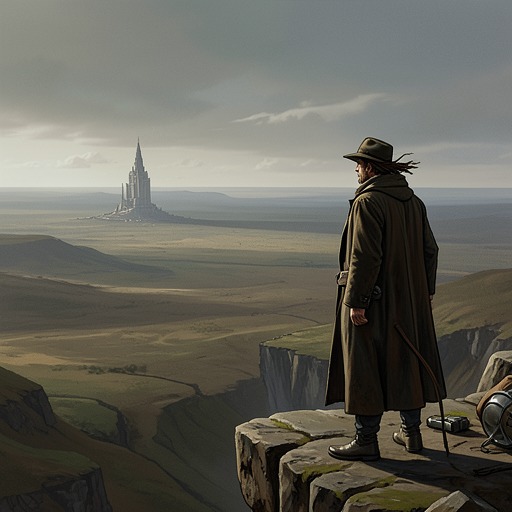
On Earth, they built immense cities of windowless basalt towers and preyed upon the beings they found. Their cities and the passages connected to them later became part of the geography of confinement: the Great Race drove the Elder Things into caverns beneath the surface and sealed the entrances. Some of the ancient structures were retained after the conquest, not simply as objects of scientific or historical interest but for reasons bound up with superstition. The built environment thus carried a memory of danger even when its original inhabitants had been forced below ground.
Conquest and Containment
When the minds of the Great Race reached Earth from Yith, they created instruments that enabled them to subdue the predatory beings. The conquerors drove the Elder Things into the inner earth, into caverns already linked to their own abodes, and sealed the ways down. This victory secured the surface for the Great Race but did not amount to an assured final destruction of its enemy.
Over the succeeding ages, signs suggested that the imprisoned population was growing stronger and more numerous. Particularly dreadful eruptions occurred in remote cities, including deserted elder cities where paths to the depths had not been properly sealed or guarded. The Great Race responded by increasing its precautions. Many routes were closed permanently; a few trapdoors remained sealed but available for strategic use if the Elder Things broke through elsewhere. Geological change also altered the network of passages, choking some routes while creating new rifts. Containment therefore required both deliberate defenses and continuing attention to a landscape that could change beneath the defenders’ feet.
The Future Threat and Its Legacy
The Great Race’s deepest fear concerned a final successful irruption. Its projections through time had foretold a catastrophe associated with the Elder Things, and the Great Race concluded that the coming attack would be an act of vengeance rather than an attempt to reclaim the surface. Later histories showed the planet hosting other races without the Elder Things returning to open dominion; they may have preferred the inner abysses, where light held no meaning, or weakened over the aeons. The account offers these as possibilities, not settled explanations.
The anticipated danger nevertheless shaped the Great Race’s eventual decision to send millions of minds forward into safer future bodies. The Elder Things were expected to be dead by the era of the Post-human Beetle Race, whose members would become the Great Race’s future hosts. Until then, the Great Race maintained weapons and watchfulness while keeping the subject under a strict taboo. Their appearance remained unknown to the narrator: the surviving hints suggest monstrous changeability, moments of invisibility, control or military use of great winds, whistling sounds, and colossal tracks marked by five circular toe-prints, but no reliable description resolves what they looked like.
The dominion is therefore known through a chain of mediated traces: tabooed recollections, fragmentary dreams, reports of ancient cities, and interpretations made long after the events themselves. Its scale unsettles ordinary history, while its sealed trapdoors give that immense past a concrete point of contact with the Great Race’s later world. The Elder Things’ rule had ended, but the possibility that they might emerge again remained powerful enough to govern what their conquerors remembered, concealed, and feared.