Gardner farm meteorite fall
The Colour Out of SpaceThe Gardner farm meteorite fall was the first extraordinary event in the history of the farm that would become the Blasted Heath. In June 1882, an object from unknown stellar space landed beside the well at Nahum Gardner’s farm near Arkham; its persistent heat, progressive disappearance, and apparently anomalous material properties defeated scientific examination before a storm erased the main mass entirely.
Arrival at the farm
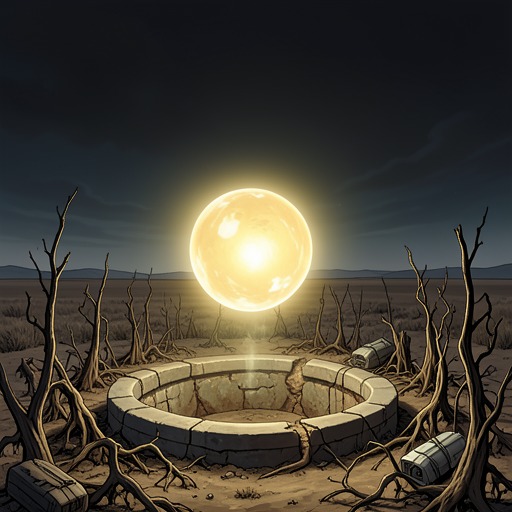
Before the fall, the western woods had no reputation for the wild legends that later gathered around them. The change began with a white cloud at noon, explosions in the air, and a pillar of smoke rising from a valley deep in the woods. By night, word had spread through Arkham that a great rock had fallen from the sky and lodged beside the well on the Gardner farm. The place was then a trim white farmhouse surrounded by fertile gardens and orchards, not the devastated ground it would become.
Nahum Gardner went into town to tell people what had happened and stopped at Ammi Pierce’s house. The next morning, Ammi and his wife accompanied three professors from Miskatonic University to inspect Nahum Gardner’s meteorite. Nahum showed them a large brownish mound in torn earth and charred grass beside the well-sweep. He said the stone had already shrunk since the previous day and had glowed faintly at night. The professors initially answered that stones did not shrink, but the object’s heat lingered, and a geologist’s hammer revealed a substance unusually soft—almost plastic—that could be gouged rather than chipped.
The first sample was put in an old pail borrowed from Nahum’s kitchen. Even the small piece would not cool. On their return journey, the professors stopped at Ammi’s home; Mrs. Pierce noticed that the fragment was growing smaller and burning through the pail’s bottom. The observation turned a puzzling report into a material fact: the specimen continued changing outside the farm, in the hands of the investigators themselves.
A specimen that resisted examination
At the college, the sample behaved unlike any known stone. It faded away when placed in a glass beaker, and the beaker disappeared with it. The professors also reported its affinity for silicon. Further tests left the object’s identity no clearer: it produced no occluded gases when heated on charcoal, reacted negatively in a borax bead, and did not volatilize even at the temperature of an oxy-hydrogen blowpipe. On an anvil it appeared highly malleable, while in darkness it showed marked luminosity.
Chemical tests likewise failed to give the investigators a familiar point of reference. Water and hydrochloric acid had no effect; nitric acid and aqua regia hissed and spattered against the specimen without overcoming it. Although the fragment steadily lost weight and seemed to cool somewhat, the solvents showed no sign of attacking it. It was magnetic, and faint traces resembling the Widmannstätten figures of meteoric iron appeared after immersion in acid. As the material cooled, the professors continued their work in glass, leaving chips from the original fragment in a beaker. By the next morning, both the chips and the beaker had vanished, with only a charred mark on the wooden shelf.
When Ammi returned with the professors to the farm, the main mass had shrunk beyond dispute. The vacant ground around it was broken only where the earth had caved in; the stone, which had measured about seven feet across the day before, was now scarcely five. Still hot, it yielded another, larger sample under hammer and chisel. This time the professors exposed an uneven core containing what appeared to be part of a large coloured globule embedded in the material.
The globule and the storm
The Coloured globule in the meteorite had a glossy surface and a quality that seemed at once brittle and hollow. Its hue resembled bands in the meteorite’s strange spectrum, though the professors could call it a colour only by analogy. When one struck it sharply with a hammer, it burst with a small pop. Nothing came out; the globule simply vanished, leaving a hollow spherical space about three inches across. The investigators thought other globules might be revealed as the surrounding substance wasted away, but drilling failed to find any.
The second sample proved as unclassifiable as the first. It retained heat, magnetism, slight luminosity, and an unknown spectrum; it wasted away in air and attacked silicon compounds with mutual destruction. The scientists could not place it within terrestrial categories. In their account, it was a piece of the great outside, subject to properties and laws that did not belong to the known world. Their tests accumulated observations without producing an explanation.
That night, a thunderstorm supplied the event’s final reversal. The meteorite, previously magnetic, appeared to possess some unusual electrical property. Nahum reported that lightning struck the furrow beside the well six times within an hour. After the storm, the great mass was gone. Only a ragged pit remained near the ancient well-sweep, partly choked with fallen earth. Digging revealed nothing, and the professors confirmed that the stone had vanished completely. A fragment they had carefully sealed in lead survived for a week, but then disappeared too, leaving no residue and no conclusion that could make the encounter ordinary.
Consequences and significance
The fall brought reporters to the farm and made Nahum a local celebrity. Newspapers in Arkham covered the incident, and at least one Boston daily sent a writer to question him. Nahum spoke often of the meteorite in the following weeks, while he and Ammi continued their frequent visits. For the professors, however, public attention could not repair the failure of their investigation: each test produced another property, disappearance, or contradiction, while the object itself left no lasting specimen.
As recalled by Ammi, the fall marks the boundary between a familiar rural landscape and the strange days that followed. Its significance lies not only in the arrival from the sky but in the way matter itself seemed to evade observation: samples dwindled, laboratory glass vanished, a globule left only an empty cavity, and lightning removed the main body. The event offers no stable object for later study, only traces and testimony. The farm’s first transformation thus begins with a scientific investigation that repeatedly finds evidence and repeatedly loses the thing that evidence might explain.