Great Race central archives
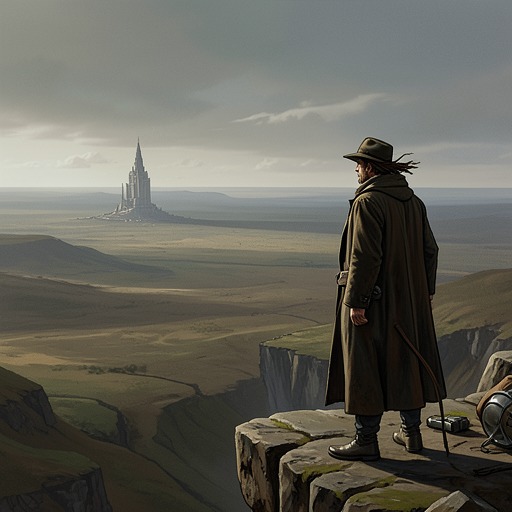
The Colour Out of SpaceThe Great Race central archives are a colossal underground repository designed to preserve the histories of Earth’s successive species and, in Peaslee’s account, the annals of the wider cosmos. In his dream-fragments it is a place of immense order and almost unimaginable duration; in his later underground exploration, a book bearing his own handwriting makes that remembered archive seem physically real, while the failure to recover the book leaves its reality unsettled.
Purpose and historical scope
The archives serve the Great Race of Yith as a storehouse for knowledge gathered across ages. Their books contain histories and descriptions of species that have existed or will exist on Earth, including accounts of their languages, arts, achievements, and psychologies. The repository’s scope is not confined to human history: it preserves knowledge assembled from many periods and forms of life, and Peaslee’s later recollection extends its records to minds from every orb and age in the solar system.
This immense collection is linked to the Great Race of Yith’s ability to investigate time by projecting minds into other periods. The race could learn from past and future life-forms, then add knowledge of different eras to its own store. The archive therefore represents more than a library of surviving documents: it is the material organization of a project to gather and classify knowledge beyond the reach of any single species or lifetime. Its comprehensiveness is asserted through the dream and mythic history that Peaslee reconstructs, not independently demonstrated by the surviving evidence.
The records also reveal limits to that project. When a displaced mind returned to its own time, the Great Race of Yith used mechanical hypnosis to erase what it had learned, because the transmission of large quantities of knowledge could bring disaster. Only fragmentary memories generally survived, and rare traces could pass into later myths or secret traditions. The archives preserve collected histories, while the means by which that knowledge was acquired were designed to prevent most subjects from carrying it home.
Design, materials, and classification
In Peaslee’s dreams, the archives occupy a gigantic subterranean structure near the center of a Great Race of Yith city. It is built to endure for as long as the race itself and to withstand even severe geological upheavals. Its massive construction gives the collection a physical counterpart to its ambition: records meant to span aeons are housed in a building conceived to survive them.
The books are made from sheets of unusually durable cellulose fabric and open from the top. Each is stored in an individual case of light, rustless grey metal, marked with mathematical designs and a title in the Great Race of Yith’s curvilinear script. The cases are arranged in tiers of rectangular metal vaults, secured by knobs that require intricate turns to open. The archive’s contents are thus not simply accumulated in one undifferentiated mass; both the cases and the storage system impose a formal order on the records.
Peaslee’s own history is assigned to the lowest, vertebrate level, in a section devoted to humanity and the furry and reptilian species that preceded it in terrestrial dominance. This classification places humankind within a sequence of animal populations rather than at the center of history. The section’s position also gives the archive an unsettling perspective: what human beings treat as the principal story of the world is only one category in a much longer catalogue.
The archive as a remembered place
Peaslee’s impressions of the archive arise from his dreams of life during his period of amnesia. He remembers preparing a history of his own age for the central collection, partly through his own participation and partly in response to promises of greater access to libraries and travel. The book he was preparing was to join records housed in the massive building, but his recollections of daily life there remained misty, disconnected, and out of sequence.
Other fragments nevertheless give the repository a precise spatial presence. Peaslee recalls a great stone room of his own, the vaults on the lowest level, and the familiar procedure for opening the metal shelves. In his later account, the memory of particular turns and pressures returns with startling confidence. That remembered familiarity becomes consequential when he reaches the underground structure: instead of approaching an unknown ruin as a detached investigator, he feels drawn through it by knowledge he cannot explain as ordinary recollection.
Ruins and the approach to the vaults
The Australian expedition gives Peaslee’s dream-knowledge a material setting. After a month of digging, the party has uncovered about 1,250 blocks, many of them carved megaliths, without finding a clear arrangement among them. Their extreme age and scattered condition suggest repeated geological upheavals. The expedition does not establish that these blocks belong to the archive itself, but the ruins intensify Peaslee’s sense that the buried world he remembers may have existed.
During his underground exploration, Peaslee recognizes a route toward what he believes is the central archival structure. He passes through obstructed corridors and reaches a low circular crypt with arches opening on every side. Its walls bear dense curvilinear inscriptions, some of them apparently added after the period represented in his dreams. Beyond the crypt, the preserved contours of the underground complex and the great metal shelf-doors match his recollections closely enough that familiarity displaces ordinary surprise.
Inside the vaults, the signs of long duration are visible in both survival and damage. Some shelf-doors remain in place; others have sprung open or buckled under geological pressure. Dust-covered heaps lie beneath empty shelves where cases appear to have fallen. The masonry has endured, but the storage system has not escaped the earth’s movement intact. As Peaslee hurries through the aisles, his shoeprints mark dust he believes no human feet have disturbed before, making the act of entering the archive itself a new trace within the deep past.
The book and the limits of proof
Among the cases, Peaslee opens a thin volume with a familiar hooked fastener. Its dimensions and top-opening metal covers fit the form he remembers, while its durable cellulose pages appear to have survived immense spans of time. At first, the book’s pigmented writing seems to belong to a language associated in his dreams with a captive mind from a large asteroid. He also remembers that this level held records concerning non-terrestrial worlds.
The final recognition overturns that first interpretation. The marks on the pages are not an unknown script but the familiar English alphabet, spelling words in Peaslee’s own handwriting. The volume appears to connect the buried archive directly to the history he had been composing during his remembered existence among the Great Race of Yith. If genuine, it would turn the archives from a dream-image into material evidence that his lost years involved more than amnesia or myth-shaped fantasy.
Yet Peaslee brings no metal case back from the ruins, and the underground corridors remain undiscovered by others. His account therefore ends with a critical gap between the force of recognition and the absence of an independently inspectable object. The archives’ narrative significance lies in that tension: they promise a record complete enough to encompass ages and species, but the single object that might prove Peaslee’s connection to them survives only as his report of what he saw.