Henry Wentworth Akeley
The Colour Out of SpaceHenry Wentworth Akeley is a learned Vermont recluse whose firsthand evidence overturns the folklore debate that brings him into contact with Albert N. Wilmarth. Akeley’s passage from observer to apparent ally of the Outside Beings, and then to an absent figure represented by artificial face and hands, gives the story a human center while leaving its crucial question—who, or what, has taken his place—unanswered.
Identity and Background
Akeley belongs to a locally distinguished family of jurists, administrators, and gentleman-agriculturists, and is its last representative on its home soil. The family’s intellectual direction had shifted away from practical affairs before him: he pursued scholarship instead, studying mathematics, astronomy, biology, anthropology, and folklore at the University of Vermont. Despite this education, he is described as a recluse with little worldly sophistication. His combination of rigorous learning and isolation matters to Wilmarth’s assessment of him: Akeley seems neither a simple fabulist nor a polished persuader, but an intelligent man working from evidence that has unsettled him.
Akeley’s knowledge of the region’s strange traditions began with stories told by elderly farmers. These accounts belonged to a wider body of New England folklore about hidden beings in remote hills, and they echoed reports of footprints, dangerous valleys, and voices imitating human speech. In the older legends, the beings usually left people alone unless their privacy was violated; later versions also told of secret contact, disappearances, and recluses suspected of alliance with them. Akeley’s scholarship gave him a framework for recognizing these stories, but his own testimony would persuade him that inherited legend did not explain away everything people claimed to have encountered.
From Folklore to Firsthand Evidence
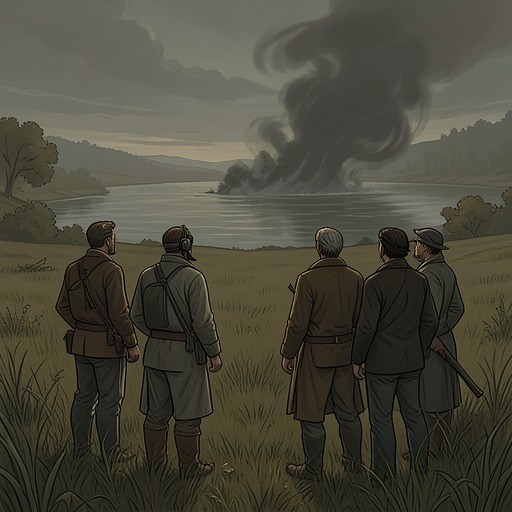
The 1927 Vermont floods revived rumors of strange forms seen in swollen rivers. Reports clustered around three locations: the Winooski River near Montpelier, the West River beyond Newfane, and the Passumpsic River above Lyndonville. Witnesses described pinkish, roughly five-foot-long bodies with crustacean shapes, articulated limbs, and great fins or membranous wings. Wilmarth initially explained such testimony through flood debris and the power of old stories to shape what frightened witnesses thought they saw. Akeley challenged that dismissal from a different position: he had not seen the river forms, he said, but he had encountered similar beings under circumstances he dreaded recounting.
In a letter to Wilmarth, Akeley reported footprints drawing nearer to his home, the old Akeley place south of Townshend Village on Dark Mountain, and voices heard at particular places in the woods. To preserve one of those sounds, he took a phonograph with a dictaphone attachment and a wax blank to the site. The resulting record frightened older listeners because one voice resembled the buzzing voice in the traditions they had heard from their grandmothers. Akeley also promised photographic prints that he believed would support his claims. The phonograph and photographs were not just stories about distant witnesses: they were attempts to make local evidence portable and testable.
Akeley’s caution was as important to Wilmarth as the alarming subject itself. He argued that there were nonhuman watchers and spies among people, but distinguished his private investigations from public debate. He said he supported Wilmarth’s skeptical side publicly because attracting attention might draw visitors toward the places he had explored. He also traced some of his clues to a man he believed had been one of the spies; that man later died by suicide, and Akeley suspected others remained. His fear thus combined particular evidence with a practical concern about what public curiosity might bring.
Reversal and Alliance
By September 1928, Akeley wrote that his earlier fearful attitude had been mistaken, though he did not withdraw his claim that the phenomena were real. He reported that a messenger from the Outside Beings had come to his house in response to signals. The visitor, Akeley emphasized, was a fellow human being, and his account had changed Akeley’s interpretation of the beings’ hidden colony and intentions. Akeley now treated the hostile legends and alleged offers as products of misunderstanding: speech shaped by sharply different cultures and habits of thought, he believed, had been read as something evil or degrading. He conceded that his own conjectures had been no more reliable than those of the farmers and Indigenous storytellers whose accounts he had studied.
This reversal makes Akeley’s learning both an asset and a vulnerability. He is willing to revise a conclusion when new testimony changes how he reads the evidence; at the same time, his confidence in a new explanation follows a meeting whose details remain beyond Wilmarth’s direct knowledge. The letter presents reconciliation as the result of communication, but it cannot settle whether Akeley has correctly understood his visitor or the beings’ purposes. His shift therefore does not close the mystery. It changes its terms, moving the danger from an openly hostile hidden race toward the problem of trusting an account supplied through an intermediary.
Wilmarth’s Visit and Akeley’s Disappearance
When Wilmarth visits Akeley’s farmhouse, the host’s apparent physical condition deepens the uncertainty. Akeley is rigid and nearly motionless, with a corpse-like appearance, and speaks in an incessant whisper. Wilmarth finds the sound peculiarly penetrating despite its apparent weakness, and later recognizes in it an unsettling resemblance to the voice associated with the phonograph record. Rather than reassuring him, Akeley’s illness and their earlier correspondence now pull in opposite directions: the man Wilmarth had trusted on paper provokes repulsion in person.
A mechanical speaker adds another version of the human body to this uncertainty. It identifies itself as a human brain housed in a cylinder at Round Hill, connected to sight, hearing, and speech equipment. The speaker claims to have traveled on thirty-seven celestial bodies, including places beyond the galaxy and beyond the curved cosmos of space and time, and says it expects to travel with Akeley. Its account presents brain-cylinder travel as a means by which human beings can accompany the Outside Beings. Wilmarth is also told that Noyes, his guide, is one of the beings’ human allies. These revelations make Akeley’s apparent change of allegiance part of a larger human association, but they do not prove what has happened to Akeley himself.
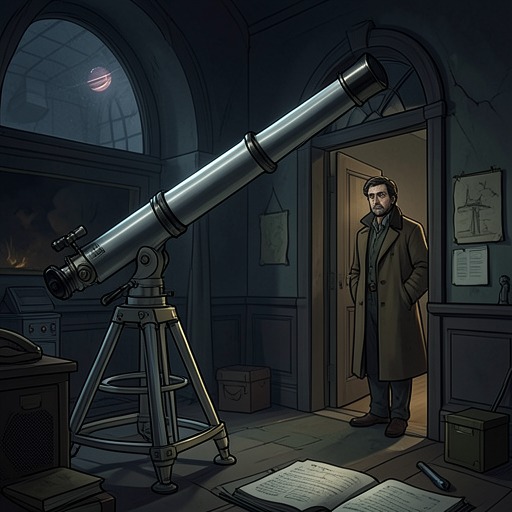
Later, Wilmarth finds Noyes asleep on a living-room couch and enters the dark study, where a fresh, shiny brain cylinder bearing Akeley’s name remains on the table with sensory attachments and a speech machine nearby. Akeley is not in his chair. His dressing gown trails to the floor, and his yellow scarf and large foot bandages lie beside it; the strange odor and vibration Wilmarth had noticed near him have also disappeared. In the chair, partly concealed by the clothing, Wilmarth finds three ingenious constructions fitted with metallic clamps: a face and hands that seem, in microscopic detail, to be Akeley’s. The investigators later do not find these objects. The evidence suggests substitution or concealment, but neither Wilmarth nor the reader receives a definitive account of where Akeley is or what became of his living body.
Narrative Role and Unresolved Identity
Akeley first appears as a countervoice to Wilmarth’s confidence that folklore can explain reports of the uncanny. His scholarly training makes him a credible challenger, while his isolation and fear keep his evidence bound to a landscape that outsiders rarely visit. The movement from newspaper reports to recorded voices, correspondence, mechanical speech, and the objects in the empty chair steadily changes the status of what can be known: each new form of evidence seems more tangible, yet each leaves a more disturbing question about its source.
His disappearance is the sharpest expression of that tension. Akeley’s name survives on a cylinder, and his face and hands survive as objects, while the person they identify is absent. The apparent proof of bodily imitation does not establish whether the man who welcomed Wilmarth was Akeley, an impostor, or something in between. By withholding that answer, the story turns the scholar who once sought reliable evidence into evidence himself: a set of traces that can be examined, but cannot restore certainty about the person who left them.