Mind projection and temporal body exchange
The Colour Out of SpaceMind projection and temporal body exchange is the method by which the Great Race of Yith ranges across time, entering other eras in living bodies and drawing knowledge from minds displaced into its own age. It makes time an inhabited field of study rather than a one-way passage: minds can cross the boundary between periods, but the exchange also creates captivity, dependence on machinery, and the possibility of permanent displacement.
Temporal reach and purpose
The practice belongs to a race described as the greatest of Earth’s successive peoples because it alone mastered the secret of time. Its minds could project themselves across gulfs of millions of years to investigate what had been known, or would eventually be known, on Earth. The knowledge gained was associated with the legends of prophets in human mythology, though the Great Race’s method was not prophecy in the ordinary sense: it was an investigation conducted by a mind present in another period.
The Great Race’s libraries preserved histories and descriptions of species from across Earth’s past and future, including accounts of their arts, achievements, languages, and psychologies. This archive made projection more than a means of individual discovery. The race could select ideas and techniques from different eras and adapt them to its own circumstances. Knowledge of the past was harder to obtain than knowledge of the future; the latter had a more material procedure, supported by suitable mechanical aid.
How the exchange works
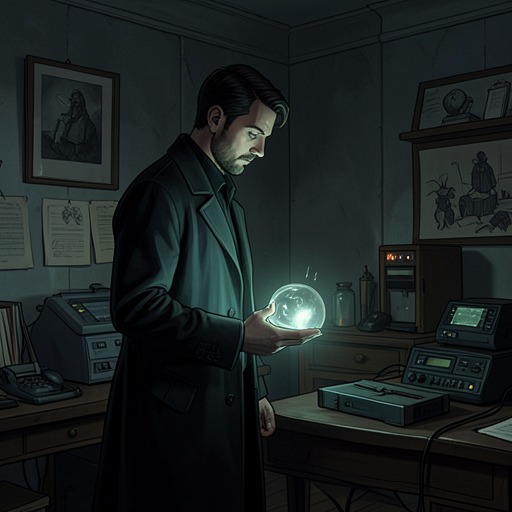
In a forward projection, a mind travels toward a chosen future period until it can identify a suitable representative of that age’s highest life-forms. After preliminary trials, the projecting mind enters that organism’s brain and establishes its own activity there. The organism’s displaced mind is sent backward into the projector’s body and period. Each consciousness thus occupies a body belonging to a different time: the explorer studies the future from within its life-form, while the captive mind inhabits the Great Race member’s body in the earlier age.
The displaced mind was supervised and prevented from harming the body it occupied, then questioned by trained interrogators so that its knowledge could be recorded. When earlier expeditions had supplied a record of the relevant language, questioning could take place in the captive’s own tongue. If the Great Race could not reproduce that language physically, it constructed machines capable of rendering the unfamiliar speech. The exchange therefore relied not only on mental projection but also on records and devices that mediated communication between radically different forms of life.
Captivity, study, and return
The ordinary exchange did not end with interrogation. Once the initial shock and resentment had diminished, a captive mind could study its temporary environment and approach some of the understanding available to its displacer. With precautions and in return for services, it might travel through the habitable world in titan airships or in large, boat-like vehicles powered by atomic engines. It could also consult the Great Race’s libraries. Access to unfamiliar histories and futures could make the captive’s situation more bearable, without changing the fact that its own mind had been removed from its proper era and body.
When the explorer had learned what it sought, it built an apparatus like the one that initiated the journey and reversed the projection. The explorer returned to its own body and age; the captive mind went back to the future body to which it belonged. This restoration was the intended outcome of ordinary exploration, not an automatic consequence of the original exchange: a second operation was required to undo the first.
Failure, memory, and lasting consequences
Restoration became impossible if either body died during the exchange. The surviving mind then had to live out its life in a foreign body and period. The Great Race also knew of complicated exchanges involving minds from different times, including cases in which another mind displaced an explorer or an already captive consciousness. Such cases could be investigated and rectified, and penalties for members who displaced future minds could be arranged to follow them into their new bodies. These safeguards show that projection had serious consequences within the Great Race’s own society as well as for its captives.
A returned captive mind was subjected to mechanical hypnosis intended to remove what it had learned in the Great Race’s age. The procedure reflected the danger attributed to carrying large amounts of knowledge across time: a small number of clear transmissions had caused, or were expected to cause, major disasters. Most returning minds therefore retained only broken impressions, often as a dream-like blank extending back to the first exchange. Occasional fragments nevertheless survived and contributed to later traditions about the Great Race, including material associated with the Pnakotic Manuscripts and the Necronomicon. Memory erasure could limit what returned minds carried home, but it could not guarantee that every trace disappeared.
Migration and significance
The Great Race’s own origin is presented as an earlier instance of mind transfer on a vast scale. Its mental heritage came from beings of a dying elder world, whose minds projected en masse into the cone-shaped species that inhabited Earth roughly a billion years ago. The incoming minds survived in new bodies, while the minds displaced into the elder forms were left to die. The Great Race’s bodily form was thus not the origin of its consciousness: its collective identity had crossed between worlds and species before it developed its mastery of temporal exploration.
That history anticipates a later migration. When the Great Race again faced the limits of its physical existence, its best minds would project forward into the bodies of another species with a longer future ahead of it. Temporal exchange is therefore both a research method and a means of survival across biological eras. Its central paradox is that the pursuit of knowledge depends on displacing another consciousness, while the effort to preserve a mind can leave that mind stranded in a life, body, and age it did not choose.