Nahum Gardner's well
The Colour Out of SpaceNahum Gardner's well is the focal point of the unexplained disaster at the Gardner farm. Set beside the house where a meteorite fell, it first becomes a source of contaminated water and later the place where the family’s losses, the strange substance, and the limits of the investigators’ explanations converge. Its importance lies not only in what may be beneath it, but in how the well links the meteorite’s arrival to the farm’s decline and the final evidence that the threat remains active.
Setting and First Signs
The well stood in the front yard of Nahum Gardner’s trim white house, near the place where the meteorite struck the ground. When Nahum showed the visitors the fallen stone, the mound lay amid ripped earth and charred grass beside the well’s archaic sweep. The stone had already seemed to shrink, retained heat, and yielded a soft fragment for examination. That fragment continued to change on the journey back: it grew smaller and burned through the bottom of the pail borrowed from Nahum’s kitchen. The well was therefore part of the scene from the first investigation, though the observers initially focused on the meteorite and the unusual specimen rather than on the water below.
That arrangement gives the well a double role. It is an ordinary feature of the farmyard, used within a household that depends on its own land and water; at the same time, its position beside the impact site places it within the area altered by the meteorite. The later events make that physical proximity consequential. What first appears to be a practical source of water becomes a suspected channel through which the farm’s unseen danger reaches the people and animals living there.
Water and the Family’s Decline
As the vegetation withered and the household’s condition worsened, the well water acquired an unpleasant taste. Ammi Pierce recognized the change during one of his rare visits and advised Nahum to dig another well on higher ground, so the family could use a different supply until the soil recovered. Nahum did not act on the warning. By then, the family had grown accustomed to a succession of strange and distressing changes, and Nahum and his sons continued drinking from the well as they went through their daily chores.
The danger associated with the water becomes more explicit when Thaddeus Gardner visits the well in September. He returns without the water he went to draw, distressed and speaking of moving colors below. His experience marks a further change in the well’s significance: it is no longer simply a questionable household supply but a place from which a member of the family returns profoundly changed. Later, in his final account to Ammi, Nahum connects the well to the family’s losses. He says that the strange substance lived there, that Zenas Gardner did not return from a visit, and that the water was evil. He also describes the substance as drawing life from living things. These statements are Nahum’s explanation of what happened, not a scientific account established by the investigators, but they make the well the center of the family’s understanding of the disaster.
Search and Findings
After Nahum’s death, Ammi tells the authorities that Nahum had feared something was in the well and had avoided searching it for Merwin and Zenas. The officials insist on examining it before leaving the farm. They haul up the water, which is foul and much lower than expected, and find remains belonging in part to both boys, along with those of a deer, a dog, and smaller animals. The evidence confirms that the well contains the missing family members and animals, but it does not explain how they came to be there or establish the precise cause of their deaths.
The examination deepens rather than resolves the mystery. At the bottom, the ooze and slime appear porous and bubbling; a pole pushed into the mud meets no solid obstruction, even at considerable depth. The investigators find no convincing explanation that can connect the farm’s damaged vegetation, the illnesses affecting people and livestock, and the boys’ deaths in the well. They consider whether the meteorite poisoned the soil or the water, but neither suggestion accounts for the full range of events. Thus, the well supplies evidence while resisting interpretation: it yields remains and tainted water, yet its bottom offers no ordinary boundary that could settle what lies beneath.
The Light and the Well’s Significance
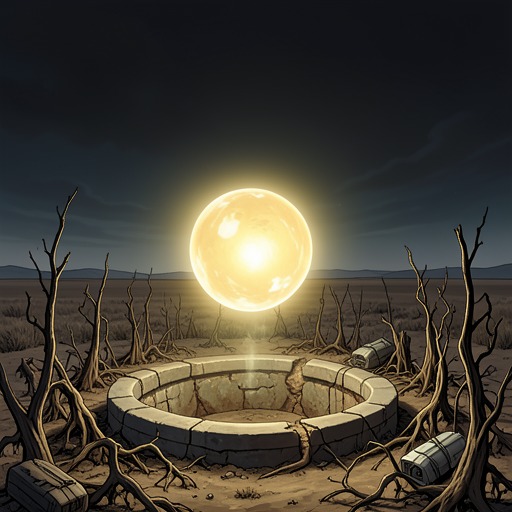
After night falls, the coroner notices a distinct glow rising from the well. Ammi recognizes its unusual color from earlier appearances: in the meteorite’s strange globule, in the altered plants, and briefly at the barred window of the room where disturbing events had occurred. He also recalls the vapor that passed him before Nahum was taken by something of the same color. The light from the well therefore brings scattered observations together, linking the original stone, the farm’s changing vegetation, the household’s suffering, and the well itself.
The glow does not provide a complete explanation. It does, however, make the well’s role more ominous than that of a contaminated water source: after the family has been devastated and the investigators have searched its depths, it emits the same anomalous light associated with the meteorite and the spreading changes. The well becomes the story’s point of recurrence, returning the reader to the place where the impact entered the farm’s everyday landscape. Its ordinary function and its unexplained activity remain inseparable, and the investigation ends with evidence that the danger has not been accounted for or contained.