Nahum Gardner’s meteorite
The Colour Out of SpaceNahum Gardner’s meteorite falls beside the well at Nahum Gardner’s farm in June 1882 and turns a quiet valley into the starting point of the strange days. Its behavior repeatedly frustrates scientific measurement: it shrinks, remains hot, and disappears in stages, while its brief appearance in the laboratory offers signs of matter that does not obey familiar earthly laws.
Arrival and examination
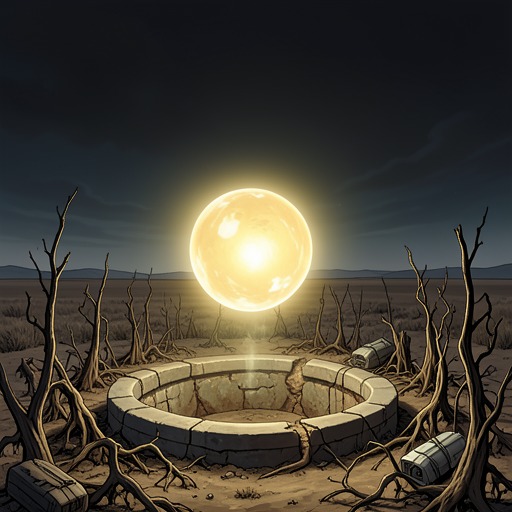
The meteorite comes down after a white noontide cloud, explosions in the air, and a pillar of smoke rise from the woods. It beds itself in the ground beside the well at the Nahum Gardner farm, whose trim white house, fertile gardens, and orchards still stand where the blasted heath will later be. Before the fall, the western woods had not been feared in the way they would be after the strange days.
The following morning, three professors from Miskatonic University go with Ammi Pierce to inspect the object. Nahum Gardner says it has already shrunk since the previous day. The professors doubt that stones shrink, but find the mound soft enough to gouge with a geologist’s hammer rather than chip. They carry a sample away in a pail borrowed from Nahum’s kitchen; even this smaller piece stays hot. At Ammi’s house, Mrs. Pierce notices that the fragment is diminishing and burning through the pail’s bottom.
An unclassifiable substance
In the laboratory, the sample continues to waste away. It fades completely when placed in a glass beaker, and the beaker disappears with it. The professors find that heating it produces no occluded gases and that it behaves negatively in a borax bead test; it is also non-volatile at every temperature they can produce, including the oxy-hydrogen blow-pipe. On an anvil it appears highly malleable, while in darkness its luminosity is conspicuous.
The most striking result comes when the sample is heated before a spectroscope: it shows shining bands unlike any known colors in the normal spectrum. The fragment is magnetic, retains heat, and resists water, hydrochloric acid, nitric acid, and aqua regia. Its weight nevertheless decreases over time. The tests also suggest an affinity for silicon: the substance and silicon compounds attack one another with mutual destruction. None of these properties lets the professors identify it, and their measurements do not yield a dependable classification.
The colored globule
As the enclosing substance wastes away, investigators uncover part of a glossy colored globule embedded within it. Its appearance is so unfamiliar that calling it a color is only an analogy, though it resembles some of the meteorite’s spectral bands. Tapping it suggests both brittleness and hollowness. When a professor strikes it with a hammer, it bursts with a small pop; nothing emerges, and the object vanishes at the puncture. It leaves a hollow spherical space about three inches across. The investigators think further globules may be exposed as the surrounding material disappears, but drilling in search of them proves futile.
Vanishing and significance
A thunderstorm brings the meteorite’s disappearance. According to Nahum, it draws lightning with peculiar persistence: he sees six strikes hit the furrow in the front yard within an hour. When the storm ends, the object is gone, leaving a ragged pit beside the ancient well-sweep, half choked with fallen earth. Digging finds nothing, and the professors confirm that the meteorite has vanished.
The fragment they had kept sealed in lead lasts another week. It then disappears without residue, after yielding no useful explanation. The meteorite thus defeats the usual promise of scientific inquiry: it can be observed and tested, but not preserved long enough to be understood. The narrative presents it as a piece of the great outside, governed by properties beyond earthly matter. Its fall is the first material sign of the strange days, while its repeated vanishing makes that sign impossible to hold onto.