Peaslee delved into the underground ruins and found the archive
The Colour Out of SpaceNathaniel Wingate Peaslee’s descent into the buried ruins culminates in the discovery of the Great Race of Yith’s central archive, where an apparently ancient book bears his own handwriting. The journey transforms a landscape he had approached as an archaeologist into a place he seems already to know from the dreams and fragmentary memories that have haunted him. Its decisive evidence is also incomplete: Peaslee leaves the metal case behind, and the underground passages remain unverified by anyone else.
From Excavation to a Buried Structure
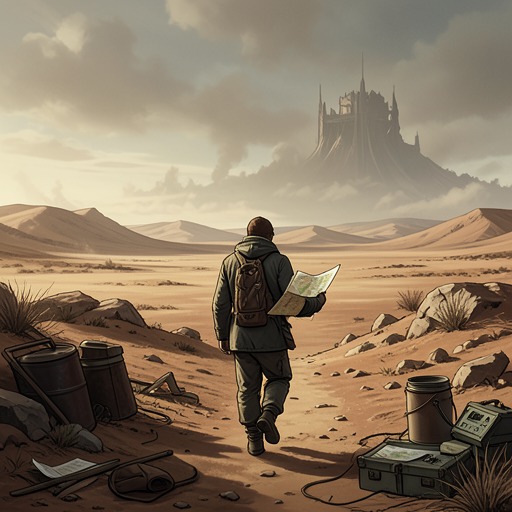
The approach begins during the expedition to investigate ruins in the desert of Western Australia. After a month of digging, the party has uncovered about 1,250 blocks, many of them carved megaliths with curved tops and bottoms. The deeper the excavators go, and the farther north and east they work, the more blocks appear, but they cannot establish how the stones were arranged. William Dyer is struck by their immense age; the scattered fragments suggest geological upheaval on a scale that makes ordinary historical chronology feel inadequate.
Peaslee’s son, Wingate Peaslee, takes an aeroplane up to look for larger patterns in the sand and rocks. The shifting surface makes the aerial impressions unreliable, but some of the fleeting outlines seem disturbingly familiar to his father. Peaslee’s growing sense of recognition draws together two kinds of evidence that cannot easily be separated: actual ruins in the desert and dream-images associated with his former life as a captive mind of the Great Race of Yith. He does not set out with a clear, demonstrable route to the archive; rather, the apparent fit between remembered architecture and the scattered stones increasingly directs his attention.
The Opening Beneath the Megaliths
During a solitary night walk, Peaslee comes upon the largest concentration of blocks he has yet seen, a low, irregular mound roughly forty feet across and between two and eight feet high. At first the stones resemble the earlier finds. Looking across several at once, however, he recognizes that their curving designs are related: together they form parts of a single decorative scheme. This is the first place where he finds the masonry still arranged in a definite, though ruined, structure rather than scattered without discernible order.
As he climbs over the mound and clears sand from the stones, its former shape comes to him with a precision that exceeds what the visible fragments appear to explain. He recognizes it as a corridor about thirty feet high, paved with octagonal blocks and once roofed by a vault. His dream-derived knowledge supplies a larger plan as well: a route to the Square of Pillars, a room of machines, a passage to the central archives, and a trap-door several levels below. These details are not presented as the result of archaeological reconstruction alone. Peaslee is unsettled by how readily he seems to know the positions of places still hidden beneath the rubble.
A current of air rising from a depression near the mound suggests a substantial hollow below. Peaslee moves the blocks that he can shift, opening an aperture wide enough to enter. Beneath it, fallen masonry slopes downward at about forty-five degrees, while a dark gap and the remains of immense vaulting indicate a much larger structure under the desert floor. He begins the descent alone, without arranging for anyone to know his whereabouts. The route is difficult and the ruins unstable, but his attention is fixed on the familiar architecture and the possibility that the archive still exists.
Following Familiar Corridors
At the lower level, massive walls and vaulted spaces correspond to the buildings of his recurrent dreams. The connection is more than a general resemblance: Peaslee believes he knows the archive’s location and remembers the mechanisms used to open its metal storage units. In the dreams, he had helped prepare a history of his own era for the Great Race of Yith’s central archives. Those records were described as histories of the solar system, produced by captive minds from different worlds and periods. The ruins therefore seem to connect his private dream-life with a specific institution of the vanished civilization.
The route is obstructed by collapsed masonry. Peaslee crosses a mound of fallen stone, squeezes through a passage he has forced open, and reaches a circular crypt with arches opening around it. The walls retain carved, curving symbols, and some appear to have been added after the period represented in his dreams. Beyond a familiar archway, the archive’s construction seems to have survived with its essential contours intact: its immense blocks and strong binding materials have resisted geological forces that damaged other parts of the complex.
Inside, Peaslee finds rows of metal shelf-doors, some still in place, some open, and others bent by earth movements. Dust-covered piles beneath empty spaces suggest that cases have fallen from their shelves. The surviving arrangement gives him access to an archive still legible in its broad organization, but not untouched: the ruined shelves and scattered cases register the passage of geological ages. He recognizes the vaults and their classifications as features of the place he had known in dreams, and presses onward through the aisles with a purpose he cannot fully account for.
The Book and the Uncertain Evidence
Peaslee stops at an open vault and removes a thin metal case. Its fastening is familiar to him; inside is a book with tough cellulose pages, metal covers, and writing in unfamiliar symbols. He recognizes the script, through his dream-memory, as belonging to a captive mind from a large asteroid, and understands the volume to belong to the archive’s section on non-terrestrial worlds. The encounter makes the archive more than a remembered architectural setting: its classification system and surviving records also seem to correspond to information carried over from his dreams.
The crucial discovery comes when Peaslee reaches a volume whose appearance at first seems to promise proof of the ancient archive. Its pages, however, do not contain an unknown script. They bear the familiar alphabet and English words, written in Peaslee’s own hand. The book links the Great Race of Yith’s archive to the history he had prepared in his dreams and to the years of memory loss that shaped his later life. It is the strongest evidence that his dream-knowledge may derive from an actual experience rather than from invention, while also making the apparent identity between past and present more disturbing than the discovery of unfamiliar writing would have been.
The evidence remains vulnerable because Peaslee does not bring the metal case back from the ruins, and the subterranean corridors have not been found. He later presents his account as dependent on the reality of what he believes he saw, while acknowledging that the experience might have been a dream or an illusion. The action therefore ends in a double outcome: he has located, in his own account, the archive that his dreams had repeatedly described, but he has returned without the physical object that could make the discovery independently verifiable. The ruins make deep time tangible; the missing case leaves their history—and the source of Peaslee’s knowledge—unsettled.