Peaslee escaped from the underground ruins
The Colour Out of SpaceNathaniel Wingate Peaslee’s escape from the subterranean ruins is both a physical return to the desert and a collapse of confidence in what he can remember. Carrying a metal case out of the buried archive, he is driven by alarming sounds and an unexplained wind toward the surface; after a violent crossing, he emerges in Australia without the case or his flashlight and cannot decide where waking experience ends and delirium begins.
The return through the ruins
Peaslee knows the route back through the buried structure, but the return is more difficult than his earlier passage. He recognizes the archway that leads toward the way out, then reaches a high mound of debris obstructing the narrow passage he had previously forced through. The archive case, newly added to his burden, must be pushed through the opening before he can squeeze after it. The obstacle makes quiet movement difficult, and when the case slides down the rubble beyond the aperture, its clatter echoes through the ruins.
The noise changes the character of the escape. Peaslee believes it may have been answered from far behind by a strange whistling sound, though he cannot establish whether the first instance was real or imagined. Instead of pausing to test the impression, he rushes onward, concentrating on reaching the desert and moonlight above. His flight carries him over a larger mound formed by fallen masonry. When he loses his footing near its summit, the descending rubble produces a much louder crash, magnifying the very disturbance he had hoped to avoid.
The pursuit and the crossing
After the collapse, Peaslee retains only a fragmentary impression of continuing along a corridor with both the case and his torch. Near the ancient basalt crypt, the whistling returns. This time he is certain he hears it, and it comes from ahead rather than from the direction he has travelled. The change overturns the apparent logic of escape: the sound is no longer merely a possible response to his noise behind him, but seems to bar the route in front.
A powerful draft comes from the unguarded depths beyond the crypt. As Peaslee moves over obstacles toward the structure leading back to the surface, he experiences the wind as an impediment, not assistance, while the sound grows more insistent. He passes the archway to the room of machines and approaches the incline to the higher level, where a cleft about four feet across remains between him and the route onward. The crossing, which had been manageable on the way down, now confronts him while he is exhausted, carrying the case, and trying to move uphill. His torch is fading, and he fears the unseen depths beneath the gap.
The danger appears to come from both sides. Peaslee senses the pursuing blasts and whistles behind him, but also perceives forceful gusts and sounds rising through the cleft ahead. He abandons deliberate judgment and leaps across. His recollection ends as he is enveloped in darkness and noise. The narrative therefore presents the crossing as the decisive break in his remembered escape, not as a clearly observed passage into safety.
Fragmented consciousness
After the leap, Peaslee distinguishes no reliable sequence of events. He describes a fall through darkness, alien noises, and impressions of subterranean spaces and ancient landscapes, but expressly treats these as material from delirium rather than confirmed fact. His consciousness then shifts to the city he had seen in his dreams, now experienced as inhabited: he recalls a nonhuman body among the Great Race of Yith and captive minds moving books through its corridors. That vision is interrupted by further impressions of struggle and movement in darkness, intermingling the city of memory with the debris and flight of the present expedition.
A faint sense of bluish light above him precedes a dreamlike recollection of climbing through shifting rubble into moonlight. The moonlight, rather than any clear awareness of having reached the surface, finally signals to Peaslee that the waking world may have returned. This sequence preserves the uncertainty at the center of the episode: memory supplies signs of escape, but it also repeatedly folds those signs into dreams, impressions, and possible hallucinations.
Emergence and unresolved evidence
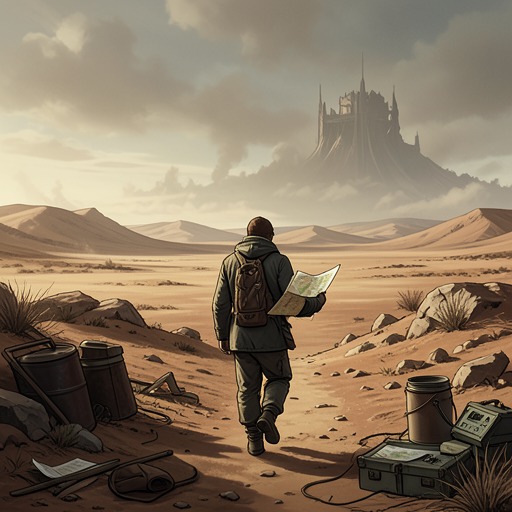
Peaslee’s next definite recollection is of crawling through the Australian desert. His clothes are in tatters, and he has bruises and scratches, but he cannot tell how much of his remembered ordeal corresponds to actual events. The flashlight is gone, and so is the metal case. He cannot confirm that he possessed the case at the point of escape, or even establish that the abyss and the mound he remembers were real. Behind him he sees only the desert sands, with no visible trace to settle the question.
As the wind subsides and the moon sinks, Peaslee gets to his feet and makes his way southwest toward camp. The bodily return is clear; its cause is not. He considers whether he may simply have collapsed in the desert and crossed the sand in a dream-racked state. Yet the possibility that the abyss was real reopens the larger implication of his earlier memory: that the Great Race and the ancient city might be historical realities rather than inventions. The escape thus ends without proof of what pursued him or what happened below ground. Peaslee reaches the desert, but the missing case and the unresolved gap between memory and delirium leave the reality of his subterranean experience unsettled.