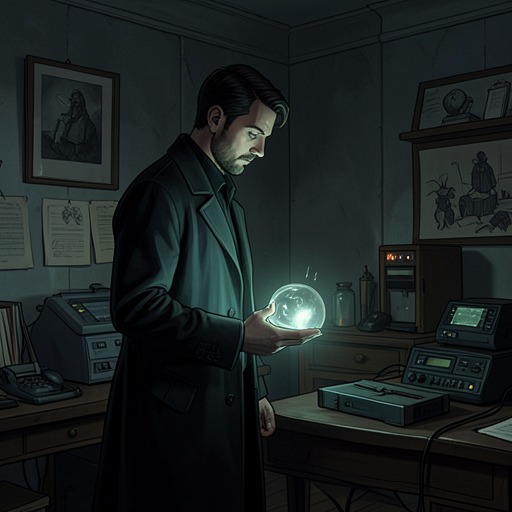
Peaslee's Amnesia
The Colour Out of SpacePeaslee's Amnesia is the five-year-and-four-month interruption in Nathaniel Wingate Peaslee's ordinary life, beginning with his collapse on May 14, 1908, and ending when his rightful consciousness returned in 1913. Its significance lies in the gulf between the two lives contained within one body: the established professor who loses access to his identity, and the strange, intensely acquisitive presence whose actions leave Peaslee with a damaged family life, an unexplained history, and memories that return only as dreams.
Identity and Onset
Before the episode, Peaslee's background appeared unremarkable. He had grown up in Haverhill, entered Miskatonic University at eighteen, studied economics at Harvard, and returned to Miskatonic as an instructor in 1895. He married Alice Keezar in 1896; by 1908 he was a professor with three children. He had shown no interest in occultism or abnormal psychology. That stable biography makes the rupture especially stark: the account presents the amnesia not as the culmination of a known pursuit, but as something that came from outside his ordinary experience.
On Thursday, May 14, Peaslee experienced brief, chaotic visions and a headache, along with the unfamiliar impression that someone else was trying to take possession of his thoughts. At about 10:20 a.m., while teaching a class on the history and present tendencies of economics, he began seeing strange shapes and felt himself to be in a grotesque room rather than the classroom. His speech and thought wandered from the lesson; then he slumped unconscious in his chair. No one could rouse him, and his ordinary faculties did not return for five years, four months, and thirteen days.
The first awakening did not restore his former self. After sixteen and a half hours without signs of consciousness, he opened his eyes at three in the morning on May 15. His family and the attending doctors soon became frightened by his language and manner. He appeared not to remember who he was or what his life had been, yet seemed anxious to hide that ignorance. His gaze and facial movements were unfamiliar, and his speech sounded awkward and laboriously learned, with archaic and otherwise incomprehensible elements. The outward signs thus suggested more than a blank in memory: the person who had awakened seemed to inhabit Peaslee's body without sharing his identity.
The Altered Interval
From 1908 to 1913, the altered presence spent much of its time in libraries, arranged unusual travels, and pursued study at American and European universities. Peaslee's case attracted notice among psychologists, who treated it as an example of secondary personality, though some of its symptoms seemed to puzzle them. He was also notably isolated. People he encountered felt aversion or fear toward him, and even his own family reacted as if a stranger had displaced the husband and father they knew.
The journeys were not conventional academic travel. In 1909 the presence spent a month in the Himalayas; in 1911 it drew attention with a camel trip into the deserts of Arabia. In the summer of 1912 it chartered a ship and sailed north of Spitzbergen, later showing signs of disappointment. That year it also spent weeks alone in the extensive limestone caves of western Virginia, a labyrinth so difficult to retrace that the route back could not be considered. Peaslee later could not discover what had happened on these journeys. Their locations and circumstances survived in the outward record, while their purpose and the experiences themselves remained inaccessible to him.
Family Separation and Return
The altered behavior imposed lasting costs on Peaslee's family. Alice Keezar regarded the awakened person with horror and loathing, believing that an alien usurper occupied her husband's body. She obtained a legal divorce in 1910 and refused to see Peaslee even after his ordinary consciousness returned in 1913. His elder son and daughter shared her reaction, and Peaslee never saw either of them again.
Only his second son, Wingate Peaslee, overcame the fear and repulsion caused by the change. Although Wingate felt that his father was a stranger, he held to the belief, even as an eight-year-old, that Peaslee's proper self would return. After the return, Wingate sought him out, and the courts gave Peaslee custody of him. In later years Wingate helped with the studies that Peaslee felt driven to pursue; by the time of the account, Wingate had become a professor of psychology at Miskatonic. This relationship offers the clearest continuity across the rupture: the family was largely lost, but Wingate's early faith became practical support in Peaslee's life afterward.
Dreams, Research, and the Unresolved Past
The return of Peaslee's consciousness did not make the interval recoverable. He had to reconstruct its outward history largely from old newspapers and scientific journals, rather than from a continuous personal memory. Nor did the missing years leave him in peace. His dreams grew more vivid and concrete, and he discussed them with Wingate and trusted psychologists before beginning a scientific investigation of similar cases. He consulted researchers in psychology, history, anthropology, and medicine, comparing his experience with records of divided personalities extending from possession legends to modern case histories.
Most documented amnesia cases had no counterpart to his dreams. A very small number of accounts, however, resembled his experience closely: fragments of folklore, medical histories, and anecdotes buried in standard histories described people who entered an alien secondary life, first marked by awkwardness in voice and body and then by extraordinary acquisition of scientific, historical, artistic, and anthropological knowledge. In those accounts, the original consciousness returned suddenly, while vague dreams of an apparently erased horror persisted afterward. The resemblance to Peaslee's own nightmares, sometimes down to small particulars, convinced him that his case belonged to a rare recurring pattern rather than standing alone.
Some of the parallel accounts included mention of an unknown machine like one that had been in Peaslee's house before a later change. He also found reports of people without clearly defined amnesia who experienced fleeting glimpses of the same kind of nightmares: a brief alien force followed by a rapid lapse and only a fading memory. These findings broaden the mystery beyond Peaslee's personal recollections, but do not explain what happened during his lost years. The episode therefore remains divided between evidence that can be assembled from records and dreams, and the decisive experience that cannot be retrieved.
Narrative Significance
Peaslee's Amnesia makes personal identity legible through its discontinuities. The body and public biography remain recognizable, yet the voice, expression, knowledge, conduct, and family relationships all mark the awakened presence as someone other than the man remembered by those closest to him. Peaslee's later account must consequently be built from external traces and other people's testimony, even as the recurring dreams suggest that the erased interval still exerts pressure on the returned consciousness.
The story also sets an apparently private catastrophe against a sparse historical pattern. Peaslee's research finds only rare precedents, scattered across long stretches of human record, but their recurring sequence resembles his own too closely to dismiss. That structure changes the meaning of his amnesia: it is at once an intimate loss of years and relationships, and a clue to an occurrence that exceeds the limits of individual memory. The history can be partly reconstructed; its central fact remains withheld.