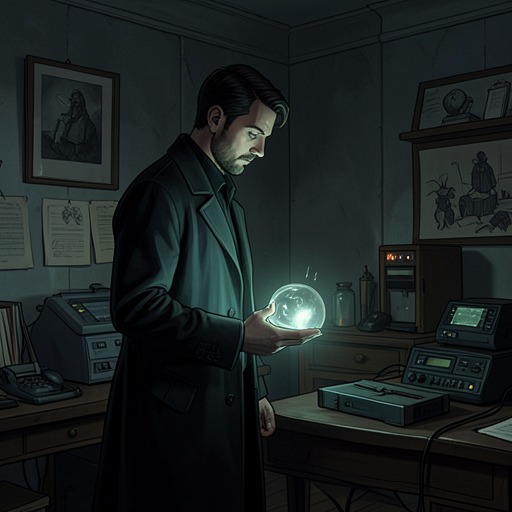
Peaslee’s English record
The Colour Out of SpacePeaslee’s English record is a book recovered from a buried archive of the Great Race of Yith. Its pages contain not an ancient alien script but English in Nathaniel Wingate Peaslee’s own handwriting, making the object the most direct apparent link between his fragmentary memories and the civilization he believed he had encountered. Yet Peaslee brought no physical proof out of the ruins, leaving the record’s existence—and the history it implies—open to doubt.
Identity and archival context
In Peaslee’s dreams, he wrote a history of his own age for the Great Race’s central archives. The work was prepared partly through his own participation and partly in return for promises of greater access to libraries and travel. Its supposed destination was a vast underground repository near the city’s center, built to endure as long as the civilization itself.
The archive classified Peaslee’s history within a section devoted to humanity and the furry and reptilian species that had preceded it in terrestrial dominance. That placement gives the record a defined role in the archive’s account of successive Earth cultures: it was not merely a private manuscript, but a history assigned a place in a system meant to preserve knowledge across immense spans of time.
Material form and preservation
The archive’s books were made from large sheets of unusually durable cellulose, bound in volumes that opened from the top. Each was stored in an individual case of light, rustless grey metal, marked with mathematical designs and a title in the Great Race’s curvilinear hieroglyphs. The cases were kept in rectangular metal vaults secured by intricately turning knobs.
Peaslee encountered these storage arrangements intact in parts of the archive, though geological stresses had sprung some vaults open, bent others, and shaken cases onto the dusty floors. The surviving cases and their contents suggested a preservation system built to withstand enormous time and physical disruption. The book he identified as his own appeared remarkably well preserved: its pages were brittle and browned by the ages, but its writing remained legible under his torch.
Discovery and recognition
As he hurried through the archive, Peaslee first examined a different volume, written in a language he associated with the mind of a captive being from a large asteroid. That encounter established the archive’s reach beyond Earth’s histories, but it was not the discovery that resolved his own past. Later, he found a case whose hieroglyphs provoked a powerful, difficult-to-explain recognition. He opened it and drew out the book inside, already suspecting what its presence might mean.
The cover bore familiar curvilinear characters. Peaslee delayed opening it, shut off his torch to conserve its battery, and then illuminated the exposed page. What he saw seemed to confirm his fear: the marks were the letters of the English alphabet, spelling words in his own handwriting. He understood the sight as evidence that the history he remembered writing in dreams had survived in the archive, in a place untouched by human hands since humanity appeared on Earth.
Memory and the archive’s purpose
The record’s apparent survival bears on the Great Race’s treatment of returning minds. When a displaced mind was restored to its own body in the future, an intricate mechanical hypnosis was used to remove what it had learned in the Great Race’s age. The account presents this erasure as a response to the dangers of transmitting knowledge across eras; in most cases, the returning mind retained only fragmentary, dream-shadowed impressions. Rare memory traces could nevertheless persist, and the record offers a material counterpart to those uncertain recollections.
That contrast is central to the book’s significance. The archive was designed to preserve histories, while the minds that had helped produce or encounter them were generally prevented from carrying that knowledge back. Peaslee’s handwriting appears to bridge the gap between those systems of preservation and forgetting. But the apparent bridge does not settle what happened to him: the book’s contents are not reproduced, and the surviving account identifies its language and handwriting rather than establishing a full explanation of its creation or arrival.
Unverified survival
Peaslee left the metal case in the underground archive instead of bringing it back to the surface. He intended to show the book to his son, Wingate Peaslee, if it was real, but no such physical demonstration followed. The subterrene corridors remained undiscovered, and the record therefore could not serve as proof for anyone else.
Its ending is consequently double-edged. The handwriting offers a startlingly specific confirmation of Peaslee’s remembered work, yet the missing case leaves that confirmation inaccessible and contestable. The record stands in the narrative as both an archival survival across aeons and an evidentiary absence: the object that might have made the past certain is precisely the object Peaslee did not bring back.