Pilbarra
The Colour Out of SpacePilbarra is a mining town in Western Australia that becomes the expedition’s staging point for a search among ancient stone remains in the Great Sandy Desert. It is not the site of the ruins themselves: its importance lies in the correspondence that brings the discovery to Nathaniel Wingate Peaslee and in the transport route that makes an investigation possible.
Setting and Route
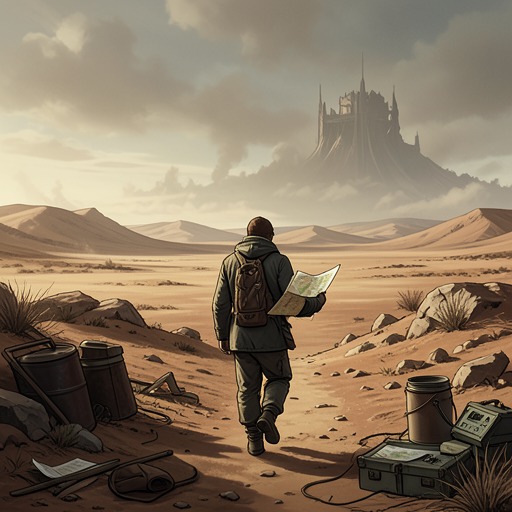
The desert site described to Peaslee lies roughly 500 miles east of the prospecting area associated with Pilbarra. Robert B. F. Mackenzie estimates that it can be reached from Pilbarra in about four days by motor tractor, a journey requiring equipment suited to difficult desert conditions. As an alternative approach, supplies could be taken up the De Grey River rather than sent directly from Pilbarra.
The Discovery Reaches Peaslee
On July 10, 1934, the Psychological Society forwarded Peaslee a letter postmarked Pilbarra, Western Australia, along with photographs. Mackenzie, a mining engineer, reported that he had found weathered blocks of dressed stone in a circle in the desert. Their carved curves and markings resembled the designs Peaslee had described in articles about his dreams and related legends. The snapshots made the connection tangible: they showed worn stones whose forms and markings appeared to match images from Peaslee’s recurring pseudo-memories.
Mackenzie also described the local significance of such stones. Aboriginal people spoke of marked great stones and feared the particular place; their traditions linked underground stone structures with Buddai, a gigantic being said to sleep beneath the earth. Mackenzie treated these reports cautiously, but regarded the blocks themselves as evidence of a civilisation of extreme antiquity. He judged that water had once covered and later left exposed the stones, and urged Peaslee to organize archaeological excavation. The discovery thus reached the scholar through both photographs and a proposed field investigation, joining remembered images to a material site.
Expedition Staging Point
Mackenzie offered to assist with the expedition and said that he could assemble miners for the heavy digging. The preparations were organized with support from Miskatonic University; Mackenzie came to Arkham in early 1935 and helped make the final arrangements. Tractors were waiting at Pilbarra, and the party chartered a light-draught tramp steamer to travel up the river to that point. Pilbarra therefore functioned as the handover between the sea journey and the overland approach to the ruins.
The expedition sailed from Boston on March 28, 1935, and reached the West Australian coast after crossing the Atlantic and Mediterranean, passing through the Suez Canal and Red Sea, and crossing the Indian Ocean. After meeting Mackenzie and Dr. Boyle, the eighteen-member party set out over the sand and rock. Its route crossed a branch of the De Grey River on May 31 before reaching the desert site. The location’s role was logistical but decisive: the tractors and river access assembled there carried the inquiry from correspondence and photographs into archaeological exploration.
Narrative Significance
Pilbarra marks the point where Peaslee’s private record of dreams becomes a practical expedition. The letter’s photographs offered what abstract comparisons and folklore could not: visible stonework whose worn curves and hieroglyphs appeared to correspond to the shapes he remembered. The town’s place in the route also makes the investigation materially dependent on transport, labor, and careful excavation. From Pilbarra, the party could move toward evidence that was at once geological, archaeological, and disturbingly close to Peaslee’s supposed memories of a lost world.