Robert B. F. Mackenzie
The Colour Out of SpaceRobert B. F. Mackenzie is an Australian mining engineer whose discovery of weathered, carved stones in the Great Sandy Desert turns Albert N. Wilmarth’s research into a practical expedition. He supplies the crucial field report, helps organize the Australian preparations, and brings local knowledge to bear when a strange desert wind unsettles the camp. His role joins geological evidence, logistics, and folklore without resolving the mystery they collectively suggest.
Discovery and Report
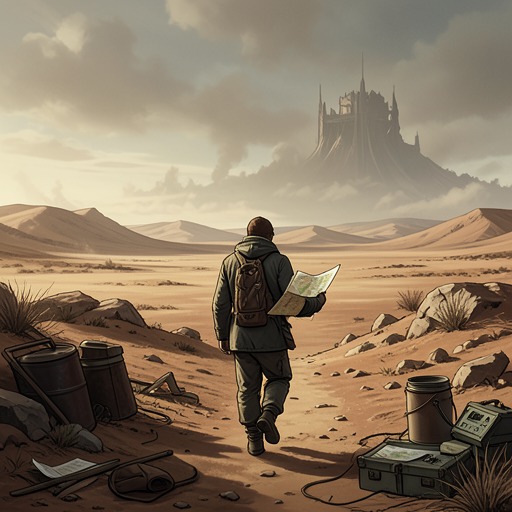
While prospecting in the desert about 500 miles east of his gold field, Mackenzie found roughly thirty or forty dressed-stone blocks scattered within a circle about a quarter of a mile across. The blocks were large—around three feet by two by two—and deeply weathered. Although their markings were difficult to see at first, he recognized carved curves like those described to him in local accounts. He photographed ten or twelve representative stones and carefully recorded the site’s position.
Mackenzie passed the information and photographs to the government at Perth, but no action followed. After meeting Dr. E. M. Boyle, who had read Wilmarth’s articles, he showed him the images. Boyle recognized a resemblance to the masonry in the legends and dreams Wilmarth had investigated. Mackenzie then studied Wilmarth’s descriptions and drawings and concluded that the stones matched the reported forms. His evidence was not merely visual: as a mining engineer with geological knowledge, he judged the blocks—mostly sandstone and granite, with one apparently made from an unusual cement or concrete—to be extraordinarily ancient. Water-worn surfaces suggested that the land had once been submerged and later emerged. Mackenzie could not date the remains precisely, but understood that their age might extend far beyond ordinary historical reckoning.
From Field Evidence to Expedition
Mackenzie offered to cooperate with an archaeological expedition and proposed assembling a dozen miners for the heavy digging. He and Boyle kept the discovery quiet, leaving Wilmarth and the organizations he might approach priority in investigating it. Mackenzie also supplied practical details: the site could be reached from Pilbarra by motor tractor in about four days, or approached by river transport on the De Grey River. He gave its approximate coordinates and advised that an expedition travel in the Australian winter, when conditions would be more suitable.
Miskatonic University backed the expedition, and Mackenzie came to Arkham early in 1935 to assist with final preparations. Wilmarth described him as a competent, affable man of about fifty, well read and deeply familiar with Australian travel. Mackenzie had tractors waiting at Pilbarra; the party also chartered a light-draught steamer to travel upriver. His initial letter had turned an isolated report into an actionable plan, and his local expertise helped carry that plan from correspondence to the desert.
Work at the Ruins
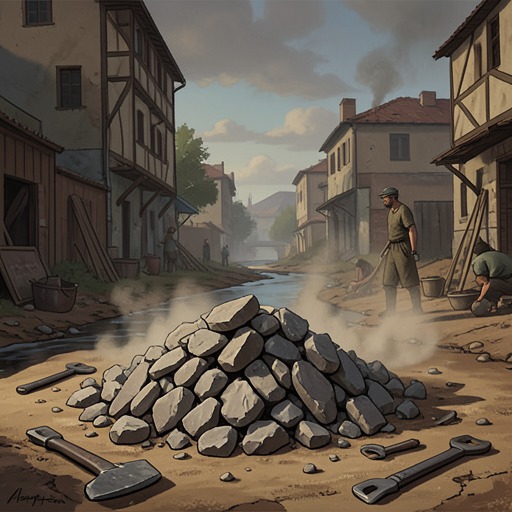
The expedition reached the site and began digging with a deliberately careful method, sifting the sand and avoiding disturbance to anything that might remain in its original position. Over a month, the party recovered about 1,250 blocks in varying states of wear and disintegration. Many were carved megaliths with curved tops and bottoms; others were smaller, flat, and square or octagonal, while some exceptionally massive pieces appeared suited to arches, vaulting, or rounded window casings. The deeper the excavation went, especially farther north and east, the more blocks appeared, although no clear arrangement emerged.
These results broadly substantiated the scale of Mackenzie’s find while deepening its implications. The fragments seemed to belong to structures rather than a few isolated stones, yet their scattering and extreme age resisted reconstruction. Mackenzie’s original photographs had secured attention; the excavation revealed a much larger field of remains whose condition suggested immense spans of time and geological upheaval.
The Wind and the Limits of His Role
On the night of July 17–18, after Wilmarth had gone out walking toward the northeast, a violent wind rose around 3:30 a.m., woke the camp, and brought down three tents. Mackenzie explained to Professor Tyler M. Freeborn that the Australians’ unease had been influenced by Aboriginal folklore: local traditions associated rare, clear-sky winds with underground stone structures where terrible events had occurred. The gale subsided suddenly, and the sand hills had changed shape. Wilmarth returned to camp shortly after five, but the evidence provided here does not establish what happened during his absence or whether the wind had a supernatural cause.
Mackenzie’s importance rests on this combination of tangible assistance and carefully bounded testimony. He identifies the stones, records their location, helps make their investigation possible, and conveys the folklore surrounding the desert. He does not explain the ruins or verify the fears attached to them. Instead, his field report and practical work make the unknown harder to dismiss, while his account of local belief leaves the expedition’s central uncertainty intact.