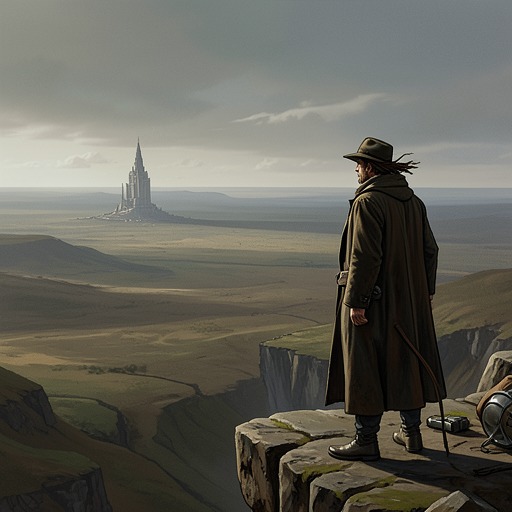
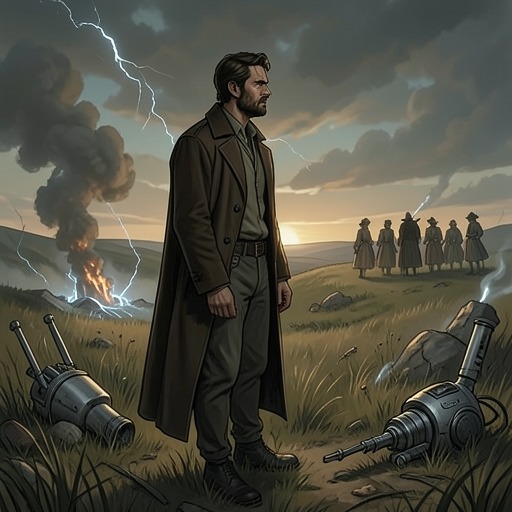
The Great Race migrates from Yith to Earth
The Colour Out of SpaceThe Great Race migrates from Yith to Earth through a vast transfer of consciousness: minds from a dying world cross the void and take up residence in Earthly bodies, while the minds displaced from those bodies are cast back into the past. In Nathaniel Wingate Peaslee’s reconstruction, this exchange creates the Great Race as a new power on Earth and sets the stage for its conflict with the Elder Things. The account makes migration less a passage of bodies than a succession of minds across cosmic time.
Origin and Transfer
Peaslee’s account distinguishes the Great Race’s mental inheritance from its physical form. Its minds came from an elder world approaching death; those beings sought a world and species in which they might continue to live for a long span. They sent their minds en masse into the cone-shaped beings that inhabited Earth about a billion years ago. The Great Race’s consciousness was therefore older than the bodies through which it came to exist on Earth.
The exchange had a cost for the beings already occupying those bodies. Their minds were displaced backward in time into the dying, unfamiliar forms left behind by the migrants, where they were abandoned to die. The event is thus both a collective arrival and a forced displacement: the Great Race gained an earthly bodily existence by taking the place of minds native to that future age.
Arrival and Earthly Consequences
The migration brought the Great Race into an Earth already inhabited by other powerful beings. Peaslee’s account describes the Elder Things as predatory entities that had built cities on Earth and other planets. When the Great Race arrived from Yith, it used instruments it had created to subdue them, drive them into inner-earth caverns, and seal the entrances. It then occupied much of their great cities, retaining some important buildings for reasons attributed to superstition.
That conquest did not end the danger. In later ages, the Elder Things grew numerous and strong in the underground world. Their sporadic incursions into remote cities, and into deserted settlements where passages had not been adequately sealed or guarded, led the Great Race to close many routes permanently. The account presents these later precautions as consequences of the ancient settlement: the migrants’ new home remained marked by the threat of those they had driven below.
Memory, Myth, and Material Traces
Peaslee places the migration within a history reconstructed from myths, records, and uncertain impressions, not direct human testimony. The traditions do not offer a single consistent account of where strange beings came from. Pennacook myths, for example, describe the Winged Ones as coming from the Great Bear and maintaining earthly outposts to obtain stone. Such accounts share a sense that the beings are not native to Earth, but they do not name Yith or establish that their subject is identical with the Great Race.
The narrator’s broader reconstruction connects ancient stories of lost civilizations with physical remains. During the 1935 Australian expedition, the party uncovered about 1,250 weathered blocks, many carved and some shaped as though they had belonged to arches or vaults. Their condition and dispersal suggested immense age and geological upheaval, but the account does not establish them as proof of the migration from Yith. They serve instead as material signs within a narrative where fragments of stone, inherited legends, and recovered memories all suggest a past far older than human history.
Deep Time and the Limits of the Account
The migration unsettles ordinary historical sequence because its actors move between epochs as well as worlds. Peaslee’s account describes minds crossing gulfs of time, with the Great Race’s own origin reaching back to an earlier dying world and its earthly history extending across immense spans. The movement from Yith to Earth is consequently one episode in a succession of worlds and species, not a human-scale founding story.
The account remains filtered through Peaslee’s research into what he calls a mixture of myth and hallucination. Its claims are presented as a reconstruction assembled from fragmentary sources, while the discoveries in Australia offer suggestive but not conclusive material context. That uncertainty is central to the event’s meaning: the migration can be narrated as the origin of the Great Race on Earth, yet the evidence available to human observers never removes the possibility that their apparent history is entangled with delusion and incomplete memory.